Madhya Pradesh
Madhya Pradesh is a state in central India. It borders Uttar Pradesh, Gujarat, and Rajasthan. A detailed overview of the province's various assets.
Madhya Pradesh is a state in central India. It borders Uttar Pradesh, Gujarat, and Rajasthan. A detailed overview of the province's various assets.
Introduction
Madhya Pradesh is, after Chhattisgarh, the second largest state in India. Its geographical position at the heart of the country works in its favour, making it a convenient and affordable destination to explore. A land blessed by nature, offering stunning postcard-perfect landscapes. A sacred centre of Hinduism, where the worship of Shiva inspires daily life and customs. A people with compelling traditions, expressing their passion and pride through Mughlai cuisine, Gond tribal art, and textile craftsmanship. Whether for its generous natural bounty or its extraordinary cultural heritage, Madhya Pradesh stands as a prime destination during a trip to India. Don't delay any longer in booking your flight to Madhya Pradesh.
History
The state of Madhya Pradesh, as it exists today, was created in 1956. Archaeological surveys prove that the region was inhabited approximately 2,000 years before Christ. Thus, the secret caves of Bhimbetka offer a rich insight into how the earliest Indians lived and sustained themselves during the Stone Age.
The chalcolithic sites in the western part of the state preserve memories of this distant period. Travellers will be delighted to discover copper and stone implements belonging to the Malwa civilization: this was between 1800 and 1500 years before Christ, when Indians lived entirely from the fruits of harvest, game, and fishing. The Malwa culture is distinguished by its craftsmanship and weaving, producing striking red fabrics adorned with chocolate-coloured patterns.
From 600 BC to 400 BC, Ujain—as Madhya Pradesh was originally called—was the historical heart of the kingdoms of Avanti, Karusha, Dasarna, and Nishada before being occupied by the Mauryas.
Between the 4th and 5th centuries, the Guptas' conquest of the city ushered in an era of exceptional development. The Parivrajaka and Uchchhakalpa dynasties governed much of central India, making Ujain a major centre of Hinduism and Buddhism.
The Middle Ages witnessed the rising power of Rajput clans. The kings of this period distinguished themselves through both military victories and their patronage of artistic endeavours. While the Malwa region of the Paramaras became a leading literary hub, the Khajuraho of the Chandelas was renowned for its sandstone sanctuaries adorned with exquisite sculptures, where the deities of Hindu mythology gathered. The Kandariya Mahadeva Shiva temple, considered their finest achievement, was constructed around the 11th century, before neighbouring powers began to invade the kingdom. Around 1183 AD, the Chahamana ruler of Rajasthan brought an end to Chandela rule.
Following the fall of the Chandela dynasty, Ujain fell successively into the hands of the Delhi sultans, the Malwa sultans, and the Mughal Empire. From 1720 to 1760, the Marathas held dominance.
The English took control of the entire Indian subcontinent in the 19th century; the principalities of Indore, Bhopal, Rewa, and Nagpur, along with other smaller kingdoms, became princely states of British India. In 1947, the British Crown granted independence to India and Pakistan.
Thus was formed the State of Madhya Pradesh. Bhopal is its official capital, with Indore being the most important city, home to nearly 2 million inhabitants.
Today
Madhya Pradesh positions itself as a major economic hub of India. The population stands at 75 million inhabitants spread across 52 districts. Agriculture plays a diminished role, giving way to agro-industrial and textile industries.
Tourism is experiencing robust growth, with museum cities such as Bhopal, Indore, and Gwalior bearing witness to the state's grandeur during the Rajput and Mughal eras. The temples of Khajuraho, famous for their erotic statues, attract visitors from around the world. Beyond heritage exploration, Madhya Pradesh offers numerous opportunities for excursions, safaris, shopping, and outdoor activities.
What to See and Visit
Madhya Pradesh brims with points of interest that any self-respecting traveller should visit.
The Temples of Khajuraho
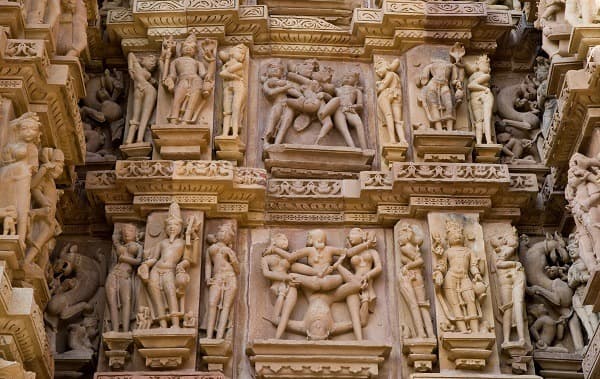
Listed as a UNESCO World Heritage site, the Khajuraho monument group ranks as number one among the must-see attractions in Madhya Pradesh. Founded between 950 and 1050, the ancient Chandela capital originally contained 85 Hindu and Jain temples; plundered in the 16th century by Akbar's Muslim forces, they were abandoned and consumed by the jungle before being rediscovered in 1838. Only 22 temples remain, and their unparalleled beauty truly warrants a visit.
The Lakshmi Temple, the Kandariya Mahadeva Temple, and the Devi Jagadamba Temple are the most impressive. The idols of the Hindu pantheon are assembled in their entirety. The temple follows a square plan, with a long series of columned halls and a stepped dome. Both inside and out, the walls are covered with statues of deities, beautiful nymphs with voluptuous forms, and couples of lovers in intimate acts, which have made the entire Khajuraho monument complex famous worldwide.
Sacred Sites
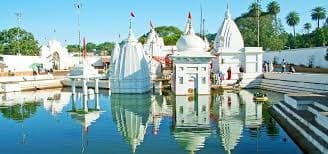
Tourism in Madhya Pradesh is inseparable from visits to sacred locations. Besides the Khajuraho temples, other noteworthy sites include:
the Sanchi Stupa: the Buddhist temple at Sanchi (no. 17) is the first example of its kind in India. Dating from the 5th century, the stupa is emblematic of the Gupta era, which saw the emergence of distinctive architecture and sculpture;
the Mahakaleshwar Temple: this notable place of worship ranks among the 12 most sacred retreats dedicated to Shiva. You will not be disappointed witnessing the bhasm aarti, a ritual unique to this temple, practised nowhere else.
the Laxmi Narayan Temple: built by a wealthy merchant in honour of Lakshmi, the Indian goddess of wealth, the temple is a haven of serenity, ideal for reflection and strolling away from crowds. Perched on a rocky outcrop, it offers a breathtaking view of Bhopal's old city.
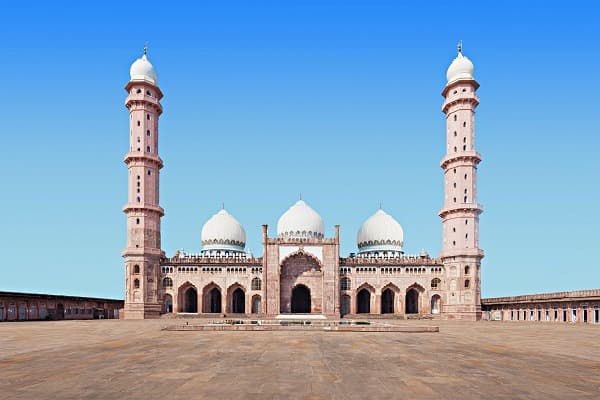
the mosques of Bhopal: the capital is home to India's largest mosque: the Jama Masjid, also known as the Taj ul Masjid. With its rose-coloured facade adorned with three circular domes and two eighteen-storey minarets, the structure ranks among the finest jewels of Mughal architecture. You can continue your exploration with the Moti Masjid or the Sufia Masjid.
National Parks
Beyond pilgrimage tourism, Madhya Pradesh plays the nature card to attract visitors and encourage them to extend their stay. Safari? Jungle exploration? Birdwatching or an experience in pristine wilderness? Here are the natural parks not to miss:
the Van Vihar Wildlife Sanctuary: spanning 445.21 hectares, Van Vihar is a popular excursion destination for families. The jungle is lush, leading to a lake that hosts an extraordinary gathering of birds.
Bandhavgarh National Park: difficult of access though it may be, this park earns the favour of safari enthusiasts; it constitutes the best base camp for observing tigers and wild birds. Flora is dominated by deciduous trees.
Kanha National Park: this is a well-known address for nature lovers on holiday in central India. The verdant grasslands, sal and bamboo forests, and bird-filled lakes create a spectacular natural setting. The park serves as natural habitat for marsh deer, sloth bears, and Bengal tigers.
Pench National Park: those who have read The Jungle Book, for which the park provided the historical setting, will appreciate its incredible wild biodiversity. Pench Nature Reserve is the place to be for spotting leopards, tigers, and wild dogs. Ornithology enthusiasts will also be thoroughly delighted.
Historical Sites
Craving history and tales of military conquest? Your wishes will be abundantly satisfied by exploring the following sites:
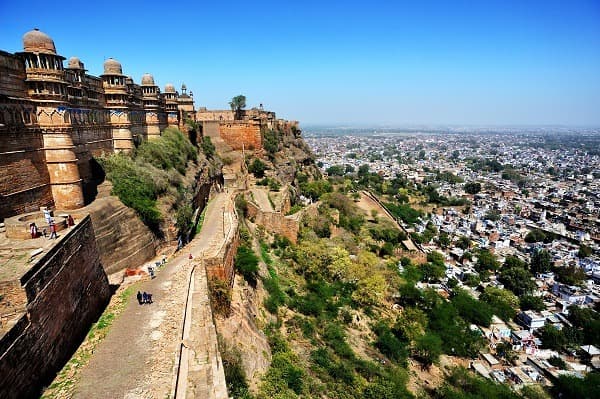
Gwalior Fort: clinging to the summit of a hill, the Gwalior fortress, framed by towers and ramparts, retains a medieval character. It houses the Teli-Ka-Mandir palace, the Man Singh palace, and an archaeological museum. A recommended destination for travellers seeking history and authenticity.
the Jahaz Mahal: built in the 15th century, the Jahaz Mahal palace evokes the golden age of Delhi sultans in the Mandu region. It once served as a harem where sultans confined their concubines. Jahaz Mahal is an enchanting place for its idyllic waterside setting, fountains, and cascades.
the Jahangir Mahal: this superb medieval palace rises in the old city of Orchha, near the Betwa river. The ochre-yellow facade of the palace is reflected in the river's peaceful waters.
the tomb of Hoshang Shah: built in honour of Malwa's first king, the garden-tomb, adorned with cenotaphs and lotus-patterned gates, represents one of the finest achievements of Afghan architecture.
the Bhimbetka rock shelters: this archaeologically significant site nestles at the foot of the Vindhya range. The rock engravings provide insight into the way of life of early Indians: hunting or gathering scenes, silhouettes of elephants, tigers, or peacocks, paintings depicting harvests…
Things You Must Do
Beyond the points of interest mentioned above, Madhya Pradesh has much to offer and experience during your vacation:
capture in photographs the royal Bengal tiger;
camp one night at Kanha Park and wake to the sounds of wild fauna;
immerse yourself in the local folk atmosphere by attending a festival: the Great Night of Shiva, Ram Navami, the Pachmari festival, or the Malwa festival;
enjoy an outdoor activity on the Orchha river: rafting, kayaking, or a simple boat ride;
breathe fresh air at the Pachmarhi hill station;
savour Mughlai dishes, which blend Asian and Iranian preparations with medieval Mughal cuisine: kebab, khichri, pilaf, and more.
When to Visit?
Madhya Pradesh enjoys a hot and dry climate. Summer (March to June) is characterised by extremely scorching temperatures, with May being the hottest month. It is inadvisable to visit Madhya Pradesh during this season. It is better to plan your vacation during winter, between October and March, when the sun is milder and weather conditions more favourable.
That said, if you are not sensitive to heat, summer is an opportune time to pursue wild mammals. The dryness forces wildlife to leave their dens and gather around water sources.
Madhya Pradesh is easily accessible given its proximity to Uttar Pradesh, Rajasthan, Maharashtra, and Chhattisgarh. Depending on your preferences and budget, you can travel by plane, train, or car.
by air: Raja Bhoj International Airport in Bhopal and Devi Ahilyabai Holkar International Airport in Indore primarily handle international flights. Khajuraho, Jabalpur, and Gwalior also have airports connected to major destinations within the country;
by road: if you are travelling from Delhi or Mumbai, you can take inter-state buses;
by rail: train is the least expensive means of transport to reach Madhya Pradesh. Beyond Bhopal, other railway stations are located in Indore, Katni, Ujain, Jabalpur, Itarsi, and Ratlam.