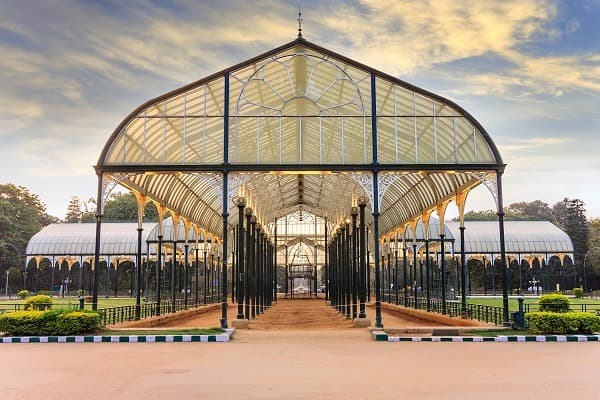
Lal Bagh Palace
Lal Bagh Palace
Once the residence of the Holkar Maharajas in Indore, Lal Bagh Palace preserves a rare European décor in India: Italian marble, Belgian stained glass and a spring-mounted ballroom.
Lal Bagh Palace, residence of the Holkars in Indore
Sprawling across a 12-hectare complex in the south-west of Indore, in Madhya Pradesh, Lal Bagh Palace was the official residence of the Maharajas of the Holkar dynasty until 1987. Today transformed into a museum, it preserves furnishings, décor and collections that speak to the Holkars' taste for late-19th-century European architecture.
Why visit Lal Bagh Palace
The palace offers one of the most complete decorative ensembles in Madhya Pradesh: Italian marble, monumental chandeliers, Belgian stained glass, Persian carpets and painted ceilings coexist within a princely residence that has remained largely intact. The visit appeals equally to lovers of Indian princely history and those who wish to understand how the Holkar sovereigns imported European aesthetic codes into their capital.
The entire complex can be explored in 1 to 2 hours. It is one of the major sites in Indore, rarely frequented by foreign tourists, which makes for a peaceful visit.
History of the palace
Lal Bagh Palace was built from 1886 by Maharaja Shivaji Rao Holkar. Its construction unfolded in three successive stages, with the final phase completed in 1921 under Maharaja Tukoji Rao Holkar III. This lengthy timeline explains the diversity of influences present in the building.
The palace's monumental doors are regarded as replicas of those at Buckingham Palace. They were manufactured in England and then shipped by boat to Indore, a logistical undertaking that illustrates the European ambition of the project. The palace remained the official residence of the Holkar family until 1987, when it was converted into a public museum.
What to see inside
Architecture and décor
The edifice blends codes of European neoclassicism with decorative elements from across Europe:
- Columns and pillars in Italian marble
- Grand chandeliers in the reception rooms
- Original Persian carpets
- Reliefs inspired by Greek mythology
- Nymphs painted on the ceilings
- Stained glass imported from Belgium
The furnishings and much of the décor reflect the Georgian style, which dominated aristocratic British residences of that era.
The ballroom
The ballroom is one of the most distinctive rooms in the palace. Its wooden floor is mounted on springs to provide better bounce for dancers, a device rarely seen in India and characteristic of 19th-century European ballrooms.
The museum's collections
The museum presents several collections:
- Prehistoric objects discovered in the region
- Collection of coins from the Muslim period
- Indian and Italian paintings
- Personal objects and furnishings of the Holkar family
Practical information
The palace is open Tuesday to Sunday and closed on Mondays. Opening hours follow standard daylight hours for Indian museums; it is best to verify on arrival, as times may change.
Entry fees remain very modest, with a small additional charge for video equipment. Cameras and mobile phones are prohibited inside the palace: plan to leave your personal effects at a designated drop-off point.
Allow 1 to 2 hours to tour the collections and residence.
How to reach Lal Bagh Palace
The palace is located in the south-western part of Indore, a short distance from the city centre. Several options are available depending on your starting point:
- By air: Indore Airport (Devi Ahilyabai Holkar) is approximately 20 km from the palace and serves Mumbai, Delhi, Bhopal and several other major Indian cities.
- By train: the main station is Indore Junction, connected to the principal lines of the Indian railway network.
- In town: from the airport or station, autorickshaws and taxis provide transport to the palace. Local buses also serve the neighbourhood.
Madhya Pradesh offers a regular network of buses linking Indore to other cities in the region, including Bhopal and Ujjain.
What to see around Indore and beyond
Indore is a good base for exploring Madhya Pradesh. To the north-east of the city, the historic town of Chanderi deserves a visit for its fort, weavers and medieval monuments.
If your itinerary then takes you into Rajasthan, several sites extend your interest in princely architecture: the City Palace in Udaipur, the Jagdish Temple and Bagore Ki Haveli in Udaipur, or the Taragarh Fort.
FAQ
Frequently asked questions
Preparing your trip
Lal Bagh Palace fits naturally into an itinerary devoted to Madhya Pradesh or Indian princely architecture. To build a custom itinerary including Indore and other highlights of the subcontinent, explore our journeys across India.
Interested in this visit?
We can include it in your personalised itinerary.