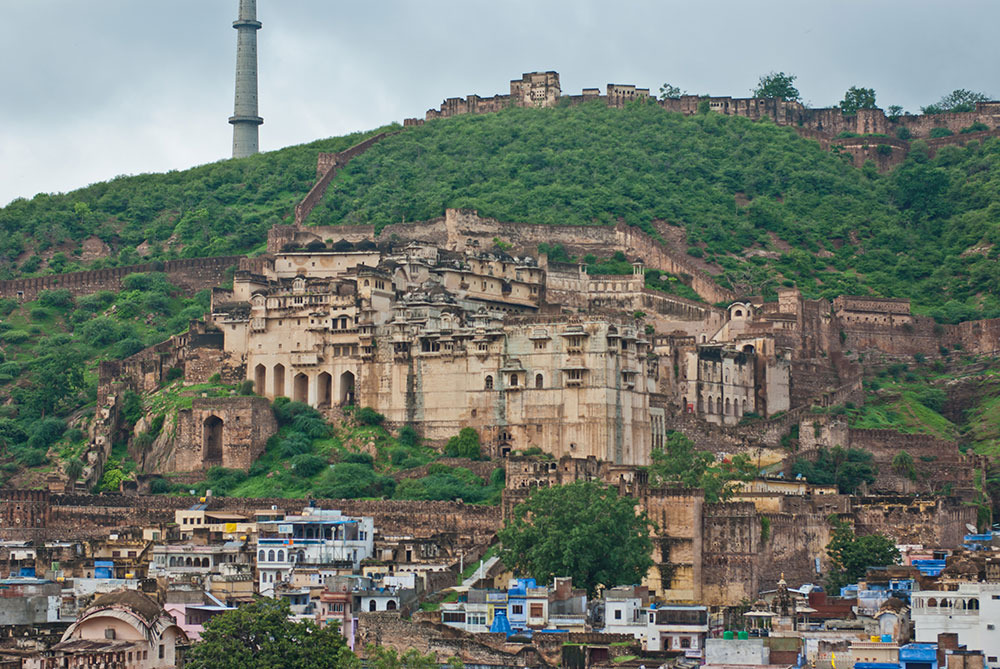
Jahaz Mahal (Mandu, Madhya Pradesh)
Jahaz Mahal (Mandu, Madhya Pradesh)
Stretching 110 meters between two lakes on the Mandu plateau, Jahaz Mahal creates the illusion of a ship — a 15th-century palace at the heart of the Malwa sultanate.
The Jahaz Mahal, literally "Ship Palace," occupies a narrow strip of land between two artificial lakes within the royal complex of Mandu, in Madhya Pradesh. Long and low-slung, it creates the illusion of a moored vessel — an effect deliberately created by its 15th-century builders, particularly striking after the monsoon when the reservoirs are full.
Why visit Jahaz Mahal
Three main reasons make this palace compelling. First, its silhouette: 110 meters long by 15 meters wide, an elongated proportion without parallel in Indo-Islamic architecture. Second, its hydraulic engineering, which combines reservoirs, cisterns, and stepped wells. Finally, its setting: Mandu remains a fortified city rarely crowded with international tourism, and exploration here unfolds in relative solitude.
The edifice rewards slow observation. Openings frame the lakes, terraces command views across the Malwa plateau, and the passage between levels reveals the logic of a palace designed for the heat of central India.
History
Jahaz Mahal was built in the 15th century under the reign of Ghiyas-ud-din Khilji, sultan of Malwa. According to historical chronicles (notably those attributed to Ferishta), the sovereign maintained a harem of some 15,000 women; the palace was allegedly designed to house this female court. The figure belongs more to historiographic tradition than verifiable record, yet remains inseparable from the site's identity.
At that time, Mandu served as the capital of the Malwa sultanate, perched on a plateau ringed by ramparts. The city distinguished itself through its monuments, gardens, and advanced hydraulic expertise. Jahaz Mahal embodies this philosophy: its position between Munj Talao and Kapur Talao, two artificial ponds, ensured water supply and created the floating palace effect that earned it its name.
As the sultanate declined and later political upheavals unfolded, the palace fell into disrepair. Its structure endured thanks to the quality of its masonry. Restored and protected by the Archaeological Survey of India, it stands today as a key reference for understanding medieval court architecture in central India.
What to see
Architecture and layout
The palace comprises two stories. The ground floor connects a series of vaulted chambers and corridors, opening to the water through broad apertures. The upper level features a panoramic terrace, punctuated by pavilions and chhatris, from which the lakes and other royal complex monuments unfold in view. Air circulation between openings maintains perceptible coolness even during hot seasons.
The role of water
Water structures the entire edifice. Inside, lotus-shaped basins collected water channeled through a network of conduits and reservoirs. The baoris (stepped wells) of the complex completed the system. This ensemble illustrates the technical mastery of Mandu's engineers, who merged utility with aesthetic spectacle: reflections, cascades, mirrored waters.
Decoration and influences
Jahaz Mahal blends multiple traditions:
- arches and domes of Islamic inspiration;
- chhatris (elevated pavilions) drawn from northern Indian architecture;
- floral and geometric motifs of Persian influence.
Materials are local: stone and mortar, without decorative excess. The restrained ornamentation contrasts with the ambition of the overall plan.
When to visit
The dry season, from October to March, offers the most comfortable temperatures and clear skies. It is the most practical window for exploring the site and the broader Mandu plateau.
Visitors drawn to the "floating palace" effect should prioritize late monsoon, September through October: both lakes fill, vegetation greens, and the palace's reflections on water reach their peak. During the monsoon itself (July-August), rain may complicate visits, yet the landscape proves stunning. Peak Indian tourist season clusters around weekends and holidays; on weekdays, the site remains tranquil.
Practical information
The site is open daily during daylight hours, per Archaeological Survey of India schedules (typically morning through late afternoon). Admission is nominal for Indian visitors and moderate for foreigners; a combined ticket can cover several monuments within the royal complex. Plan 1 to 2 hours on-site, longer if combining adjacent structures.
Practical tips:
- favor morning or late-afternoon light for reflections on the lakes;
- bring water, hat, and sturdy shoes (irregular surfaces);
- ground can be slippery after rain.
How to get there
Mandu lies in Dhar district, on a Madhya Pradesh plateau. The nearest airport is Indore, approximately 2 to 3 hours by road. From Dhar, allow roughly one hour. The road climbs gradually to the plateau and passes through the fortified gates of the ancient city.
On-site, Jahaz Mahal is accessible by foot or rickshaw from central Mandu. Renting a vehicle by the day from Indore remains the simplest option for visiting dispersed monuments across the plateau.
Nearby
Jahaz Mahal forms part of a royal complex containing several remarkable structures, best explored in a single day:
- Hindola Mahal, the "swinging palace," with characteristic tilted walls;
- Jami Masjid, a grand 15th-century mosque;
- Hoshang Shah's Tomb, considered one of India's first entirely marble tombs;
- Rupmati Pavilion and Baz Bahadur Palace, to the south of the plateau.
To further explore Madhya Pradesh, the State Museum of Bhopal provides valuable context on regional history.
Frequently asked questions
Frequently asked questions
Including Mandu in an itinerary
Mandu suits a one- to two-day stopover in a Madhya Pradesh circuit, often paired with Maheshwar, Omkareshwar, or nearby archaeological sites. To build an itinerary incorporating Mandu and other regions of the subcontinent, consult our Inde journeys.
Interested in this visit?
We can include it in your personalised itinerary.