Taj Mahal
Taj Mahal
A white marble mausoleum erected by Shah Jahan in Agra between 1631 and 1648. Complete guide: history, architecture, gardens, access and practical information.
The Taj Mahal, a white marble mausoleum standing in Agra on the right bank of the Yamuna, is one of the most visited monuments in India. Built between 1631 and 1648 on the orders of Mughal emperor Shah Jahan in memory of his wife Mumtaz Mahal, it has been inscribed on the UNESCO World Heritage List since 1983 and ranks among the Seven Wonders of the Modern World. Here's what you need to know to plan your visit.
Why visit the Taj Mahal
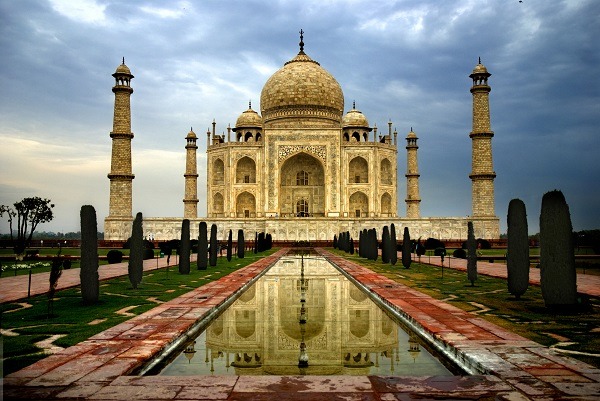
The site combines three rare dimensions: an Indo-Islamic architectural masterpiece, a testament to Mughal power at its height, and a place laden with personal history. Its central dome, 35 metres high, symmetrical minarets and inlays of semi-precious stones make it a stylistic landmark cited throughout the history of Asian architecture. The complex, which covers more than 17 hectares, attracts 7 to 8 million visitors each year, both Indian and foreign.
Beyond the image that everyone knows, the interest of a visit also lies in the details: the fineness of Quranic calligraphy in black stone, the organisation of Persian gardens, the architectural staging that plays with the light of the marble according to the time of day.
History: a mausoleum for Mumtaz Mahal
The origins of the Taj Mahal date back to 1631, the year Mumtaz Mahal, the favoured wife of Shah Jahan, died giving birth to their fourteenth child. The emperor orders the construction of a mausoleum in her memory. Work begins in 1632 and mobilises approximately 20,000 workers and a thousand elephants to transport materials, including white marble principally extracted from Rajasthan.
The main mausoleum is completed in 1648. The entire complex—gardens, mosque, guest pavilion, gateways—requires several more years of work. In 1657, Shah Jahan is overthrown by his son Aurangzeb and imprisoned in Agra Fort, from where he is said to have contemplated the mausoleum until his death in 1666. He is then buried alongside Mumtaz in the underground burial chamber, according to Islamic tradition.
What to see on the site
The main mausoleum
Built entirely of white marble on an elevated platform, the mausoleum stands approximately 73 metres high. The central dome reaches 35 metres, surrounded by four smaller domes and four minarets reaching nearly 40 metres. A little-known technical feature: the minarets are slightly tilted outward, so that in the event of an earthquake they would collapse away from the mausoleum.
The facades are inscribed with Quranic verses traced in black stone and inlays of semi-precious stones forming floral motifs and arabesques. Inside, the atmosphere is subdued. The cenotaphs of Mumtaz Mahal and Shah Jahan occupy the centre of the hall; the actual tombs lie in the underground crypt, closed to the public.
The Mughal gardens
The gardens follow the Persian model of the Chahar bagh: a square divided by four channels oriented toward the cardinal points, forming four symmetrical gardens themselves subdivided into 16 lawns. At the centre, a marble terrace and fountain mark the main axis. This organisation echoes the Islamic representation of an earthly paradise.
The mosque and guest pavilion
To the west of the mausoleum, facing Mecca, stands the mosque: a red sandstone building inlaid with white marble, topped by three domes. To the east, an identical structure—the guest pavilion—mirrors the mosque to maintain the symmetry of the complex. It was used during ceremonies marking the anniversary of Mumtaz Mahal's death.
The Taj Mahal Museum
Established in 1982, the museum occupies the west side of the complex, at garden level. It displays manuscripts, objects of Mughal use, calligraphies, antiques, as well as the original plans and drawings of the monument and portraits of Shah Jahan and Mumtaz Mahal.
The Mehtab Bagh viewpoint
On the opposite bank of the Yamuna, the Mehtab Bagh garden offers an alternative view of the Taj Mahal, generally more peaceful and particularly interesting in late afternoon for photography.
Practical information
The site is open daily from dawn to dusk, except Friday mornings, reserved for prayer (access is restricted but possible in the afternoon for worshippers). Allow 2 to 3 hours for a comfortable visit to the complex, longer if you include the museum and Mehtab Bagh.
Tickets can be purchased on site or online; booking online saves time during peak season. Foreign visitors pay significantly more than Indian residents, and an additional fee grants access to the interior of the mausoleum. Entry is free for children under 15. Visits during full moon nights are permitted by prior reservation, in limited numbers.
At the entrance, certain items are prohibited (tripods, drones, large bags). Wear shoes that are easy to remove: you access the mausoleum platform barefoot or with shoe covers provided on site.
When to visit
The most pleasant period extends from October to March, with comfortable temperatures and generally clear skies. Summer is very hot in Agra, and the monsoon, from July to September, brings humid heat and showers. Whatever the season, dawn remains the best time of day: the marble takes on rosy hues, crowds are fewer. Sunset offers golden reflections on the facades.
How to get there
Agra is located a little over 200 km south of Delhi. Several options are available:
- By train: the most practical means. The Taj Express and Bhopal Shatabdi Express trains connect Delhi to Agra in a few hours, departing from New Delhi and Hazrat Nizamuddin stations.
- By car or private taxi: the journey via the Yamuna Expressway takes on average 3 to 4 hours, more depending on traffic.
- By bus: several daily connections exist, but the journey is longer and less comfortable.
Once in Agra, the Taj Mahal is about 4 km from the city centre. Local rickshaws and taxis serve the west and south entrances of the complex. Motorised vehicles are not permitted in the immediate vicinity of the site, to preserve air quality.
Nearby attractions
A visit to the Taj Mahal naturally fits into a two to three-day stay in the region. In Agra itself, Agra Fort and Mehtab Bagh complement the discovery of Mughal heritage. About fifty kilometres away, Fatehpur Sikri, a former Mughal capital, warrants a full day. Further south, Jai Vilas Palace in Gwalior testifies to the splendour of 19th-century princely rule. To the west, Alwar's City Palace and Deeg Fort mark a route toward Rajasthan.
Frequently asked questions
Frequently asked questions
The Taj Mahal is located in Agra, in the state of Uttar Pradesh, in northern India, on the right bank of the Yamuna river.
The four minarets are slightly tilted outward. In the event of an earthquake, they would collapse away from the mausoleum, protecting the main building. This precaution adds to the visual function of balancing the facades.
The mausoleum stands approximately 73 metres high. Its central dome reaches 35 metres and the minarets approach 40 metres. The entire complex—gardens, mosque, guest pavilion, pools—covers more than 17 hectares.
White marble symbolises purity and paradise in the Islamic tradition. It comes principally from quarries in Rajasthan, several hundred kilometres from Agra, and was transported by elephants and carts. Its polished surface captures light and changes colour depending on the time of day.
The site is open throughout the week, except Friday mornings when it is reserved for prayer. Afternoon access is possible for worshippers visiting the mosque of the complex.
Including the Taj Mahal in your trip
The Taj Mahal naturally fits into a Golden Triangle circuit (Delhi – Agra – Jaipur), which covers the essentials of Mughal and Rajput heritage in one to two weeks. To plan your complete itinerary and adapt the pace to your preferences, consult our India travel guide.
Interested in this visit?
We can include it in your personalised itinerary.