Bhimbetka Caves
Bhimbetka Caves
Located 45 km from Bhopal, over 750 rock shelters and some of India's oldest rock paintings, UNESCO-listed since 2003.
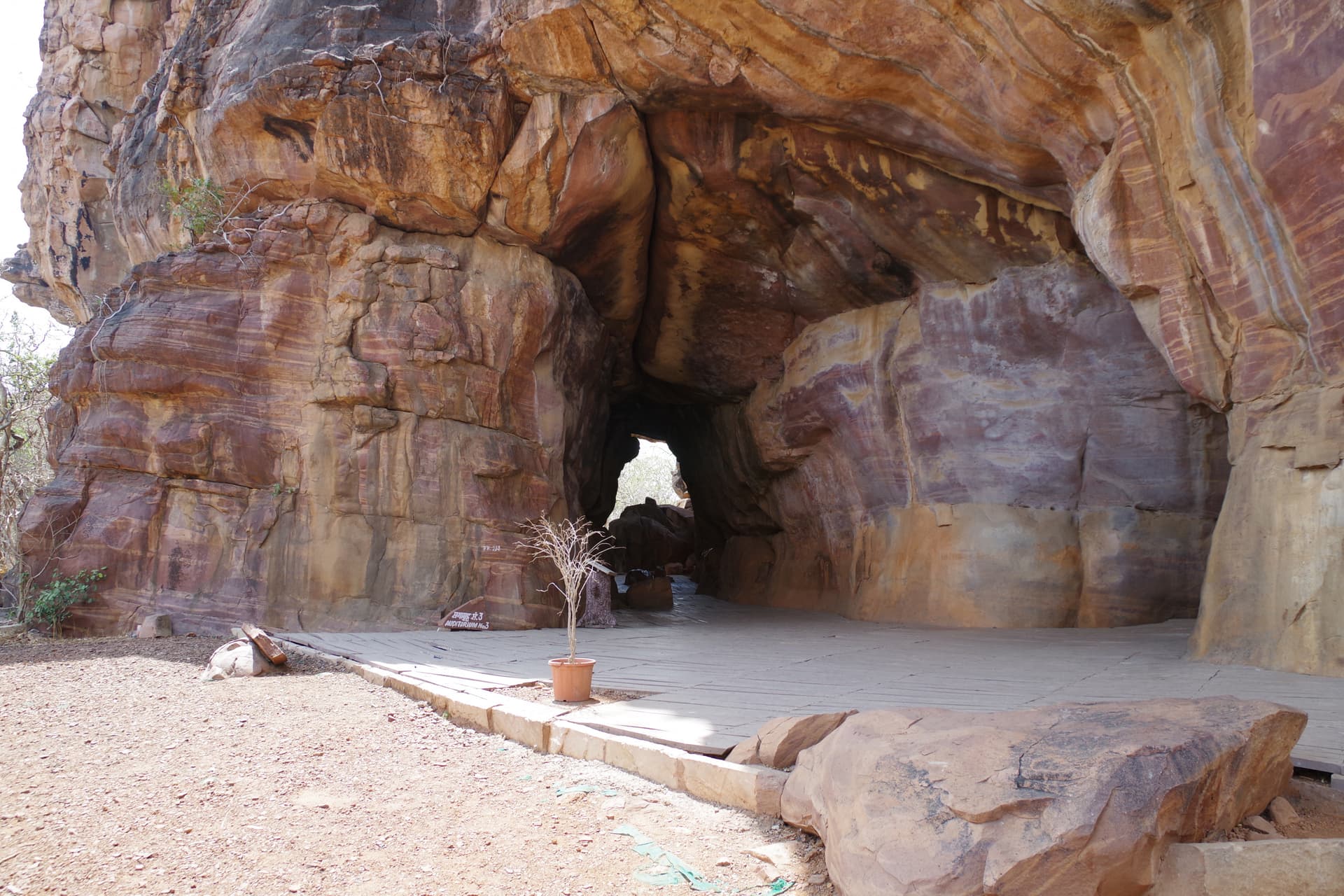
The Bhimbetka Caves, nestled in the Vindhya hills of Madhya Pradesh, encompass more than 750 rock shelters, around a hundred of which contain rock paintings among the oldest known in India. Inscribed as a UNESCO World Heritage Site in 2003, the site lies approximately 45 km south of Bhopal.
Why Visit Bhimbetka
The site provides continuous documentation of human occupation spanning several tens of thousands of years. The paintings, created between 40,000 and 10,000 BC, cover the walls and ceilings of natural shelters carved by sandstone erosion. Multiple artistic phases overlap on the same walls, forming a rare palimpsest.
Compared to the cave complexes of Lascaux in France or Altamira in Spain, Bhimbetka testifies to a capacity shared by early human groups to represent their environment and transmit their memory long before the advent of writing.
History and Discovery of the Site
Indian archaeologist Vishnu Shridhar Wakankar spotted the rock formations from a train in 1957. Struck by their resemblance to European prehistoric sites, he returned to the location and identified decorated shelters. Excavations began in 1958 and continued until 1974, revealing the extent of occupation.
The site's name combines Bhima, one of the five Pandava brothers from the Mahabharata, and Baithak, meaning "resting place." According to legend, Bhima is said to have sheltered here during the Pandavas' exile, blending Hindu epic with actual geography.
Carbon-14 dating remains impossible due to the mineral nature of the pigments. Researchers therefore rely on style, motifs, and layer stratification to establish a chronology divided into nine phases: I to V for the Mesolithic period, VI for the Chalcolithic (Copper Age), and VII to IX for the historical period.
What You'll See On-Site
Techniques and Pigments
Artists used red pigments derived from hematite, whites made from kaolin or limestone, and occasionally yellows, greens, or blacks. These powders were bound with plant sap, animal blood, or fat, then applied using chewed branches, plant fibres, or feathers. The rock's natural relief served to give volume to the figures.
Scenes of Life and Fauna
The paintings depict hunts, honey harvesting, meal preparation, circle dances, and processions. Human figures often appear in groups, sometimes masked or adorned with jewellery made from shells, bone, or stone.
Fauna occupies a central place: bison, tigers, elephants, boars, deer, lions, peacocks, dogs, and lizards are rendered with precision. Some animals are drawn within another animal, a stylisation that may carry symbolic significance.
Later Motifs and Symbols
More recent artworks incorporate identifiable Hindu deities: Ganesha, Shiva, the Mother Goddess. The trishul (trident) and swastika appear, along with battle scenes and chariots that may reference episodes from the Mahabharata.
Archaeological Remains
Excavations have yielded chipped stone tools, arrowheads, microliths, hearth remains, pottery fragments, beads, shells, animal bones, and human burials. Some shelters feature levelled floors and steps carved into the rock, evidence of permanent settlement.
Practical Information
The site is open daily from sunrise to sunset. Entry fees differ for Indian and foreign visitors, with additional charges for two-wheelers and vehicles. The entrance gate is approximately 2 km from the caves; a vehicle is needed to reach the main parking area and then follow the marked circuit.
Allow 2 to 3 hours to tour the shelters open to the public. Bring water, sturdy shoes, and a hat: the trail is in the open air with minimal shade. A local guide, hired on-site or through an operator in Bhopal, helps identify the less obvious paintings.
When to Visit
The most comfortable season runs from October to March: the climate remains dry and temperatures allow for comfortable walking. Several regional festivals enliven the Bhopal area during this period, including Dussehra, the Sanchi Mahotsav, and the Bhopal Utsav Mela.
The monsoon (July-August) renders trails slippery and dense vegetation complicates viewing the walls. Summer (April to June) attracts fewer visitors but daytime temperatures can exceed 40°C.
How to Get There
- By air: Bhopal Airport (Raja Bhoj) is approximately 45-50 km from the site. Indore International Airport, 190 km away, offers more international connections.
- By train: Bhopal Junction railway station is connected to major Indian cities (Delhi, Mumbai, Agra).
- By car: From Bhopal, follow NH 46 towards Hoshangabad for approximately 45 km, then follow signs to the site. Allow 1 to 1.5 hours driving time.
Nearby Attractions
The Bhopal region features several sites that complement a visit to Bhimbetka. The city itself houses the Bhopal State Museum, which places Bhimbetka's artefacts within the broader regional archaeological context. The Ajit Singh Memorial rounds out a day spent in Bhopal. Further north, the Buddhist stupas at Sanchi (another UNESCO site) and the unfinished temple at Bhojpur fit logically into a 2 to 3-day circuit around Madhya Pradesh's capital.
Frequently Asked Questions
Frequently asked questions
Plan for 2 to 3 hours on-site to walk the marked circuit serving about fifteen shelters open to the public. Adding travel time to and from Bhopal, set aside a half-day to a full day.
The circuit is marked and explanatory panels accompany the main shelters. A local guide remains helpful for identifying the least visible paintings and understanding the chronology of the artistic phases.
Flash-free photography is generally permitted. Flash and tripods may be restricted or subject to an additional fee; check at the entrance gate.
The circuit uses earthen trails, carved steps, and narrow passages between rocks. Access is limited for people with reduced mobility; however, some shelters close to the parking area remain viewable.
Plan Your Trip
Bhimbetka integrates naturally into a Madhya Pradesh itinerary combining Bhopal, Sanchi, and the region's national parks. To craft a bespoke journey including this UNESCO site, explore our travels in India.
Interested in this visit?
We can include it in your personalised itinerary.