Deeg Fort
Deeg Fort
Deeg Fort, built in 1730 by Maharaja Suraj Mal, stands 35 km from Bharatpur in Rajasthan, preserving 12 towers, palaces, and Mughal gardens.
Also called Jal Mahal (the "water palace"), Deeg Fort overlooks the small town of Deeg in Bharatpur district, in eastern Rajasthan. Built in the 18th century by Jat rulers, it combines defensive walls, residential pavilions, and Mughal gardens within a single fortified perimeter.
Why visit Deeg Fort
The fort appeals to travelers seeking a historical site untouched by mass tourism, midway between Agra and Jaipur. Visitors come for three key reasons:
- A rare fortified complex in Rajasthan, with 12 towers and an enclosure stretching several kilometers, still visible in the landscape.
- Composite architecture blending Mughal, Rajput, and Bengali influences, notably visible in the Suraj Mal Haveli.
- A worthwhile complement to the nearby Deeg Palace and Keoladeo National Park, less than an hour's drive away.
Fort History
The fort was built in 1730 by Maharaja Suraj Mal, founder of the Jat dynasty of Bharatpur. Originally conceived as a military stronghold, it later served as a secondary residence and administrative base for Jat rulers, becoming one of the centers of their regional power.
The region experienced several military episodes during the 18th and 19th centuries, notably during conflicts between Jats, Marathas, and British forces. The fort itself bears traces of its defensive role: moats, bastions, an entrance bridge fitted with anti-elephant stakes to break the momentum of war mounts.
What to see on the site
The fortified enclosure
The outer walls extend approximately 8 km in circumference, pierced by 10 gates and reinforced by 72 bastions. The main entrance is protected by a bridge designed against elephant charges. Once inside, the scale of the site is striking: it reads more as a fortified quarter than a single castle.
The towers
The fort has 12 towers, the most imposing being Lakha Burj, located in the northwest corner. It served as an observation post over the town and surrounding countryside. The Suraj Mal Haveli, built in a Bengali style recognizable by its curved roof, stands as one of the most distinctive structures in the complex.
The palaces and gardens
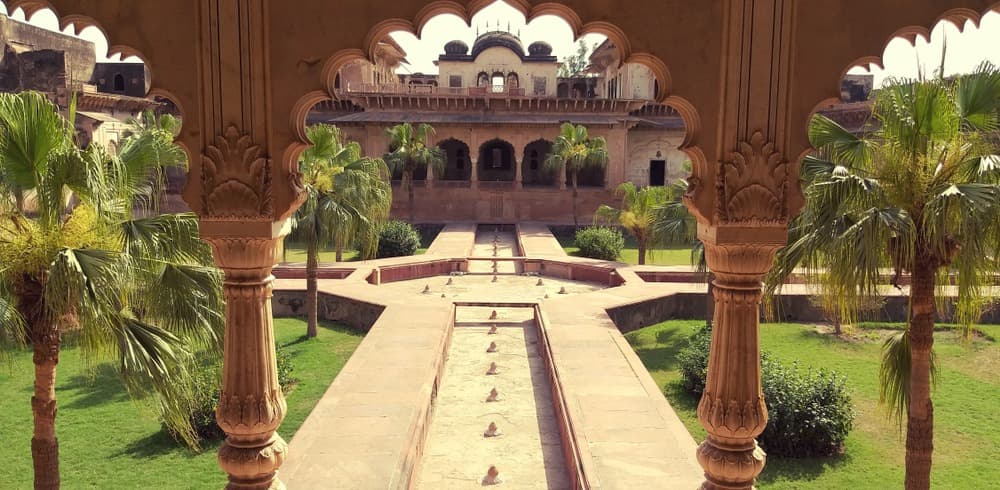
Inside are several palatial pavilions: Gopal Bhavan, Nand Bhavan, Kishan Bhavan, Keshav Bhavan, Purana Mahal, and Sheesh Mahal. They are organized around gardens in the Char Bagh style, a Mughal plan divided into four quarters traversed by channels. Some buildings are in ruins, but the ensemble remains legible and photogenic.
Practical Information
- Opening hours: daily except Sundays, daytime (generally morning to late afternoon).
- Admission: modest entry fee, payable on site; an additional charge applies if photographing with professional equipment.
- Duration: 1.5 to 2.5 hours depending on your interest in architecture.
- Tip: bring water, sturdy shoes, and a hat—shade is scarce on the ramparts.
Best time to visit
Eastern Rajasthan has a distinct climate. The ideal period for visiting Deeg runs from November through March, when daytime temperatures remain manageable. From April to June, heat frequently exceeds 40°C, making walks uncomfortable. The monsoon, July to September, greens the gardens but can hinder travel. Prefer visiting in the morning or late afternoon to make the most of the light on the pavilions.
How to get there
Deeg lies approximately 35 km north of Bharatpur, to which it is administratively linked.
- By air: Delhi's Indira Gandhi International Airport is the nearest, about 220 km by road. From there, taxi or train to Bharatpur, then onward to Deeg.
- By train: Bharatpur railway station connects to Delhi, Agra, Jaipur, Kota, Sawai Madhopur, Mumbai, and Ahmedabad. Taxi or bus for the final kilometers.
- By car: Deeg is easily accessible from Agra, Mathura, Fatehpur Sikri, Jaipur, and Delhi via a well-maintained road network. Public and private buses serve the town.
Nearby attractions
- Bharatpur and Keoladeo National Park (35 km): UNESCO-listed bird sanctuary.
- Mathura and Vrindavan (50–60 km): major Krishna pilgrimage centers.
- Agra (100 km): Taj Mahal and Red Fort.
- City Palace in Alwar: another example of Rajput-Mughal architecture, roughly 110 km away.
- Bagore Ki Haveli in Udaipur, to further explore Rajasthan's palaces.
FAQ
Frequently asked questions
Including Deeg in your itinerary
Deeg Fort fits naturally into an eastern Rajasthan circuit that includes Bharatpur, Agra, and the route to Jaipur. To craft a custom journey weaving together Mughal heritage, Rajput forts, and nature reserves, explore our India travel suggestions.
Interested in this visit?
We can include it in your personalised itinerary.