Safdarjung Mausoleum
Safdarjung Mausoleum
The last grand Mughal tomb in Delhi, completed in 1754 for Vizier Safdar Jung: white marble dome, charbagh garden and architecture inspired by Humayun.
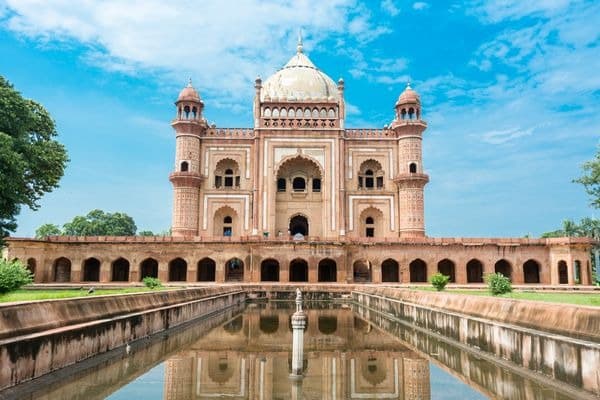
The Safdarjung Mausoleum, completed in 1754 in New Delhi, is considered the last great Mughal construction in the capital. Built for Grand Vizier Mizra Muqim Abul Mansur Khan, known as Safdar Jung, it combines a white marble dome, a red sandstone façade enhanced with yellow stone and a charbagh garden enclosed by walls measuring 280 meters.
Why Visit the Safdarjung Mausoleum
The site offers clear testimony to late Mughal funerary style, in an atmosphere far more serene than the nearby Humayun's Tomb. Its construction on a charbagh plan, its five-part façade and its nine-chambered floor plan make it a textbook example of 18th-century imperial architecture. The complex also houses a three-bay mosque, a madrasa and a library, managed by the Archaeological Survey of India.
Allow 1 to 1.5 hours to visit the central building, pavilions and garden. Foot traffic remains moderate compared to Delhi's major Mughal monuments.
History
Safdar Jung was Nawab of Oudh and then Grand Vizier of Mughal Emperor Muhammad Shah, wielding power from 1739 to 1754. During this period, Mughal authority was declining and regional nawabs controlled a significant portion of the Northern Plains, from Bengal to eastern Punjab.
Upon his death in 1754, his son Nawab Shuja-Ud-Daula obtained the Emperor's permission to construct a mausoleum befitting his father's rank. Construction was completed the same year. To save time and materials, the builders repurposed slabs from the tomb of Abdul Rahim Khankhana, which explains certain variations in the stonework pattern.
The project follows directly from Humayun's Tomb, adopting its overall silhouette while marking the end of the great Mughal funerary tradition in Delhi.
What to See on Site
The Main Building
The mausoleum rises on a high platform and reaches 28 meters beneath a bulbous white marble dome. The façade combines red sandstone and yellow stone, with rococo plasterwork ornamentation inside. The central square burial chamber holds the tombs of Safdar Jung and his wife, surrounded by eight smaller chambers arranged in the classic nine-chambered plan.
Four octagonal corner towers, crowned with kiosks (chhatris), frame the main body of the building.
The Pavilions and Charbagh Garden
The complex includes four pavilions, each bearing an evocative name: the Moti Mahal (Palace of Pearls), the Jangli Mahal (Forest Palace) and the Badshah Pasand (Emperor's Favorite Palace). They open onto the charbagh garden, divided into four parterres by water channels. The enclosure measures approximately 280 meters per side and includes four fountains, a three-bay mosque, a madrasa and a library.
Interior Decoration
The interior of the main chamber retains rococo plasterwork decoration, carved in relief on vaults and arches. The thick walls maintain a pleasant coolness, a welcome contrast to the heat from April to June.
Practical Information
- Hours: open daily, generally from sunrise to sunset. Verify the day's hours with the ASI before your visit.
- Admission: paid entry, moderate for foreign visitors, significantly reduced for Indian nationals. Additional fee for cameras and video equipment.
- Duration: 1 to 1.5 hours are sufficient for the building and garden.
- Best time: October to March, when temperatures in Delhi are comfortable. Monsoon season (July-September) greens the garden but can make visits humid.
How to Get There
The mausoleum is located at the intersection of Lodhi Road and Aurobindo Marg, near the former Safdarjung Airport, in central-south Delhi.
- Metro: Jorbagh station (Yellow Line), approximately 300 meters from the entrance.
- Taxi / Ride-sharing: Uber and Ola serve the site easily from Connaught Place or tourist areas.
- Bus: several DTC routes stop on Aurobindo Marg.
Nearby Attractions
To extend your exploration of India's heritage, several sites usefully complement your visit:
- Ajit Singh Memorial, another example of Indian commemorative architecture.
- State Museum of Bhopal, to deepen your understanding of regional dynasties.
- Alchi Monastery, in Ladakh, architectural contrast with Mughal tradition.
- Bandhavgarh National Park, for a nature stop in Madhya Pradesh.
Frequently Asked Questions
Frequently asked questions
Mizra Muqim Abul Mansur Khan, known as Safdar Jung, was Nawab of Oudh and then Grand Vizier of Mughal Emperor Muhammad Shah between 1739 and 1754. His son Nawab Shuja-Ud-Daula had this mausoleum built for him in 1754.
Yes. Safdar Jung's tomb is later (1754) and marks the end of the Mughal funerary tradition in Delhi. It draws inspiration from Humayun but in a more condensed form, and the site is significantly less crowded.
1 to 1.5 hours are sufficient for the main building, the four pavilions and the charbagh garden.
The easiest option is the metro to Jorbagh station (Yellow Line), 300 meters from the site. Taxi, ride-sharing and buses on Aurobindo Marg are also convenient options.
October to March, when temperatures in Delhi remain moderate. Avoid April to June, which are particularly hot.
Include the Mausoleum in Your Trip
This stop integrates naturally into a cultural stay in Delhi, complementing the Red Fort, Humayun and the nearby Lodhi gardens. To plan your complete itinerary, consult our tailor-made India journeys.
Nearby
Interested in this visit?
We can include it in your personalised itinerary.