Ajit Singh Memorial
Ajit Singh Memorial
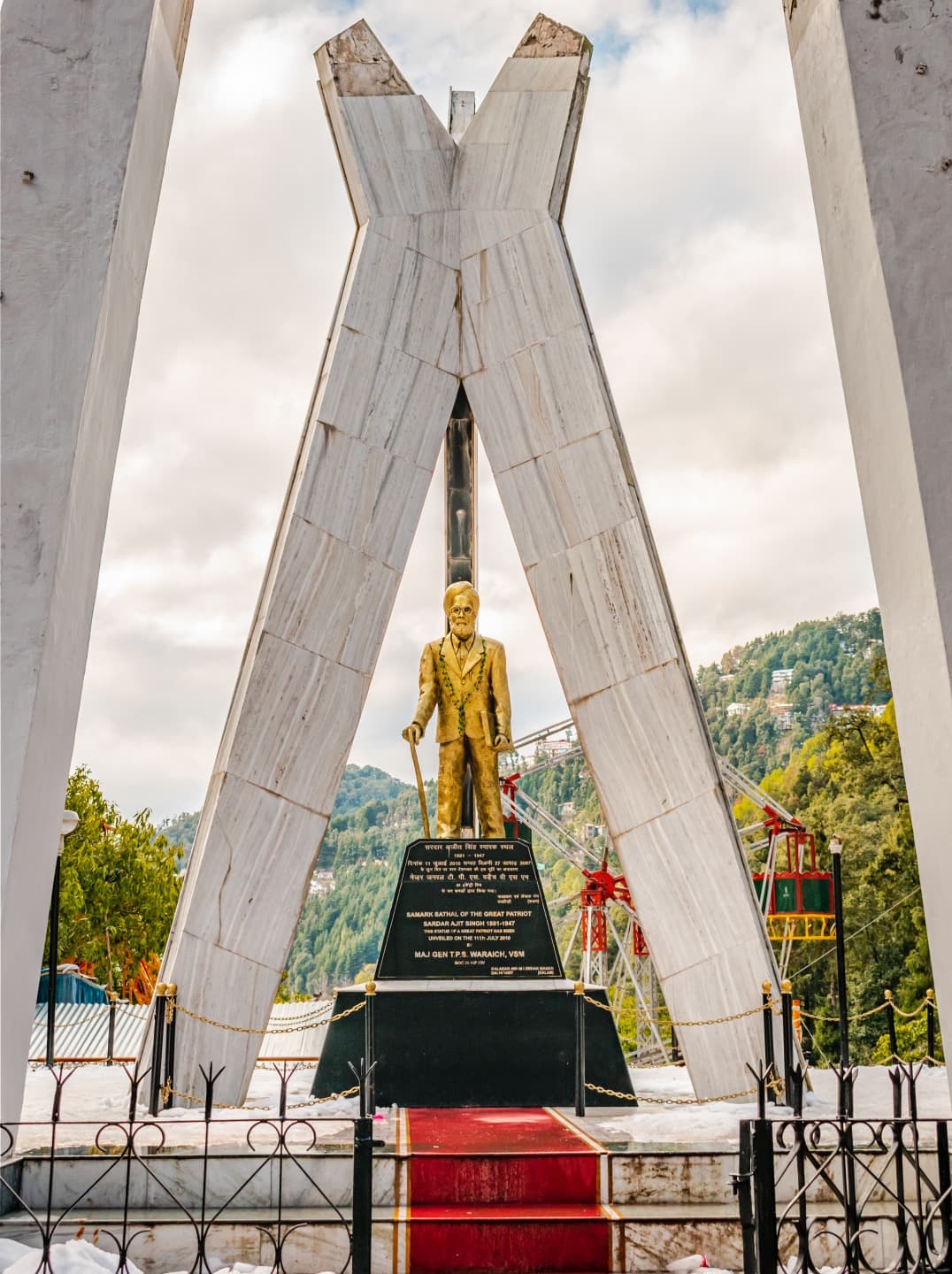
Near Panchpula stream in Dalhousie, this memorial pays tribute to Sardar Ajit Singh, Indian nationalist activist and uncle of Bhagat Singh.
The Sardar Ajit Singh Memorial honors the memory of a figure in Indian nationalism and the peasant movement of Punjab. Built near Panchpula stream, approximately 3 km from Gandhi Chowk, it combines a place of remembrance with a mid-mountain setting, away from central Dalhousie.
Why visit the memorial
The site holds a twofold appeal. First for its historical significance: it recalls the journey of an activist exiled for nearly four decades, uncle of Bhagat Singh and precursor to major Indian agricultural mobilizations. Second for its setting, on the banks of a stream and in close proximity to the Panchpula promenade area, making it an easy stop to include in a day of exploration around Dalhousie.
The visit suits both a brief stop and a more contemplative pause. Allow 30 minutes to 1 hour for the memorial alone, longer if you extend with a walk along the stream.
Sardar Ajit Singh: the path of an exiled activist
Sardar Ajit Singh was born on February 23, 1881, and died on August 15, 1947, India's independence day. Under British Raj, he engaged both in nationalist movements and revolutionary action. He played a decisive role in demonstrations by Punjab farmers against the 1906 Punjab Colonisation Act and against increases in irrigation water levies.
In May 1907, he was exiled to Mandalay, Burma, with Lala Lajpat Rai. Facing public pressure and British fears about the loyalty of the Indian army, both men were released in October 1907. Ajit Singh then continued his political work with his brothers Kishan Singh and Swaran Singh, as well as with Sufi Amba Parshad, publishing writings hostile to colonial rule.
In 1909, he left India for Iran with Sufi Amba Parshad and lived in exile there for 38 years. He returned to India in March 1947 and died in Dalhousie on independence day, August 15.
His political legacy can be measured in several ways: he founded the Bharatmata society and the journal Bharat Mata, launched the peasant movement Pagri Sambhal Jatta in 1907, and directly inspired his nephew Bhagat Singh, son of Kishan Singh, one of the most significant revolutionaries of the Indian twentieth century.
What you will see on site
The memorial consists of a bust of Sardar Ajit Singh installed on a plinth, surrounded by a small space developed on the stream bank. Plaques trace the major stages of his life. The setting is wooded, dominated by the conifers characteristic of the Dalhousie region, and the sound of Panchpula accompanies the visit.
The site is freely accessible and remains modest in scale. It appeals primarily to travelers interested in the history of the Indian national movement and to families who extend their stay by exploring nearby trails and picnic spots.
Practical Information
The memorial is open during daylight hours with no admission fee. Wear sturdy shoes: the surrounding terrain slopes toward the stream and can be slippery after rain. No dining facilities on site, but mobile vendors and small stands are present at Panchpula, a few minutes' walk away.
Keep in mind the altitude: Dalhousie sits between 1,900 and 2,400 meters depending on the area, with cool evenings even in summer.
When to visit
Dalhousie is a hill station, which determines travel planning:
- March to June: mild temperatures, lush vegetation, peak season for Indian travelers.
- July to September: monsoon season, Panchpula stream abundant with water, but muddy trails and landslide risks.
- October to November: clear skies, lower crowds, ideal conditions to combine memorial and hiking.
- December to February: marked cold, possible snowfall that occasionally closes roads.
How to get there
By air. Dalhousie has no airport. The nearest are Pathankot (75 km), Gaggal near Dharamshala (140 km), and Jammu (180 km). Amritsar airport is an alternative, accounting for approximately 4 to 6 hours of driving depending on traffic.
By train. Pathankot railway station is most convenient, well connected to Delhi and Jammu. From there, allow approximately 3 hours of driving by taxi or bus to reach Dalhousie.
By car or bus. From New Delhi, the drive is 565 km via NH1, approximately 11 hours of travel. Public carriers HPTC and HRTC serve Dalhousie, supplemented by private taxis and overnight buses. The final stretch from Pathankot is winding.
Once there, the memorial is reached by taxi or on foot from Gandhi Chowk (3 km), via the Panchpula road.
Nearby attractions
The memorial is part of a collection of sites accessible within a day:
- Panchpula: promenade area and pools formed by the stream, a few minutes from the memorial.
- Satdhara Falls: a waterfall renowned for its mineralized waters, on the Panchpula road.
- Kalatop Sanctuary: forest of cedars and green oaks, Himalayan wildlife observation.
- Chamera Lake: a dam reservoir situated below, suited to water activities.
To prepare a broader itinerary, consult our pages on other Indian historical sites such as Alchi Monastery, Alwar Bala Quila Fort, or Anjengo Fort.
Frequently asked questions
Allow 30 minutes to 1 hour for the memorial alone, and a half-day if combining with nearby Panchpula and Satdhara Falls.
The site is freely accessible. No ticket is required to visit the memorial.
Yes, except in case of heavy snowfall that may make local roads impassable. Check road conditions between December and February.
A nationalist activist and figure in the Punjab peasant movement, exiled for nearly four decades, uncle of revolutionary Bhagat Singh. He died in Dalhousie on August 15, 1947, India's independence day.
The memorial is approximately 3 km from Gandhi Chowk, on the Panchpula road. It is accessible by local taxi or on foot for hikers.
Plan Your Trip
The Sardar Ajit Singh Memorial fits naturally into a Himalayan circuit passing through Dalhousie, Khajjiar, and Dharamshala. To build a custom itinerary in the region, explore our travel suggestions in India.
Interested in this visit?
We can include it in your personalised itinerary.