Delhi
Delhi
An ancient capital and gateway to the Golden Triangle, Delhi blends the bazaars of Old Delhi with Mughal monuments and colonial avenues. Our guide to exploring it well.
No one thinks of spending time in India without reserving a stop in their journey to visit the unmissable Delhi. Discover the attractions of India's great capital.
Introduction
Delhi needs no introduction—it is India's flagship city. Situated along the Yamuna River, it borders Uttar Pradesh and the Punjab province.
Wherever your gaze falls, monuments rise everywhere, reminding us of the bygone grandeur of a city that was successively the capital of the Delhi Sultanate, the Mughal Empire, and the Maratha Empire. The abundance of exceptional historical sites—such as the Red Fort or Jantar Mantar—makes Delhi an open-air museum.
But Delhi is also a city in full economic boom. Mughal gardens stand alongside Japanese parks, a medieval palace rubs shoulders with chic and trendy restaurants, and one can easily pass from the silent majesty of a Jain or Hindu temple to the frantic atmosphere of a nightclub. What more can be said, except that the capital is a perpetual hymn to travel? Don't wait any longer to book your flight to Delhi, India's brilliant capital.
History
Visitors will be delighted to learn the captivating history of Delhi. A city more than a thousand years old stands before you, and more than one site holds important memories rich in emotion.
Archaeological studies suggest that Delhi has been inhabited since 600 BC. Around the year 736, the Rajputs began early political organization, but, constantly fighting each other, their power weakened. They could not withstand Ghûrî, who established Muslim supremacy over Bengal, the Ganges plain regions, and present-day Pakistan. He entrusted the governance of India to his general Qûtb ud-Dîn Aibak. Thus was born in 1206 the Delhi Sultanate.
Still visible today, the Qutub Minar testifies to the golden age of the Delhi sultans. The first stone was laid in 1192. The fifth and final floor was completed in 1368. The tower stands 73 meters high—a pharaonic achievement that leaves us speechless.
Mughal domination was established in 1526, after Prince Babur overthrew the Delhi Sultanate with 12,000 men against 100,000. The grandiose ambitions of Mughal rulers gave Delhi some of its finest architectural treasures: the Red Fort, the Jama Masjid mosque, and Humayun's tomb.
The arrival of the Marathas in 1720 changed the fate of Delhi. They left no lasting legacy except plunder, the dismantling of the Mughal army, and immense desolation. In 1803, the Marathes were defeated in turn by the British army.
From 1858 to 1911, Delhi temporarily lost its capital status by being integrated into the Punjab province. The British government first established its residence in Calcutta, making Jaipur its summer retreat. Later, Delhi reclaimed its title as it was prized for its strategic location.
To build a capital worthy of the British Crown, the Viceroy of India undertook major restructuring projects. The task was entrusted to architect Edwin Lutyens. The result was a city within the city that would be named "New Delhi," India's current capital.
Delhi was proclaimed the capital of independent India in 1947. More than 25 million inhabitants move through the city, ranking it fourth among the world's metropolises.
Today
Delhi today offers the charm of a joyful city with multiple facets. On one hand, skyscrapers, business centers, and noisy congested streets announce an industrial metropolis that never rests. Pollution remains a persistent problem in some areas. Nevertheless, twenty-first-century New Delhi has managed to preserve its picturesque charm that captivates Westerners.
Tourism is a substantial economic sector in Delhi. It ranks first among Indian cities most visited by foreigners, ahead of Mumbai, Chennai, Agra, and Jaipur. India's Archaeological Survey has catalogued 175 national treasures throughout the city.
At every street corner, palaces, mosques, and imposing citadels reveal to us an India of magic and legend. The Red Fort, which forms the heart of the old city, is an excellent starting point for a romantic walk. But even if New Delhi is not what one might call a party capital in the Western sense, the city offers bars, nightclubs, restaurants, and leisure facilities for all.
Whether you need spiritual escape and a change of scenery to regain your zest for life, whether you crave architecture, Mughal wonders, or cultural experiences, or whether you wish to share magical moments as a couple or family, you will find your satisfaction in staying in Delhi. India's capital will fulfill all your desires.
Religious Heritage
Pilgrimage is a major reason that draws tourists to settle in Delhi. The city has as many sacred sites as luxury hotels and accommodations.
the ISKCON temple: Built in 1998, this temple is a fine example of modern architecture. Its prayer hall, which houses beautifully sculpted statues of Lord Krishna, is a pure artistic marvel. The museum organizes video presentations on the history of the Ramayana, Hinduism's sacred text.
the Lotus Temple: Beyond its unusual lotus-shaped facade, this temple invites meditation and contemplation. A major site of Baháʼí faith.
the Digambar Jain temple: This admirable red sandstone edifice draws devotees from all corners of India. Within the temple's wing, a library offers documents and memoirs on Jainism.
the Lakshmi Narayan temple: A place of devotion with unique architecture, the Lakshmi Narayan temple stands at the heart of New Delhi. Two major Hindu festivals are held there each year: Janmashtami (Lord Krishna's birthday) and Ram Navani (Lord Rama's birthday).
the Qutab Minar: Recognized by UNESCO, India's tallest minaret stands 72.5 meters tall, with 399 steps to reach its summit. Crafted from sandstone and marble, the magnificent tower commemorates the victory of the Islamic empire over Hindu principalities in 1193. Qutab Minar is one of Delhi's most spectacular attractions.
the Gurudwara Bangla Sahib: This site earned its standing among the Sikh community since the 1664 visit of Guru Har Krishan, the eighth Guru, who purified the city and healed its inhabitants of smallpox.
the Chhatarpur Mandir: One of Delhi's most beautiful and venerated temples. Lovely landscaped gardens. The interior is richly decorated with carved idols of the Hindu pantheon: Shiva, Vishnu, Ganesha, Lord Rama, Lakshmi, and others.
the Sacred Heart Cathedral: The Catholic church designed by architect Edwin Lutyens is a pure example of classical refinement.
Public Gardens and Parks
During your stay, you will surely enjoy a leisurely walk with family through one of Delhi's landscaped gardens. Far from the hustle of the metropolis, public gardens invite serenity and contact with wildlife, helping you shed daily worries.
Deer Park: Covered with well-maintained lawns, Deer Park is a pleasant picnic spot if you're traveling with children;
The Rose Garden: This floral park where the world's rarest varieties of roses grow is a must-visit for nature lovers. Wandering through these acres of flowers, you'll feel like a seventeenth-century Mughal prince. Close to the national rose garden stand the Red Fort, Shanti Vana, and Raj Ghat, where Mahatma Gandhi's remains rest.
The Garden of Five Senses: Opened in 2003, this lovely park is one of Delhi's most visited leisure spaces. It features several themed sections: Mughal-inspired gardens, water lily ponds, an aromatic herb forest, a bamboo domain, and a solar energy park.
The Japanese Park: The Japanese Park, with its picturesque natural setting, is a rejuvenating and peaceful haven in the heart of Rohini, northwest Delhi. It offers vegetation, pedestrian pathways, and crystal-clear lakes synonymous with picnicking, hiking, and boating. The dance of storks and herons along the lakeshore offers an unforgettable spectacle.
Buddha Jayanti Park: Created on the 2,500th anniversary of Buddha's ascension to nirvana, this public garden features lakes, gigantic trees, and lawns dotted with vibrant flowers.
Places of Interest to Visit
New Delhi is home to numerous monuments and important historical sites that will delight enthusiasts:
India Gate: Linger at this splendid sandstone structure rising at the heart of Delhi. Standing 42 meters high, it honors the memory of 90,000 soldiers who perished during World War I and the Afghan invasion.
The Red Fort: Built in 1648, the Red Fort is a striking testimony to the golden age of the Mughals during medieval India. Constructed on the orders of Emperor Shah Jahan, who wished to move his capital from Agra to Delhi, the site houses audience halls, the Palace of Colors, and a private palace of remarkable wealth.
Humayun's tomb: This splendid Mughal heritage will not leave you indifferent. Akbar's mother had it built to immortalize her husband's memory.
The Jantar Mantar: This astronomical instrument bears witness to India's scientific prominence in the eighteenth century. Its construction dates to the reign of Jai Singh II, who devoted his leisure hours to studying stars and celestial bodies.
The Raj Ghat: Throning in the midst of a magnificent wooded garden, the Raj Ghat is a platform dedicated to the memory of Mahatma Gandhi, the father of free India.
What to Do?
Your stay in New Delhi is far from monotonous. There is so much to experience and do:
visit funerary monuments, including Raj Ghat, where Mahatma Gandhi's ashes are preserved;
pay homage to the unique architecture of the Lotus Temple;
admire the sunset from atop the Red Fort, where the city gleams in its endless maze of temples and sanctuaries;
enjoy a moment of tranquility in a public garden of the capital;
pose for a photo in front of India Gate, a powerful and emblematic symbol of Delhi;
taste the richness and originality of Indian cuisine;
take a tour through the Jama Masjid mosque, where Islamic culture vibrates;
stroll by rickshaw through Chandni Chowk, one of Delhi's most lively neighborhoods;
wander freely through the India Habitat Center complex where you can enjoy a drink, view exhibitions, or go shopping;
as gifts, take back spices, period objects, or costume jewelry from Sadar Bazaar market.
When to Go?
Winter is the best time recommended by travel guides to take your vacation in Delhi. While intense heat reigns from mid-March to June (30 to 35°C), with the maximum recorded in June, it is only from October onwards that temperatures begin to drop. From November to March, climatic conditions are more pleasant: the sun shines perpetually, rainy days are exceptional, and temperatures vary between 6°C and 22°C.
The monsoon, which runs from July through late September, brings heavy showers. If you wish to visit New Delhi away from crowds, time your departure during this low season.
Reaching Delhi is not difficult, as the city boasts a robust communication network. Depending on your preferences or budget, transport options include air, car, and train.
- By air: For European foreigners, flying is the easiest and most practical way to reach Delhi. The main landing airport is Indira Gandhi International Airport, named after the great figure who sacrificed himself for India's freedom. It is located 22 km from the city center. From Europe, flights to Delhi take between 9 and 12 hours.
By road: Tourists can book a taxi or a car with driver to arrive in Delhi. The city is served by India's national highway system.
By rail: Train is also an excellent transport option to come to Delhi. All major cities are connected by rail to the capital. The main railway stations are located at New Delhi, Old Delhi, and Hazrat Nizamuddin.
Once there, you can travel by rickshaw, tuk tuk, or metro. If you want maximum comfort and your budget allows, opt for a private vehicle.
Attractions in Delhi
See all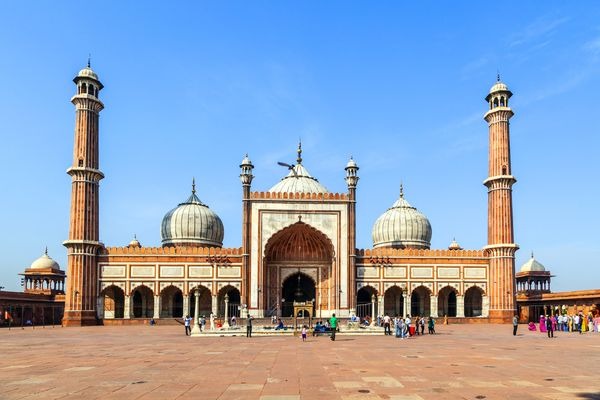
Jama Masjid de Delhi
Édifiée par Shah Jahan au XVIIe siècle, la Jama Masjid domine le Vieux Delhi avec ses dômes de marbre, ses minarets et son immense cour en grès rouge.

Sansad Bhavan (Parlement de l'Inde)
Le Sansad Bhavan, siège du Parlement indien à New Delhi, est un chef-d'œuvre de l'architecture coloniale signé Herbert Baker. Sa colonnade circulaire de 144 colonnes en grès domine le quartier monumental de Lutyens' Delhi.
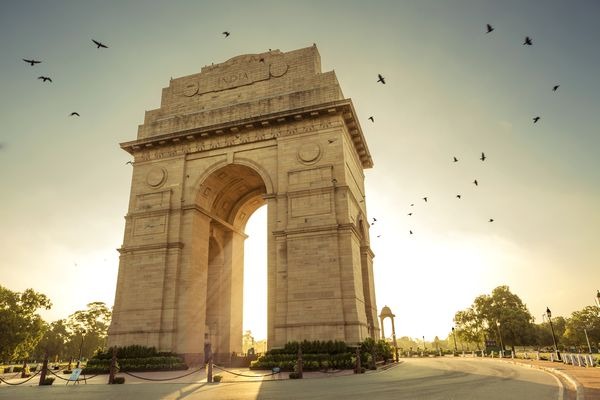
India Gate
Arc de triomphe de 42 mètres érigé en 1931 au cœur de New Delhi, India Gate commémore les soldats de l'armée des Indes. Entrée gratuite, flamme éternelle et illumination nocturne en font un symbole incontournable de la capitale.
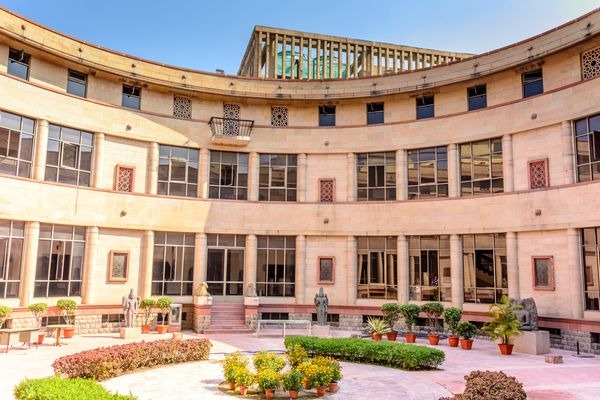
National Museum of India
Le Musée national de New Delhi rassemble plus de 200 000 objets couvrant cinq millénaires d'histoire indienne : figurines harappéennes, bronzes Chola, miniatures mogholes et art de la Route de la Soie.
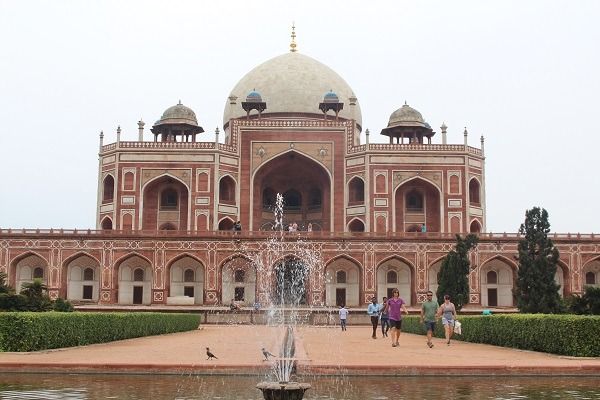
Humayun's Tomb
Premier grand mausolée de jardin de l'Inde, le tombeau d'Humayun à New Delhi mêle architecture perse-moghole et jardins géométriques. Un site UNESCO qui a inspiré le Taj Mahal.
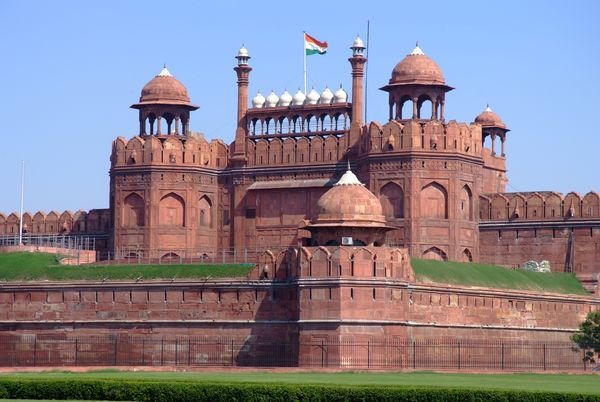
Fort Rouge de Delhi (Lal Qila)
Construit par Shah Jahan au XVII<sup>e</sup> siècle, le Fort Rouge est le monument emblématique de la vieille Delhi. Palais impériaux, remparts de grès rouge et musées : un site UNESCO incontournable au cœur de Chandni Chowk.
Accommodation in Delhi
See all

Want to discover this destination?
Our local advisors design your tailor-made trip.