Bikaner's Camel Farm
Bikaner's Camel Farm
The National Research Centre on Camels in Bikaner combines scientific research, conservation of four Indian breeds and discovery of camel milk, on the edge of the Thar Desert.
The Camel Farm of Bikaner, officially the National Research Centre on Camels (NRCC), is a scientific research centre located on the edge of the Thar Desert in Rajasthan. It combines animal conservation, agronomic research and public engagement centred on the camel, a key animal in India's arid zones.
Why visit the Camel Farm
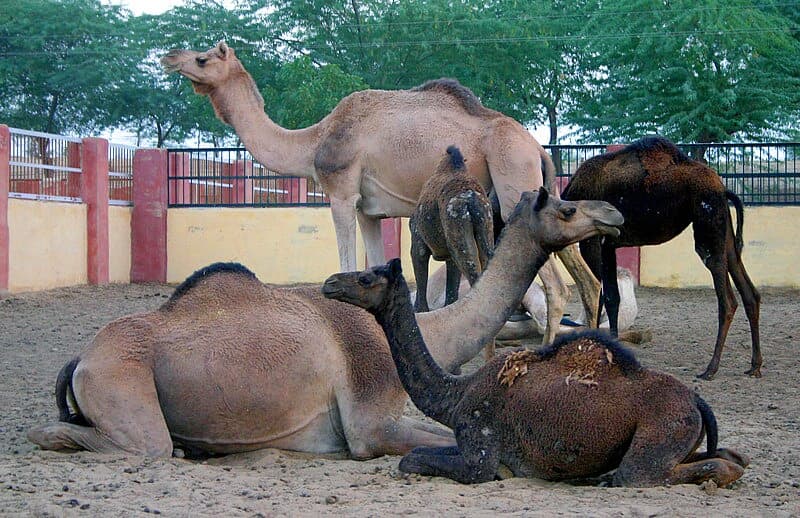
About ten kilometres from the centre of Bikaner, the NRCC is one of the few sites in India where you can observe camels from a scientific, cultural and economic perspective. The centre is home to over 300 camels and works to preserve four Indian breeds: Bikaneri, Jaisalmeri, Kachchhi and Mewari. The visit appeals equally to travellers curious about livestock and desert biodiversity and those who wish to understand the role of this camelid in Rajasthan's military and caravan history.
History of the centre
The institution was founded on 5 July 1984 with the creation of the Project Directorate on Camel, under the auspices of the Indian Council of Agricultural Research (ICAR). The initial objective was to structure research around an animal essential to the survival of populations in India's arid and semi-arid zones.
On 20 September 1995, the directorate was elevated to the status of National Research Centre on Camel. Since then, the institution has established itself as a reference point for camel farming, animal health and the development of derivative products. Today it continues applied research on camel milk and the camel dairy sector, while preserving valuable genetic heritage through its protected breeds.
The camel also left its mark on local military history: it was in Bikaner that Maharaja Ganga Singh founded a camel cavalry unit, the Ganga Risala, which served on Middle Eastern fronts in the twentieth century.
What to see and do on site
Visiting the centre and enclosures
The tour begins with the enclosures where the camels live, separated by breed and age. Explanatory panels and, depending on the day, local guides detail the morphological characteristics of each breed, their adaptation to the desert climate and the veterinary methods employed. Late afternoons are ideal for observation: the heat drops and young camellings come out to frolic.
Camel rides
Short rides are offered around the centre's perimeter, on the edge of the Thar Desert. The rides are usually accompanied by a camel herder from the site. It's a good introduction before a longer safari from Bikaner or Jaisalmer.
The Camel Milk Parlor
The Camel Milk Parlor offers a tasting of products made from camel milk, which is lower in fat than cow's milk and locally valued for its nutritional qualities. You'll find pure or flavoured milk (chocolate, vanilla), ice cream and kulfi, an Indian ice that is denser and creamier than its Western equivalents.
The museum and shop
A small museum traces the camel's role in desert civilisations, its usefulness in commercial caravans and its military importance, particularly through the cavalry unit founded by Maharaja Ganga Singh. The adjoining shop stocks local crafts: bags, camel wool scarves, traditional jewellery.
Practical information
Access
The centre is located in the Jorbeer district, approximately 8 kilometres south of Bikaner's city centre. It's easily accessible by rickshaw, taxi or private car. Allow around twenty minutes from Junagarh Fort.
Duration and prices
Plan for 1.5 to 2 hours on site for a comfortable visit, longer if you add a camel ride and tasting. Admission is modest, with a dual price structure for foreign visitors and an additional charge for photography. Rides and tastings are charged separately at reasonable rates. Opening hours generally cover the daytime outside the hottest hours; it's best to check with your local guide before heading out.
When to visit
Rajasthan is best visited from November to March, when temperatures remain manageable. Between April and June, temperatures regularly exceed 40°C in the Bikaner region, making visits tiring midday. The monsoon, in July-August, is more discrete here than elsewhere in India, but showers can complicate travel. On-site, aim for late afternoon: the light is better and camels are much more active.
What to see nearby
A visit to the Camel Farm fits naturally into a stay in Bikaner, where Junagarh Fort, Lalgarh Palace and the old town's winding streets deserve a full day. If your itinerary heads further west, Amar Sagar Lake, near Jaisalmer, extends the desert experience. For museum enthusiasts, Bhopal's State Museum and the Ajit Singh Memorial complement a cultural approach to northern and central India.
FAQ
Frequently asked questions
Allow 1.5 to 2 hours to tour the enclosures, museum and shop. With a camel ride and a stop at the Camel Milk Parlor, plan for half a day.
The milk served at the Camel Milk Parlor comes from the centre's herd and is pasteurised. It is more digestible than cow's milk for many people, but like any dairy product consumed while travelling, it's best to start with a small amount.
Late afternoon is ideal: the heat drops, the light is softer for photography and the camels are more active, especially the young camellings.
The site is about 8 km from the city centre in the Jorbeer district. A rickshaw or taxi will take you there in about twenty minutes. Be sure to agree on a round-trip fare with waiting time, as return journeys can be harder to find on site.
Organising your trip
To include Bikaner's Camel Farm in an itinerary in Rajasthan or a broader circuit in the north of the subcontinent, check out our suggestions for travel in India. Our local advisors can organise the visit with an English-speaking guide and combine it with a night in a desert camp in the Thar Desert.
Nearby
Interested in this visit?
We can include it in your personalised itinerary.