Bhandasar Jain Temple
Bhandasar Jain Temple
A 12th-century Śvetāmbara Jain sanctuary in Bikaner, celebrated for its vibrant frescoes and the legend of ghee mixed into its foundations.
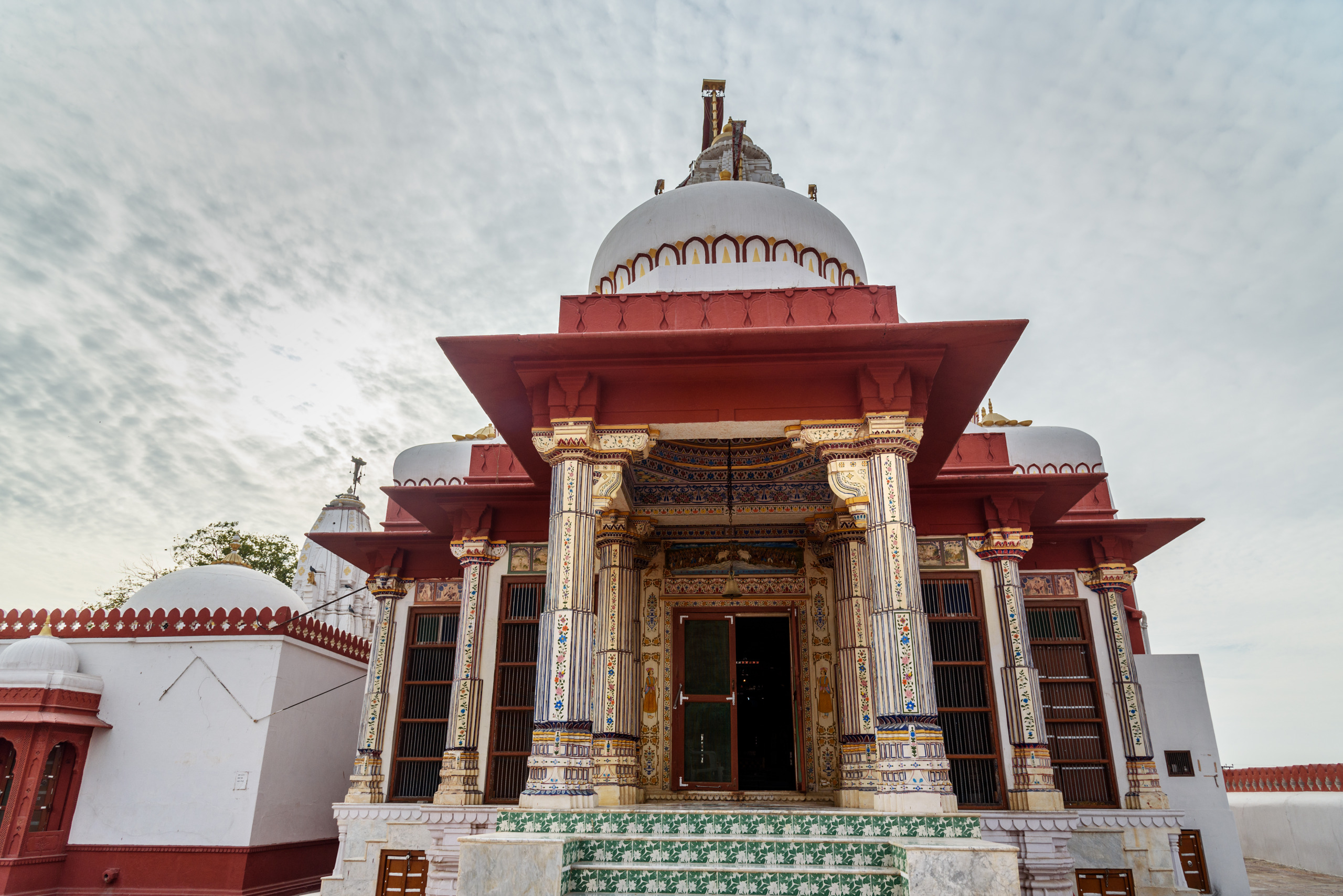
The Bhandasar Jain Temple is a Śvetāmbara sanctuary, one of the two major branches of Jainism alongside the Digambara tradition. Located in Bikaner, in Rajasthan, this 12th-century edifice stands out for its vibrant frescoes and the refinement of its sculptural decoration. It is dedicated to Sumatinath, the fifth Tirthankara of Jainism.
Why visit the Bhandasar Temple
The temple offers three compelling reasons for visitors: a well-preserved 12th-century stone architecture, a cycle of Jain frescoes in good condition illustrating the lives of the 24 Tirthankaras, and a construction anecdote that makes it one of Bikaner's most singular sites. Its soaring spire is visible from afar in the urban landscape, and the top floor offers views onto the rooftops of the old town.
The site is protected by the Archaeological Survey of India, ensuring ongoing conservation: recent fresco restorations use natural pigments and traditional techniques, continuing the original decoration.
History and the ghee legend
The temple was commissioned in the 12th century by Bhandasar Oswal, a wealthy merchant from Bikaner's Jain community. Local tradition attaches a persistent anecdote to its construction: during the work, the region supposedly suffered a severe drought, and the patron replaced the mortar's water with ghee, the clarified butter used in rituals.
According to legend, approximately 40,000 kilos of ghee were thus incorporated into the foundations. Even today, some locals claim that during the hottest hours of summer, faint oily traces seep to the surface of the floors. Local belief also credits this ghee with the building's longevity. These accounts should be received as oral heritage rather than established fact, yet they form part of the place's identity.
What to see on site
Shekhari architecture
The temple is built in the shekhari style: a main shikhara in tiers, surrounded by smaller decorative turrets carved into flame and bud forms. This superstructure, typical of north Indian Nagara architecture, emphasizes the building's vertical effect.
Three floors and views
The sanctuary rises over three levels, each decorated. The top floor offers a sweeping view of Bikaner's old town, its narrow streets and terraced rooftops—a rare and accessible vantage point for visitors.
Frescoes and sculptures
The interior is entirely painted. The frescoes illustrate episodes from the lives of the 24 Tirthankaras, interspersed with floral and geometric motifs characteristic of Jain art. Columns, ceilings, and arches bear meticulous sculptural decoration. Light entering through small openings creates contrasts that accentuate the depth of the pigments.
Practical information
Hours and admission
Admission is free. The temple opens early in the morning and remains accessible until evening; exact hours vary by season and Jain festivals. Check locally or with your accommodation the day before your visit.
Visiting rules
- Remove your shoes before entering.
- Avoid any leather items: belts, wallets, bags, watch straps. Leather is forbidden in Jain places due to the principle of non-violence (ahimsa).
- Wear modest clothing that covers shoulders and legs.
- Photography: permitted in certain areas; confirm with the guardian first.
Duration of visit
Allow 30 minutes to 1 hour to tour the three floors and observe the frescoes unhurriedly.
When to visit
Bikaner lies on the edge of the Thar Desert, with a climate marked by very hot summers (often above 40 °C from May to July) and mild winters. The most comfortable period to visit the temple and the city generally extends from November to February. March and October remain feasible. The monsoon from July to September is weak in the region, though temperatures remain high.
To observe the oil seepage phenomenon mentioned by tradition, it would be most visible at the height of summer—at the cost of a more challenging visit.
How to get there
The temple is located in the Bada Bazaar district, in the heart of Bikaner's old town, approximately 2 to 3 kilometers from Bikaner Junction railway station.
- Auto-rickshaw or cycle-rickshaw: the most practical option from the station or central hotels; agree on the fare beforehand.
- Taxi or ride-hailing app: available via local applications.
- On foot: possible if staying in the old town, though the lanes are narrow and bustling.
On navigation apps (Google Maps, Mappls), search for "Bhandasar Jain Temple, Ranisar Bara Bas, Bikaner".
Nearby
The district concentrates several sites to combine with the Bhandasar Temple:
- Lakshminath Temple: a 15th-century Hindu sanctuary dedicated to Vishnu and Lakshmi, among the city's oldest. Sober architecture, finely carved stone sculptures, still heavily frequented during religious festivals. Its immediate proximity allows comparison of two Indian spiritual traditions in the same neighborhood.
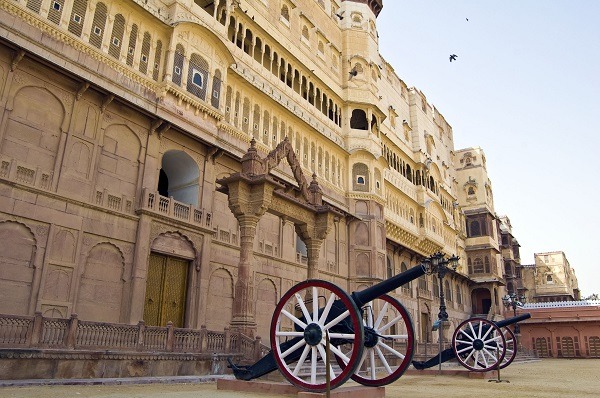
- Junagarh Fort: a 16th-century fortress at Bikaner's heart, palace and decorated inner courtyards.
- Bada Bazaar: the market surrounding the temple, with its red sandstone havelis.
To place these sites in a broader itinerary, consult the Bikaner guide or compare with other Indian places of worship such as the Alchi Monastery in Ladakh.
Frequently asked questions
Frequently asked questions
Plan your trip
The Bhandasar Temple fits naturally into a Rajasthan circuit combining Bikaner, Jaisalmer, and Jodhpur. To create a tailor-made itinerary, explore our India travel suggestions.
Nearby
Interested in this visit?
We can include it in your personalised itinerary.