Raja Ram Temple
Raja Ram Temple
In Orchha, Raja Ram Temple is one of the rare places in India where Rama is venerated as a king. A 16th-century palace converted into a sanctuary.
In Orchha, in the state of Madhya Pradesh, Raja Ram Temple holds a singular place in the Indian religious landscape: Rama is venerated not as an avatar of Vishnu, but as a king (raja). This particularity explains the atmosphere of the sanctuary, where devotees flock throughout the year for a darshan ritual codified as it would be at a sovereign's court.
Why visit Raja Ram Temple
The temple is of interest for several reasons. On the religious plane, it is one of the rare places in India where Rama is honored in his royal form, with a darshan protocol modeled on court etiquette. Architecturally, the structure is actually a palace converted into a sanctuary in the 16th century, which gives it a fortress-like silhouette not found in classical temples of northern India. Finally, the site is part of a remarkable historical ensemble in Orchha, the former Bundela capital, which alone justifies a detour into Madhya Pradesh.
History and founding legend
The temple was built in the 16th century by Raja Madhukar Shah as a gift to his wife. The queen, a devoted follower of Rama, prayed to the deity to appear before her in the form of a child. Moved by her devotion, Rama answered her prayer. The queen brought the idol to Orchha and placed it on a pedestal in the royal palace. When she wished to move it to the Chaturbhuj Temple, then under construction, the statue proved immovable. The palace was therefore converted into a sanctuary, and the Chaturbhuj Temple, which was meant to house the idol, remained without a principal deity.
A belief became attached to the place: a devotee who gazes upon the thumb of Rama's right foot during prayer will see their wish granted.
What you see on site
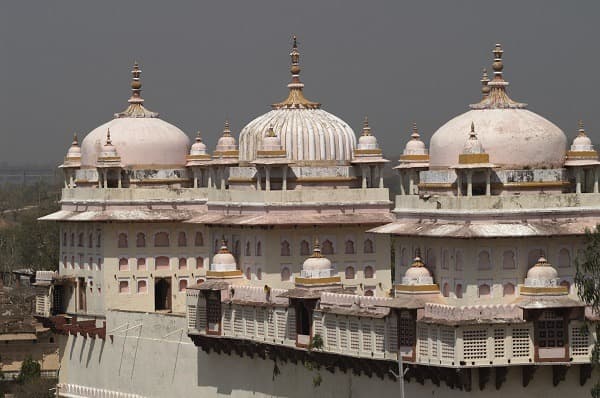
Entry is through a silver door adorned with two elephant heads. On the lintel, an engraving depicts Ganesh, accompanied by a silver emblem representing the sun. The interior preserves the structure of a palace: corridors, courtyards, and a dome whose decoration blends pink and gold tones. The temple's arcades display motifs of varied themes, some secular inherited from the palace's former use, others added at the time of conversion into a sanctuary.
The heart of the temple is the Durbar, the royal audience hall. It is here that the idol of Rama rests in the lotus position. The lord wears a royal turban, a sword in his left hand and a shield in his right hand: an iconography of a sovereign in majesty rather than a meditative deity. At his sides are the idols of Hanuman and Sugreev, faithful companions of Rama in the Ramayana.
The darshan protocol reproduces that of a royal court: changing of the guard, hymns played as for a living monarch, closing of doors during the deity's rest hours.
Practical information
Entry to the temple is free for worship. Modest fees may apply for the use of a camera or video camera; inquire at the entrance, as these conditions change regularly.
The temple is not open continuously: darshans occur in two distinct time slots, one in the morning and one in late afternoon or evening, with hours varying by season. Doors remain closed between the two slots. Check the day's hours before visiting.
Proper dress is required, shoes must be left at the entrance. Photography is often restricted inside the main sanctuary.
When to visit
The period from October to March remains the most comfortable for exploring Orchha, with manageable daytime temperatures. The monsoon, from June to September, complicates travel but offers lush landscapes around the fort.
For those interested in the religious dimension, Ram Navami (March-April, celebrating Rama's birth) is the high point of the year at the temple. Crowds are considerable and the atmosphere very different from a typical visit. Sharad Purnima, in autumn, features nocturnal ceremonies in the sanctuary.
How to get there
The nearest airport is Maharajpur in Gwalior, approximately 112 km away. From Gwalior, taxis and buses reach Orchha in a few hours of travel.
By train, Jhansi station is 13 km from the temple: this is the most practical option, with daily connections from Delhi, Agra, Bhopal, and Khajuraho. Taxis and auto-rickshaws provide connections between the station and Orchha.
By bus, state services serve the city from Shahdol and Bilaspur, as well as from neighboring cities in Madhya Pradesh and Uttar Pradesh.
What to see nearby
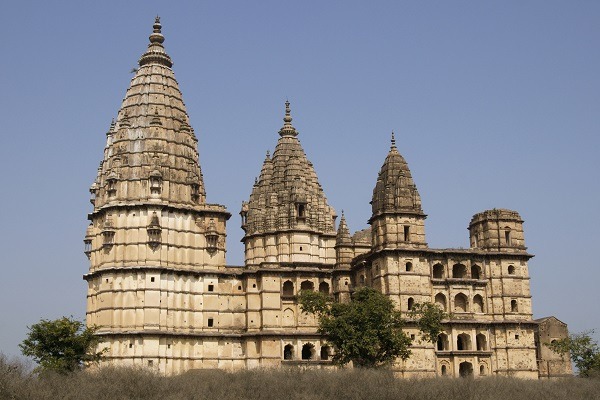
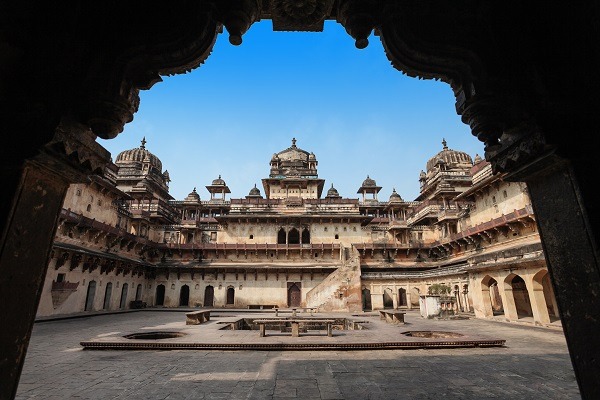
Orchha concentrates exceptional Bundela heritage within short distance of Raja Ram Temple. The Jehangir Mahal, a palace built for the visit of Mughal emperor Jahangir, presents a Mughal-Rajput architectural fusion. The Chhatris, royal cenotaphs aligned along the Betwa river, offer one of the most recognizable silhouettes of Madhya Pradesh. The Chaturbhuj Temple, just beside Raja Ram, deserves a visit for its spectacular vertical architecture and its history linked to the founding legend. The Lakshmi Narayan Temple, on a nearby hill, preserves well-preserved 17th-century frescoes.
Further afield in the state, the State Museum of Bhopal allows you to extend your exploration of regional art.
Frequently asked questions
Frequently asked questions
Including Orchha in your trip
Raja Ram Temple fits naturally into an itinerary combining the Golden Triangle (Delhi-Agra-Jaipur) and Bundela sites in Madhya Pradesh, often extended by the temples of Khajuraho. To build a coherent stay around these stops, consult our India travel suggestions.
Interested in this visit?
We can include it in your personalised itinerary.