Chaturbhuj Mandir
Chaturbhuj Mandir
In Orchha, Chaturbhuj Mandir dedicated to Vishnu blends Hindu temple architecture with Bundela palatial codes, offering panoramic views over the city.
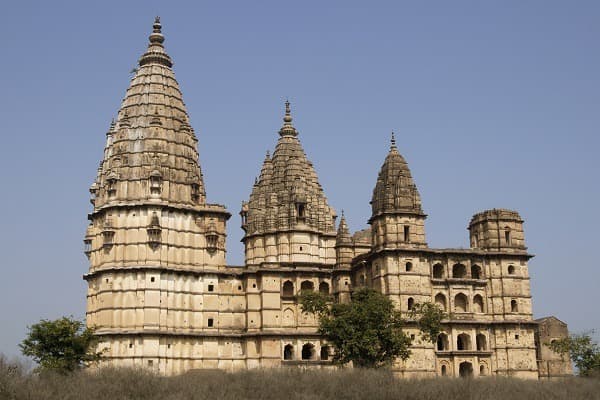
In Orchha, Madhya Pradesh, Chaturbhuj Mandir stands out with its imposing silhouette perched on an elevated platform, facing the Ram Raja Temple. Dedicated to Lord Vishnu, this Bundela sanctuary merges Hindu temple architecture with palatial codes—a rare crossing in northern India.
Why visit Chaturbhuj Mandir
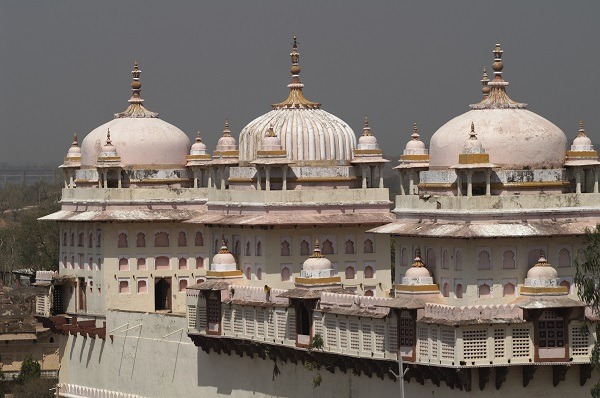
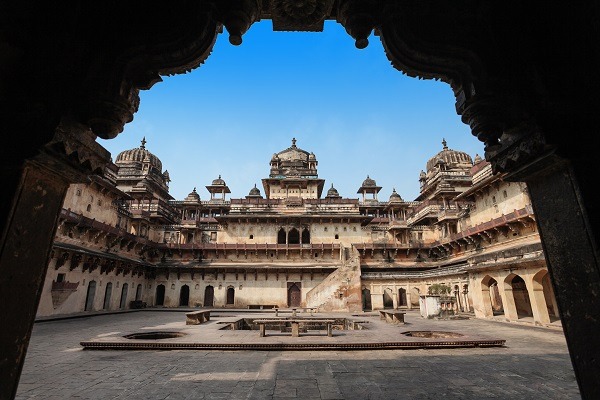
The temple first intrigues through its verticality: its shikhara soars well above Orchha's urban fabric and offers, from its chabutara (elevated platform), one of the clearest vantage points over the Bundela city, its cenotaphs, and the Betwa river. Unlike many contemporary Vishnuite temples, its layout combines sanctuary, vestibule, mandapa, and portico within a spatial language inherited equally from religious architecture and Orchha's royal palaces.
Another singularity: the main sanctuary no longer houses the idol for which it was conceived. The Rama statue, according to local tradition, never left the palace where it had been temporarily placed, giving rise to the neighboring cult of Ram Raja Temple. Chaturbhuj thus remained, in large part, a shrine without its original deity, adding to the particular atmosphere of the place.
History
The name Chaturbhuj is composed of Sanskrit words and literally means "the one with four arms," a direct reference to Vishnu. Its construction was initiated by Raja Madhukar Shah, Bundela sovereign of Orchha, between 1558 and 1573, in honor of his wife Rani Ganeshkuwari, a devotee of Rama. The edifice was completed in the early 17th century by his son Vir Singh Deo (who reigned from 1605 to 1627), under whose rule Orchha reached its architectural zenith.
The temple is also known locally as the Jatakari temple. It forms part of the monumental complex that made Orchha a major Bundela capital in the 16th and 17th centuries, before the court shifted its center of power.
What to see on site
The temple layout is organized around a sanctuary crowned with a pancharatha shikhara—a tower with five vertical projections—preceded by a vestibule, a mandapa (hypostyle hall), and an entrance portico. The ensemble sits upon a chabutara that isolates the temple from ground level and requires climbing a steep staircase.
The exterior façade is elaborately worked: lotus motifs, vegetal friezes, and sculptures of Hindu deities punctuate the walls. Inside, the contrast is striking: the walls are nearly bare, lacking the sculptural or painted iconographic program one might expect. Within the sanctuary is preserved a Vishnu idol approximately 2.7 meters in height.
Plan to climb to the accessible upper levels: the view onto the neighboring Ram Raja Temple, the Jahangir Mahal, and the cenotaphs along the Betwa justifies the visit alone. Allow 45 minutes to 1 hour on site.
Practical information
The temple is accessible free of charge, typically in the morning and late afternoon, in alignment with Orchha's worship rhythms. Visitor numbers peak in late morning. Clothing covering shoulders and knees is expected, and shoes must be removed before entering the sanctuary.
A local guide—easy to find on-site or through your accommodation—adds genuine value in deciphering the iconography, layout, and connection between Chaturbhuj and Ram Raja. Lighting is limited indoors: bring a headlamp or use your phone's flashlight to observe sculptural details.
When to visit
The best period to visit Orchha extends from October to March, with pleasant temperatures and clear skies that showcase the temple's red stone. From April to June, Madhya Pradesh's heat becomes challenging (often exceeding 40°C). The monsoon, from July to September, brings softer light and lush vegetation, but showers can disrupt visits.
How to get there
Orchha is an easy stop to integrate along the Delhi–Khajuraho axis. The nearest railway station is Jhansi, about fifteen kilometers away, well-connected to Delhi, Agra, Gwalior, and Bhopal by fast trains. Allow around twenty minutes by taxi or auto-rickshaw between Jhansi and Orchha.
The nearest airport is Gwalior, approximately 120 km away, served by flights from Delhi and Bhopal. Once in Orchha, Chaturbhuj Mandir is reachable on foot from most central accommodations, or by rickshaw.
Nearby attractions
Orchha concentrates several Bundela sites within short distance of one another: the Ram Raja Temple, just opposite, where the Rama idol originally destined for Chaturbhuj is said to have been relocated; the Jahangir Mahal, a palace at the intersection of Mughal and Rajput influences; and the royal cenotaphs aligned along the Betwa riverbanks.
To extend a Madhya Pradesh itinerary, the Bhopal State Museum offers excellent context on regional archaeology and sculpture. Further north, you'll encounter other facets of monumental India such as the Alchi Monastery in Ladakh or Amar Sagar Lake in Rajasthan.
Frequently asked questions
Frequently asked questions
Integrating Orchha into your itinerary
Orchha fits naturally into a circuit connecting Delhi, Agra, Khajuraho, and Varanasi. To plan a tailor-made journey including Chaturbhuj Mandir and the Bundela sites, explore our trips to India.
Interested in this visit?
We can include it in your personalised itinerary.