Chaumukha Temple
Chaumukha Temple
A Jain sanctuary in Ranakpur (Rajasthan), Chaumukha Temple features 1,444 intricately carved marble pillars and four-faced architecture dedicated to Adinatha.
Chaumukha Temple, more widely known as Ranakpur Temple, ranks among Rajasthan's most significant Jain sanctuaries. Dedicated to Rishabha (Adinatha), the founder of Jainism, it stands out for its four-faced structure, its 1,444 marble pillars—each one unique—and the fineness of its sculptural work. The site lies in Ranakpur, within Pali district, at the heart of the Aravalli hills, roughly 90 kilometers northwest of Udaipur.
Why Visit Chaumukha Temple
The temple counts among the finest achievements of white marble Jain architecture. Its appeal rests on three elements: the quality of carved work on each pillar, the harmony of a symmetrical four-entrance layout, and a setting preserved in open countryside. Unlike other, busier Jain sanctuaries, Ranakpur retains an atmosphere of contemplation, partly thanks to restricted visitor access outside worship hours.
The visual effect is striking: depending on the sun's angle, the pillars shift from a golden hue to pale blue, giving the entire structure a luminosity that changes throughout the day.
History
The temple's earliest structures are believed to date to the 11th century under King Kumarapala of the Solanki dynasty. These buildings were largely destroyed by Muslim invasions in the 13th century.
Reconstruction as it stands today began in the early 15th century. According to tradition, Dhanna Shah, a merchant from Ghanerao, initiated the project following a dream. The work received backing from Rana Kumbha, the Mewar ruler, and was entrusted to Deepaka, a renowned builder of the period. The story of this foundation is carved into copper plaques still preserved within the temple complex.
Over the centuries, Chaumukha has become one of the five major Jain pilgrimage sites (Pancha Tirtha) and among Rajasthan's most visited sanctuaries.
What to See On Site
The Four-Faced Layout
The name Chaumukha means "four faces." The structure revolves around a central sanctum housing four statues of Adinatha, each facing a cardinal direction. Four monumental doorways lead to the main hall, each serving distinct ritual chambers.
The 1,444 Pillars
Every single one different from the next, the white marble pillars form the temple's signature feature. Carved patterns blend divine figures, dancers, plant friezes, and scenes from Jain cosmology. No pillar obstructs the view of the central statues—a remarkable feat for a structure of this scale.
Domes, Shikaras and Vaults
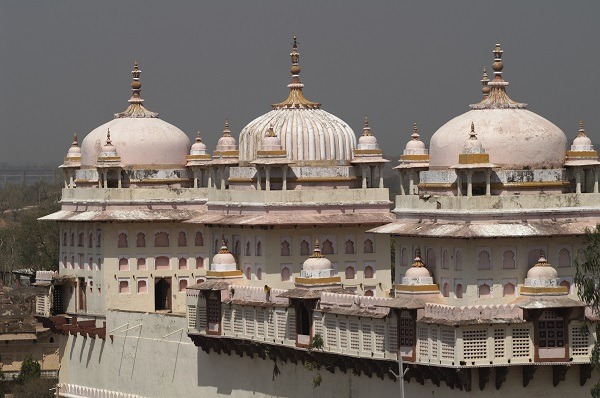
The exterior layers domes, turrets, shikaras, and vaults. The whole is crafted in pale marble, which explains the building's luminosity when viewed from the surrounding hills.
Secondary Sanctuaries
The complex houses several smaller but architecturally significant buildings: the temples of Parsavanath, Amba Mata, and Surya, along with other minor Chaumukha shrines. They enrich the visit and testify to the site's rich iconographic heritage.
Practical Information
The temple is open year-round. Non-practitioners are admitted only in early afternoon, after worship hours reserved for devotees: plan your visit for mid-day. Entry is charged for foreign visitors, and an additional fee may apply for photography. Allow 1 to 2 hours to explore the complex at a leisurely pace.
Dress covering the shoulders and knees is required, and leather items (belts, bags) must be left at the entrance, in keeping with Jain principles.
When to Visit
The best period runs from October through March, when Rajasthan's temperatures are manageable—cool in the morning and mild in the afternoon. April through June brings intense heat, making sightseeing challenging. The monsoon, from July to September, brings some relief and greens the Aravalli slopes, but rain can complicate road travel.
How to Get There
Ranakpur is most easily reached from Udaipur, a city situated roughly 90 kilometers to the southeast. The private taxi journey typically takes two to three hours. Buses also connect Udaipur to Ranakpur, though with less frequent service.
The nearest airport is Udaipur's (Maharana Pratap), at the same distance as the city. By rail, Falna station on the Ahmedabad-Delhi line provides the most convenient rail access, approximately one hour's drive from the temple.
Nearby Attractions
The area surrounding Ranakpur allows you to extend your visit with other Rajasthan sites and beyond. Travelers often combine the stop with Udaipur, Kumbhalgarh Fort (UNESCO-listed, roughly 50 kilometers away), and Aravalli landscapes. For those continuing their journey through India, several complementary destinations warrant a detour, such as the State Museum in Bhopal in central India, the Basilica of Bom Jesus in Goa on the west coast, or the shores of the Beas River in Himachal Pradesh.
Frequently Asked Questions
Frequently asked questions
The temple sits in Ranakpur, within Pali district, Rajasthan, in the Aravalli range, approximately 90 kilometers northwest of Udaipur. It should not be confused with the Jain site of Palitana, located in Gujarat.
It is consecrated to Rishabha, also known as Adinatha, the first of the 24 Tirthankaras and founder of Jainism.
The precise number ties to the sacred symbolism of Jain cosmology. Each is carved uniquely, constituting one of the site's major technical achievements.
Yes, non-practitioner visitors are admitted during public opening hours, typically in early afternoon. Mornings are reserved for rituals.
Plan for 1 to 2 hours to explore the main building and secondary sanctuaries. Architecture enthusiasts often linger considerably longer.
Include Ranakpur in Your Journey
Chaumukha Temple fits naturally into a Rajasthan circuit, between Udaipur, Kumbhalgarh, and Jodhpur. To build a tailor-made itinerary incorporating this architectural landmark, consult our India tours.
Interested in this visit?
We can include it in your personalised itinerary.