Chennakesava Temple
Chennakesava Temple
12th-century Hoysala temple in Belur, inscribed by UNESCO in 2023. Star-shaped plan, steatite carvings, and celestial maidens (madanikas) are its hallmarks.
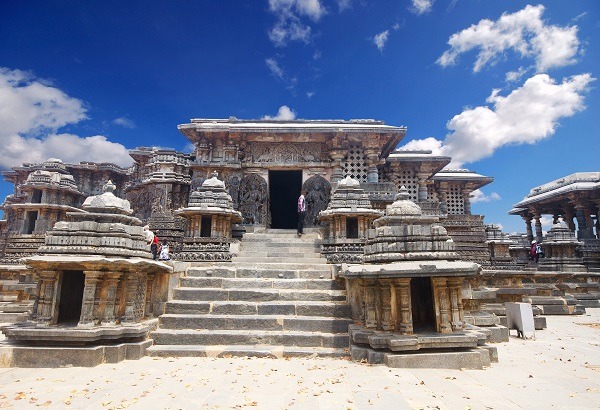
The Chennakesava Temple has stood in Belur, in the state of Karnataka, for over 900 years. Built during the reign of King Vishnuvardhana of the Hoysala dynasty, it is dedicated to Vishnu in his form as Chennakesava, which means "the beautiful Kesava." Inscribed in 2023 as a UNESCO World Heritage site as part of the Sacred Ensembles of the Hoysalas, the sanctuary concentrates on its star-shaped platform one of the densest sculptural programmes of medieval Hindu art.
Why Visit Chennakesava Temple
Three qualities make this temple singular in the landscape of Indian sanctuaries. First, its sculptural density: approximately 80 large sculptures cover the exterior walls, complemented by continuous friezes of elephants, lions, and mythological scenes. Second, its technique: soapstone, or steatite, soft at first and hardening over time, allowed Hoysala artisans to achieve a level of refinement rarely matched in India. Finally, its recent UNESCO status (2023) places it within a coherent ensemble alongside the neighbouring temples of Halebidu and Somanathapura.
History of the Temple
Commissioned in 1117 by King Vishnuvardhana, the temple is believed to have been built to commemorate his victory over the Cholas, or to mark his conversion to Vaishnavism under the influence of philosopher Ramanujacharya—both hypotheses coexist in historical sources. Construction spanned 103 years, crossing three generations of Hoysala kings and artisans. The work site survived successive raids and invasions that struck the region from the 14th century onwards.
It was precisely during this period, under Vijayanagar rule, that the entrance gopura was added, in a style distinct from that of the original sanctuary. This layering of eras is now integral to the complex's identity. Belur remains an active place of worship: it is not an archaeological ruin, but a functioning temple where daily rituals continue.
What to See
General Architecture
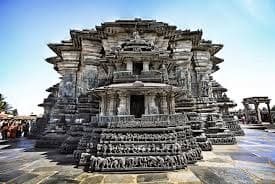
The temple rests on an elevated platform called the Jagati, surrounded by a boundary wall or Prakara. The plan adopts a star-shaped form characteristic of the Karnataka Dravida style, with zigzagging walls that multiply viewpoints and create shifting patterns of shadow throughout the day. The main sanctuary is organised into three spaces: the Navaranga Mandapa (columned hall), the Sukanasi (vestibule), and the Garbhagriha (inner sanctum) containing the statue of Chennakesava.
The Madanikas
On the corbels of the Mandapa, a series of celestial female figures, the madanikas, are carved in high relief. Each holds a different attribute: a fan, mirror, or parrot. These figures rank among the temple's most photographed elements and illustrate the mastery of Hoysala artisans in rendering movement and fabric.
Wall Sculptures and Friezes
The exterior walls bear approximately 80 large sculptures drawn from the Mahabharata, Ramayana, and Puranas. Notable scenes include Harihara accompanied by Nandi, Shiva subduing the demon Jalandhara, a depiction of Kali, and Arjuna aiming at the fish during the trial of Draupadi's Swayamvara. The lower friezes follow a symbolic logic: elephants at the base evoke strength, lions at the upper register convey courage.
Remarkable Pillars
Inside the Mandapa, each column is carved differently. Two pillars draw particular attention: the Narasimha pillar, covered with miniature figurines, and the Mohini pillar, whose refinement serves as a benchmark for Hoysala artistry.
Sub-temples and Annexes
The complex extends beyond the central sanctuary. The temple of Kappe Chennigaraya, commissioned by Queen Shantaladevi, faces it. Nearby stand the more modest sanctuaries of Saumyanayaki and Vajranarayana, as well as a shrine dedicated to Andal, a Tamil poetess of the bhakti movement. Outside, a ritual well (Pushkarani) and a large sculpture of Garuda, Vishnu's mount, complete the ensemble.
Practical Information
- Admission: free entry; a modest fee applies for photography and parking.
- Duration: allow approximately 2 hours to tour the exterior sculptures and inner sanctuaries.
- Dress code: shoulders and legs covered are recommended, as the temple remains an active place of worship.
- Hours: open daily from early morning until evening; morning and late afternoon rituals are the busiest times.
When to Visit
The most comfortable period runs from November to February: temperatures remain moderate on the Karnataka plateau and rainfall is rare. The monsoon, from June to September, makes the surrounding vegetation lush but can complicate travel from the coast. Vaishnava festivals, notably the Rathotsava (chariot procession) in spring, are highlights worth checking locally before planning your visit.
How to Get There
- By air: the nearest airport is Mangalore, approximately 130 km away. Bangalore, further afield (around 222 km), offers more international connections.
- By train: the closest railway stations are Chikmagalur (22 km) and Hassan (32 km), both well connected to the rest of Karnataka.
- By bus: Belur is served by regular connections from Mangalore, Mysore, Bangalore, Chikmagalur, and Hassan.
Nearby Attractions
The temple fits naturally into a circuit embracing other Hoysala sites and several regional cultural destinations. The town of Belur itself merits exploration beyond the main sanctuary. To further explore India's heritage, the State Museum in Bhopal provides contextual insight into the religious art of the subcontinent, while the Alchi monastery illustrates a different architectural tradition—Buddhist this time—in the country's north.
Frequently Asked Questions
Frequently asked questions
Include the Temple in Your Trip
Chennakesava Temple fits naturally into an itinerary dedicated to Hoysala art and Karnataka's heritage. To build a custom itinerary incorporating Belur, Halebidu, and other southern India sites, consult our suggestions for journeys through India.
Interested in this visit?
We can include it in your personalised itinerary.