Jahangir Mahal
Jahangir Mahal
A 17th-century Bundela palace built to welcome Emperor Jahangir, Jahangir Mahal dominates Orchha's fortified complex with its domes and chhatris.
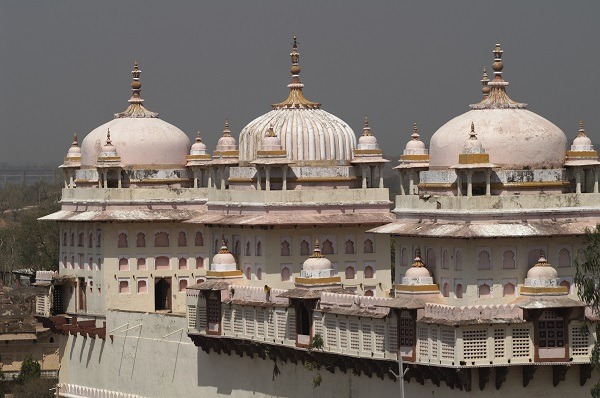
Built at the turn of the 16th and 17th centuries within Orchha's fortified complex, the Jahangir Mahal exemplifies the meeting point between the Rajput architecture of the Bundela and the codes of Mughal art. Constructed to welcome Emperor Jahangir, it combines defensive function, princely residence, and political statement.
Why visit Jahangir Mahal
- An emblematic Bundela palace, symbol of the alliance with the Mughal empire in the 17th century.
- Composite architecture: corner towers with domes, chhatris, latticed windows (jali) and elephant-trunk consoles.
- More than two hundred rooms spread across three levels, with a significant proportion of underground chambers.
- Terraces overlooking the Betwa valley and Orchha's entire monumental complex.
History
Jahangir Mahal was built under the reign of Bir Singh Deo, one of the most active sovereigns of the Bundela dynasty. It was constructed to welcome the Mughal emperor Jahangir during his visit to Orchha. Local tradition holds that the emperor stayed there for only a single night. Beyond the anecdote, the palace served as a political symbol intended to materialize the alliance between the Bundela and Mughal power.
Stonemason marks found on the building suggest that work began in the late 16th century, before being completed under Bir Singh Deo. Both citadel and residence, the palace illustrates the fusion of Mughal and local elements that would herald the distinctly Bundela style.
What to see
The Hindola Dwar gateway
Entry is through the eastern gateway named Hindola Dwar. Two sculpted elephants guard its entrance and recall the symbolic and defensive function of the place. The overall plan is square, spanning three levels, and contains more than two hundred rooms, a large proportion of which are underground.
Exterior architecture
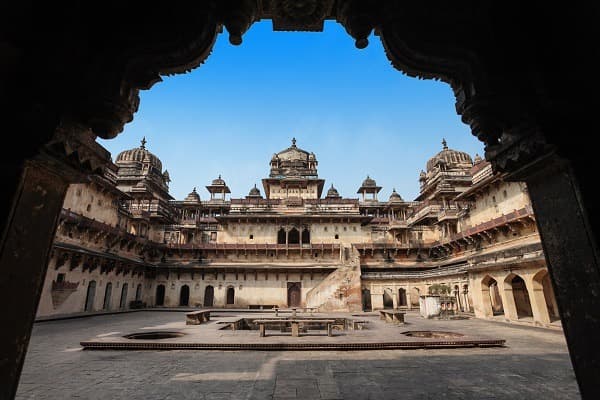
The palace distinguishes itself through corner towers crowned with domes, superimposed terraces, and chhatris. The walls were once covered in turquoise tiles, a few fragments of which remain. Its elevated position allowed surveillance of the Betwa valley, and several locations were designed to accommodate cannons.
Central courtyard and galleries
The square inner courtyard distributes light and air to the apartments. The corbelled galleries, supported by elephant-trunk-shaped consoles, are punctuated by latticed windows (jali) that filter light into the rooms.
The palace's functions
Each corner tower served a specific purpose:
- Northeast tower: prayer room.
- Southeast tower: kitchen.
- Northwest tower: treasury.
- Southwest tower: gymnasium.
An underground reservoir ensured water supply in case of siege. The vaulted rooms served as storage and provided refuge during the region's extremely hot summers.
Practical information
Jahangir Mahal is open from sunrise to sunset. Access is included in a combined ticket with Orchha Fort, which also covers several monuments within the complex. Plan for approximately 1.5 to 2 hours to explore the palace while taking time to visit the terraces and lower levels. As fares and opening hours change regularly, it's best to verify them on site before your visit.
When to visit
Orchha experiences a continental climate. The most pleasant period extends from October to March, with dry days and comfortable temperatures for walking. The months of April to June are scorching and poorly suited to extended outdoor visits. The monsoon, from July to September, can make terraces slippery but offers lush vegetation around the Betwa.
How to get there
The palace is located in the Orchha fortified complex and is accessible on foot from the town center. Local rickshaws serve the fort entrance if you prefer to avoid walking.
The most convenient railway station is Jhansi, located about fifteen kilometers away and connected to the main Indian rail network. The nearest airports are Gwalior and Khajuraho, which allow you to reach the region before continuing by road.
Nearby
Orchha preserves several monuments worth including in the same circuit as Jahangir Mahal:
- The Raj Mahal, the former royal palace known for its religiously-inspired murals.
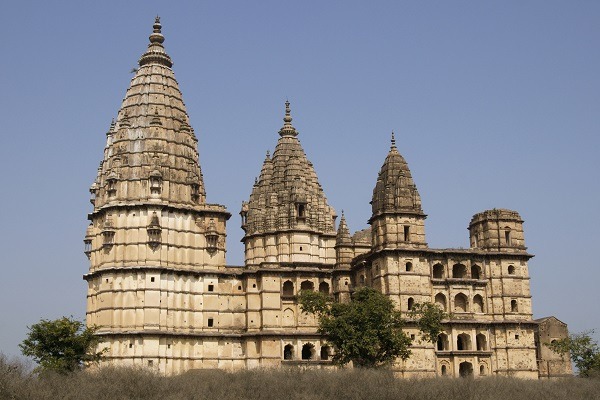
- The Chaturbhuj temple, whose imposing shikhara dominates the town.
- The Ram Raja Temple, where Rama is revered as king rather than as god.
- The cenotaphs (chhatris) of Bundela sovereigns aligned on the banks of the Betwa.
Frequently asked questions
Frequently asked questions
Both palaces belong to the same fortified complex. Raj Mahal, the earlier of the two, was the royal residence of the Bundela and preserves remarkable murals. Jahangir Mahal, built under Bir Singh Deo, was designed to welcome Mughal emperor Jahangir and marks the Bundela-Mughal alliance, with more monumental and composite architecture.
Yes, access to Jahangir Mahal is included in the combined Orchha Fort ticket, which also provides access to several other buildings in the complex, such as Raj Mahal and Rai Praveen Mahal.
Plan for approximately 1.5 to 2 hours for Jahangir Mahal alone, more if you combine it with the other fort monuments. A half-day allows you to cover the entire complex without rushing.
Organize your trip
Jahangir Mahal fits naturally into an itinerary through central India, between Khajuraho and Gwalior. To prepare your tailor-made stay, consult our India trips.
Interested in this visit?
We can include it in your personalised itinerary.