Rashtrapati Bhavan
Official residence of India's President, Rashtrapati Bhavan blends European classical architecture with Mughal motifs across 340 rooms. Its Mughal gardens open each year during the flowering season.
Rashtrapati Bhavan is the official residence of the President of India, located in New Delhi. Designed by Edwin Lutyens and completed in 1929, this red sandstone palace merges European classical architecture with Mughal motifs. With its 340 rooms, Mughal gardens, and central dome inspired by Rome's Pantheon, it remains one of the world's most imposing government buildings. A portion of the estate is open to the public.
Practical Information at a Glance
- Public Access: visits by online reservation through the official Indian government portal; places are limited and sell out quickly.
- Mughal Gardens (Amrit Udyan): open to the public for a few weeks per year, typically February–March (flowering season).
- Dress Code: smart dress required; bags and cameras may be subject to inspection.
- Recommended Duration: 1.5 to 2 hours for the guided tour of the palace and gardens.
- Accessibility: partially accessible; inquire when making your reservation.
- Transport: Udyog Bhawan metro station (Yellow Line) nearby; taxis and auto-rickshaws available.
What You'll See
The palace is organized around a central dome standing 29 meters high, visible from Kartavya Path (formerly Rajpath). The interior comprises state rooms, galleries, and ceremonial reception spaces. The Mughal gardens, renamed Amrit Udyan in 2023, extend across several hectares with fountains, geometric flowerbeds, and hundreds of varieties of roses and tulips.
History and Context
Construction began in 1912 following the transfer of the British capital from Calcutta to Delhi. Architect Edwin Lutyens collaborated with Herbert Baker to design New Delhi. The building, then called Viceroy's House, became the residence of the Viceroy of India. At independence in 1947, it was transferred to India's first President, Rajendra Prasad, and took its present name.
Lutyens's stylistic choice was deliberate: to impose British power while incorporating elements of classical Indian architecture—domes, chhatris (domed pavilions), and Mughal decorative friezes—to legitimize colonial presence in the eyes of the local population.
Highlights of the Visit
The Dome and Main Façade
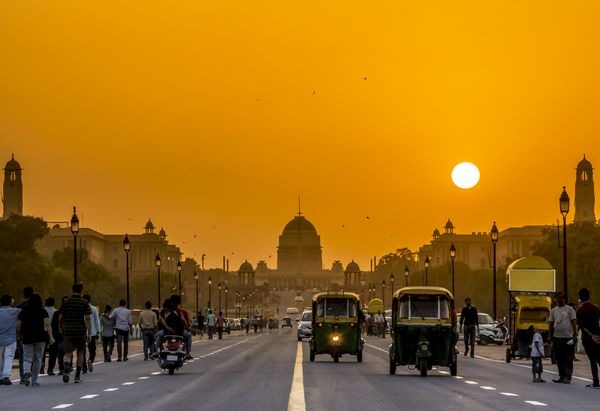
The western façade, facing Kartavya Path, offers the most photographed perspective. The central dome, flanked by Corinthian columns and chhatris, illustrates the architectural synthesis Lutyens intended. The view from the base of the avenue in late afternoon is particularly striking.
The Mughal Gardens (Amrit Udyan)
Open to the public each year during the flowering season, these gardens are designed according to Mughal garden principles: strict symmetry, water channels, and tiered terraces. Over 70 varieties of roses are cultivated here, along with tulips imported from the Netherlands.
The Durbar Hall
During authorized guided tours, the Durbar Hall—the former viceregal reception room—impresses with its marble columns and proportions. This is where certain official ceremonies of the Indian state are held.
Etiquette and Visiting Rules
- Online reservation is mandatory; no walk-in visits are permitted.
- Valid identification required at entry.
- Mobile phones are generally permitted for photography in public areas; verify restrictions when booking.
- Respect marked boundaries: certain wings remain the active residence of the President and are off-limits.
- Smart dress required; avoid shorts and overly casual attire.
Photography Tips
Golden late-afternoon light from Kartavya Path enhances the red sandstone façade. For the gardens, morning offers soft light across the flowerbeds. Indoors, lighting conditions vary by room; a fast lens is recommended.
Location and Access
Rashtrapati Bhavan stands at the western end of Kartavya Path (formerly Rajpath), New Delhi's ceremonial axis connecting the palace to the India Gate. The Lutyens' Delhi district houses government institutions and embassies.
- Metro: Udyog Bhawan station (Yellow Line / Central Secretariat) a few minutes' walk away.
- By Taxi/Auto-Rickshaw: accessible from central New Delhi in 15 to 30 minutes depending on traffic.
- Accessibility: partial access; contact the visits office for specific arrangements.
Nearby Attractions
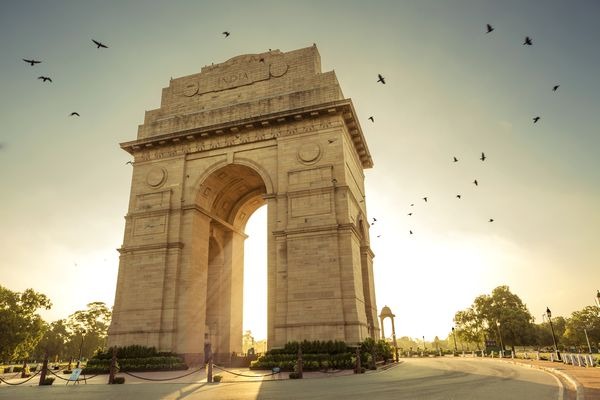
- India Gate — World War I memorial at the opposite end of Kartavya Path.
- Sansad Bhavan (Parliament) — circular building designed by Herbert Baker, immediately adjacent to the presidential palace.
- Jantar Mantar — 18th-century astronomical observation site, a few kilometers to the east.
- Connaught Place — colonial shopping and architectural hub, the nerve center of modern New Delhi.
Frequently asked questions
Visits are booked exclusively online through the official Indian government portal. Slots are limited and often sell out quickly; reserve several days in advance. Valid identification is required at entry.
The Amrit Udyan gardens typically open for a few weeks in February–March during the rose and tulip flowering season. Exact dates vary each year; check the official announcement before your visit.
Visits are organized in guided groups according to set time slots. Self-guided exploration of the palace interior is not available; the gardens may be explored more freely during their opening period.
Cameras and mobile phones are generally permitted in public areas and gardens. Certain interior rooms may have specific restrictions; inquire when booking or with the guide on-site.
The palace sits at the end of Kartavya Path. A stroll to India Gate allows you to see both sites in half a day. Parliament (Sansad Bhavan) is an immediate neighbor. Jantar Mantar and Connaught Place are accessible by metro or on foot.
Smart dress is required: avoid shorts, tank tops, and overly casual attire. This is not a place of worship but an official state residence; neat presentation is expected.
Nearby
Interested in this visit?
We can include it in your personalised itinerary.