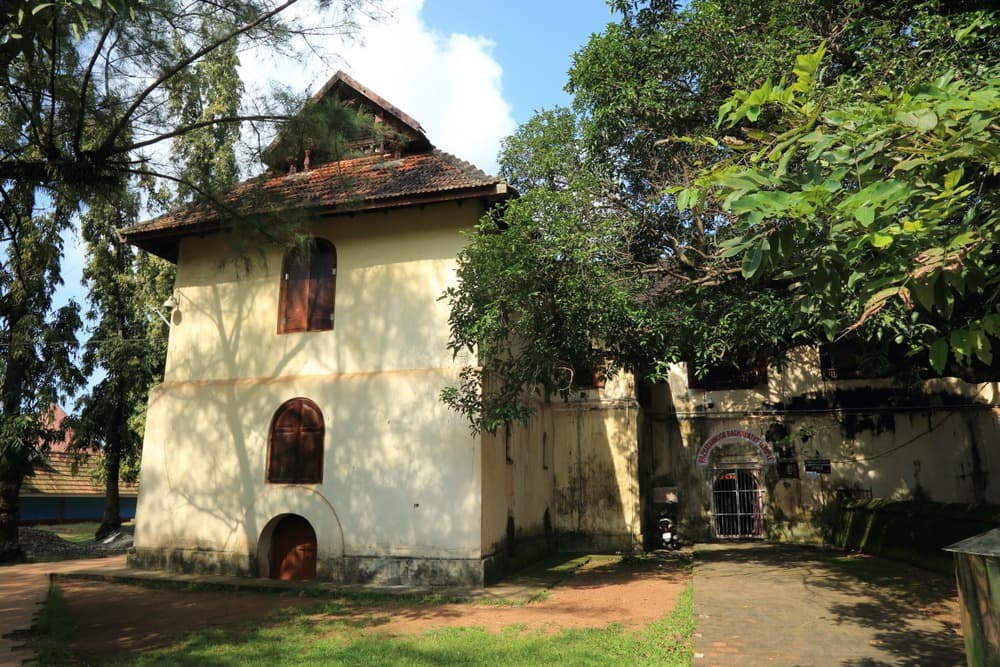
Mattancherry Palace
Mattancherry Palace
Built by the Portuguese in 1555 and renovated by the Dutch, Mattancherry Palace in Cochin houses 16th-century Hindu frescoes.
Mattancherry Palace, also known as the Dutch Palace, stands as one of the major historical monuments of Cochin (Kochi). Built in the 16th century by the Portuguese and later modified by the Dutch, it now houses a museum managed by the Archaeological Survey of India, renowned for its Hindu mural frescoes among the oldest in Kerala.
Why visit Mattancherry Palace
The palace holds multiple appeals for visitors interested in the history and art of South India:
- Mural frescoes from the 16th to 18th centuries depicting the Ramayana, episodes of Krishna Lila and Shivaite scenes
- Quadrangular architecture in Nalukettu style blending Kerala traditions with European touches
- A museum collection spanning the regalia of Cochin's rajas, the martial art Kalaripayat and the Dutch occupation
- A central location in Mattancherry's heritage quarter, in immediate proximity to the Jewish quarter and spice warehouses
History of the palace
The palace was erected by the Portuguese in 1555 as a gift to the king of Cochin, in the context of a defensive alliance against the Zamorins of Calicut. A century later, in 1663, the Dutch drove out the Portuguese, took control of the Malabar coast and undertook major renovation work. This episode gave rise to the name Dutch Palace, still widely used today.
The rajas of Cochin subsequently pursued several interior renovation campaigns, notably mural painting programs. The building was listed as a protected monument in 1951. A major restoration operation conducted around 2007 brought the structure up to international museum standards and reorganized the collections according to a coherent museographic pathway.
What to see on site
Architecture and central courtyard
The structure is organized around a central courtyard, following the quadrangular plan of the Nalukettu, typical of domestic architecture in Kerala. The general lines (gabled roofs, wooden frameworks, columned galleries) remain local, enhanced by a few elements of European inspiration inherited from successive occupations. At the center of the courtyard stands a temple dedicated to Pazhayannur Bhagavati, protective goddess of the Cochin royal family. Two other small sanctuaries, dedicated to Krishna and Shiva, frame the whole.
The dining room deserves particular attention: its sculpted wooden ceiling is enhanced with a series of brass cups, and its flooring imitates polished black marble. It is in fact a traditional coating composed of burned coconut shells mixed with local materials — a technique characteristic of Kerala.
The king's chamber (Palliyara)
Located in the southwest corner, to the left of the entrance, the Palliyara measures approximately 300 m² and preserves 48 paintings of the Ramayana dated to the 16th century. These are the palace's oldest frescoes. Several panels also represent scenes of Krishna Lila. The ensemble is traditionally attributed to the inspiration of Veera Kerala Verma.
Coronation hall and Kovinithalam
Arranged by the Dutch on the upper floor, the coronation hall is lined with frescoes depicting Lakshmi on a lotus, Vishnu asleep on the serpent Ananta, Shiva and Parvati as Ardhanariswara, the coronation of Rama and Krishna lifting Mount Govardhana. Facing it, the stairwell Kovinithalam preserves four 18th-century canvases representing Shiva, Vishnu, Devi, and a panel inspired by Kalidasa's Kumarasambhava.
Raja Gallery and weapons room
The Raja Gallery displays full-length portraits of Cochin's sovereigns, staged in a way that embraces European portrait conventions. At the center stands a remarkable 18th-century ivory palanquin. The weapons room, further on, exhibits the Vala sword, a series of Cinquedea and several panels devoted to Kalaripayat, Kerala's traditional martial art.
Royal chamber
This section presents the garments, liturgical equipment and kitchen implements of the royal household. It also displays photographs of the royal family taken between 1880 and 1920, which document traditional costumes and their evolution over four decades.
Practical information
- Management: Archaeological Survey of India
- Opening days: open daily except Friday (verify on site, closures on Indian national holidays)
- Admission: modest entry fee, free for young children
- Photography: strictly forbidden inside, actively monitored by staff
- Visit duration: plan approximately 1 to 1.5 hours to tour all galleries
The museum pathway presents itself as a loop ending with the two mural painting rooms occupying the upper floor. Bring shoes easy to remove, as access to certain areas requires walking barefoot.
How to get there
The palace is located in the Mattancherry quarter, on Cochin's peninsula. Ernakulam railway station, approximately 10 km away, is the main arrival point for visitors coming from outside. From there, several options are available:
- Auto-rickshaw (tuk-tuk): the most common mode for short distances within the city
- Public ferry: from Fort Kochi or Ernakulam ferry terminal, a quick crossing reaches Mattancherry — the most scenic option
- Taxi or ride-hailing: via local apps, convenient for combining multiple visits to the heritage quarter
Nearby attractions
A visit to the palace naturally fits into a broader circuit across the subcontinent:
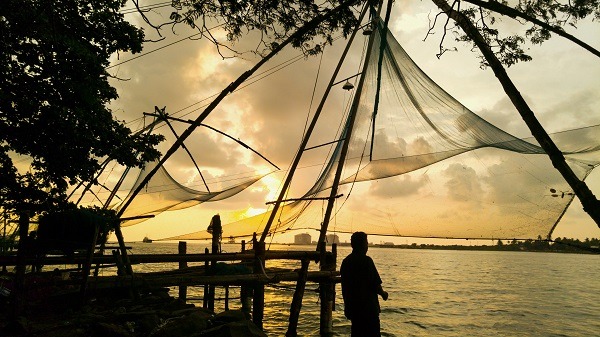
- Cochin (Kochi) — Jewish quarter, Chinese fishing nets, Fort Kochi
- Anjengo Fort — colonial trading post in South Kerala
- Bangalore Palace — royal residence with Tudor inspiration in Karnataka
- State Museum Bhopal — archaeological collections of Madhya Pradesh
Frequently asked questions
Frequently asked questions
Built by the Portuguese in 1555, the structure was significantly renovated by the Dutch after they took control of Cochin in 1663. It is these Dutch works that left a lasting mark on the palace's identity and gave rise to its nickname.
No. Photography is strictly prohibited in all galleries to preserve the frescoes. Staff actively monitor compliance with this rule.
Plan between 1 and 1.5 hours to tour the entire museum, longer if you wish to take time observing each fresco in detail.
Yes. Mattancherry is adjacent to Fort Kochi: it is easily reached by auto-rickshaw, taxi or public ferry, the latter offering a pleasant crossing of urban backwaters.
The palace is usually open daily except Friday, with occasional closures on certain national holidays. Check the calendar with the Archaeological Survey of India before traveling.
Planning your trip
Mattancherry Palace integrates perfectly into an itinerary combining Kerala with other regions of the subcontinent. To build your tailor-made journey, consult our travel suggestions for India and adapt the route to your interests.
Interested in this visit?
We can include it in your personalised itinerary.