Ramnagar Fort
Ramnagar Fort
An 18th-century princely residence on the eastern bank of the Ganges, Ramnagar Fort houses a rich museum of weapons, costumes and palanquins, and hosts the Ramlila of Varanasi.
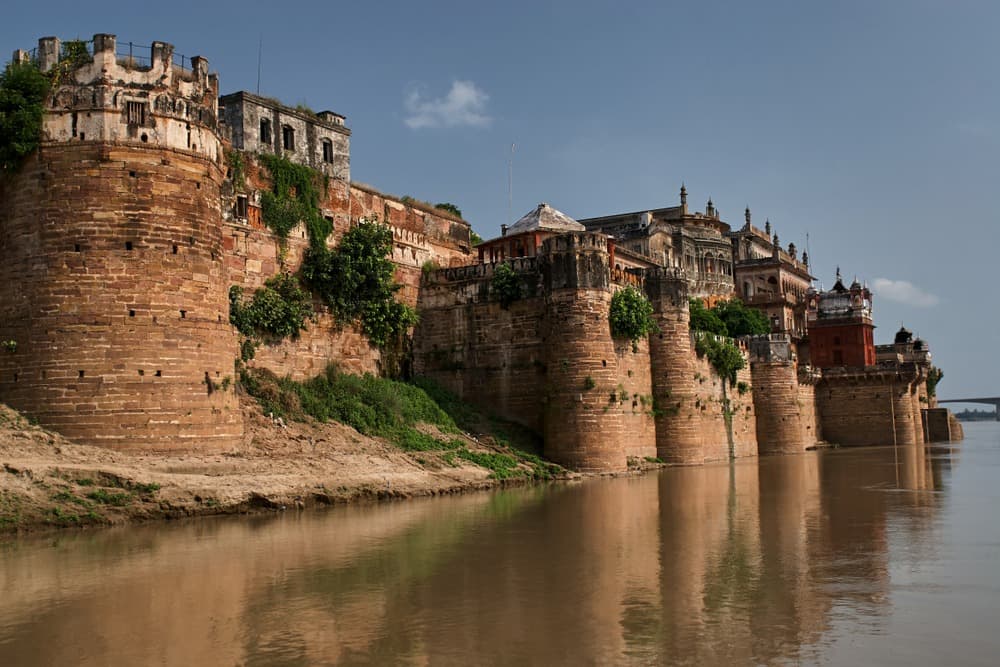
On the eastern bank of the Ganges, opposite Tulsi Ghat, Ramnagar Fort has dominated the riverbank since the mid-18th century. This princely residence, still inhabited by the Maharaja of Varanasi's family, combines Mughal architecture, a private museum and a festival calendar linked to the Ramayana. Located on the southeast edge of Varanasi, it makes for a distinct detour from the sacred ghats of the old city.
Why visit Ramnagar Fort
The site holds three complementary appeals. First, it is an active princely palace: Maharaja Anant Narayan Singh resides here, and a flag raised on the ramparts signals his presence. Second, it is a museum, Saraswati Bhawan, whose collections of weapons, palanquins, silk costumes and antique timepieces offer a rare glimpse into the culture of princely courts in northern India. Finally, it is a vibrant hub of Hindu festivals, particularly the Ramlila of Ramnagar, one of India's oldest surviving theatrical performances of the Ramayana.
History of the fort
The fort was built in 1750 by Kashi Naresh Raja Singh Balwant, the first ruler of the Varanasi dynasty. Inscriptions still legible on the ramparts confirm this 18th-century construction. The structure was placed on elevated ground to protect it from Ganges floods, which can be substantial during the monsoon.
Following India's independence and the abolition of princely privileges in 1971, the Maharaja title was retained as an honorary distinction. The royal family continues to occupy part of the complex, which is why only certain wings are accessible to visitors.
What to see on site
The architecture of the complex
The fort is entirely built of red sandstone, with a façade painted in cream, in a Mughal architectural style characteristic of northern India. The whole structure unfolds around interior courtyards, sculpted balconies and pavilions. Two white towers, accessible by a staircase leading to a vault, open onto the interior courtyards. The Maharaja's private residence occupies one side; the Durbar hall and reception rooms are located opposite.
Three temples are within the enclosure: a temple dedicated to Veda Vyasa, the Chhinnamastika temple, and a Dakshin Mukhi Hanuman temple in the southern section.
The Saraswati Bhawan Museum
Housed in one of the two white towers, the museum also contains the Durbar hall open to the public. The collections are eclectic yet coherent with the life of a princely court:
- a collection of vintage cars, including some rare American models;
- medieval costumes in kimkhwa silk, jewellery in gold and silver, and royal chairs adorned with precious stones;
- lotus-shaped palanquins and finely worked silver elephant saddles;
- an armoury hall featuring swords, old cannons from Africa, Burma and Japan, armoured muskets and daggers;
- an astronomical clock displaying the hour, day, week, month and year, as well as data on the sun, moon and planets;
- an illustrated Mughal register of 530 miniatures devoted to Islamic ethics, with decorative borders and floral motifs.
When to visit the fort
The fort can be visited year-round, but several windows are of particular interest due to the festival calendar.
- January–February (month of Magh): celebrations at the Veda Vyasa temple, which draw many pilgrims.
- February–March (Phagun / Raj Mangal): a boat procession departing from Assi Ghat and skirting the Ganges to the fort, accompanied by songs and dances.
- September–October (Ramlila and Dussehra): for approximately a month, scenes from the Ramayana are staged at various locations in the Ramnagar neighbourhood. The cycle concludes with Dussehra, presided over by the Maharaja, who parades on a decorated elephant, and culminates on Dashami, the tenth day of the full moon, with the burning of the effigy of Ravana, symbolising the victory of good over evil.
Regarding climate, the dry season from October to March remains the most comfortable for Varanasi and its region. May–June are very hot; July–September correspond to the monsoon.
Practical information
Only part of the complex is open to the public, the rest remaining the private residence of the royal family. The fort is generally visited in mid-afternoon, during opening hours that may vary; allow approximately 1.5 to 2 hours to tour the museum, courtyards and temples. Entry is moderately priced.
A few useful tips:
- wear clothing that covers your shoulders and knees when entering temples;
- some museum rooms are poorly lit; wear sturdy shoes;
- photography is restricted indoors; check at the entrance.
How to get there
The fort is located in Ramnagar, on the eastern bank of the Ganges, on the southeast outskirts of Varanasi (Uttar Pradesh). From the centre, allow about ten kilometres by road via the bridge crossing the Ganges. Several options:
- Auto-rickshaw (tuk-tuk) or taxi from the old city: the simplest solution, plan to negotiate the round-trip fare with waiting time in advance.
- Shared minibuses from Varanasi: economical but with limited comfort.
- Boat from Assi Ghat: a picturesque option via the river, to be arranged on site with a boatman; the crossing then requires a short walk or rickshaw ride to the fort.
Nearby
- Ramnagar Ghat, at the foot of the fort itself, opens directly onto the Ganges facing the old city.
- Assi Ghat, on the opposite bank, hosts the morning Subah-e-Banaras ceremony and is a common starting point for boat excursions.
- Durga Kund Temple, recognisable by its red façade and sacred pond, is located in southern Varanasi.
To expand your visit to other sites in northern India, you may consult the State Museum of Bhopal guide or, in a different architectural register, that of Anjengo Fort in Kerala and the Ajit Singh Memorial.
Frequently asked questions
Frequently asked questions
Yes. Anant Narayan Singh, a descendant of the founding dynasty, occupies part of the complex. The title has been honorary since the abolition of princely privileges in 1971. A flag raised on the ramparts indicates his presence in the palace.
Allow 1.5 to 2 hours for the Saraswati Bhawan museum, courtyards, temples and terraces. Including the journey from central Varanasi, plan for half a day.
The Ramlila of Ramnagar runs for approximately a month around September–October, with highlights on Dussehra and Dashami. Exact dates follow the Hindu calendar and vary each year.
Photography is generally restricted in certain rooms, notably the armoury and manuscript collections. Check at the entrance.
Yes, it is possible to reach the eastern bank by boat from Assi Ghat or Tulsi Ghat, located opposite. A short overland journey is still necessary to reach the fort's entrance.
Planning your visit
Ramnagar Fort naturally fits into an extended stay in Varanasi with half a day spent on the eastern bank of the Ganges. To build an itinerary combining the ghats, the fort and other stops in northern India, consult our travel suggestions for India.
Interested in this visit?
We can include it in your personalised itinerary.