Jaswant Thada
Jaswant Thada
A white marble cenotaph built in 1899 in Jodhpur, Jaswant Thada honours the Rathore sovereigns of Marwar, just steps away from Mehrangarh Fort.
Jaswant Thada is a white marble cenotaph standing on the outskirts of Jodhpur, in Rajasthan, just a short walk from Mehrangarh Fort. Erected in the late nineteenth century to honour a ruler of the Rathore dynasty, it has since served as a memorial to the maharajas of Jodhpur and marks the site of the traditional cremation ground for the city's leaders.
Why Visit Jaswant Thada
Three reasons make a stop worthwhile on a Rajasthan itinerary:
- A funeral architecture in translucent marble, finely carved, that takes on a golden hue in the slanting sunlight.
- A tangible understanding of the dynastic history of the Rathores of Marwar, through successive portraits and cenotaphs.
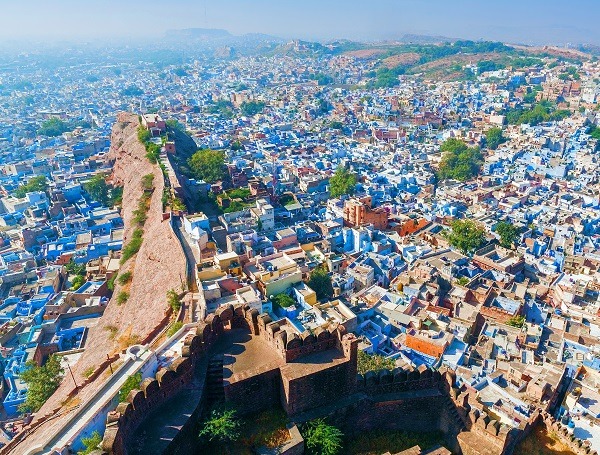
- A peaceful site, overlooking a lake, that contrasts with the intensity of the neighbouring fort and the blue-painted old town.
History
The monument was built in 1899 by Maharaja Sardar Singh, in memory of his father, Maharaja Jaswant Singh II, the 33rd ruler of Jodhpur. The chosen location corresponded to the traditional cremation ground of the city's sovereigns, anchoring the memorial in a dynastic continuity stretching back to the Rathores.
Over the decades, three secondary cenotaphs were added to the site to honour the sovereigns who succeeded Jaswant Singh II. Today, the ensemble forms a coherent royal memorial, still used by Jodhpur's royal family for certain private ceremonies.
What to See on Site
The Marble Façade
The exterior is clad in fine sheets of white marble, polished to translucency. When light passes through them, the walls take on a warm, almost golden glow. Rajasthani sculptors worked the stone into delicate motifs, most visible in oblique light, in early morning or late afternoon.
The Overall Architecture
The structure is organised around a pyramidal dome, surrounded by small domes and carved gazebos. The whole sits within a terraced garden that descends gently toward Jaswant Thada Lake. At the entrance, a marble statue depicts Jaswant Singh II on horseback; a few white steps then lead to the main memorial.
The Memorial Interior
Inside are carved pillars, delicate marble lattice work and a series of portraits of Jodhpur's sovereigns, tracing the Rathore lineage that ruled Marwar from the late thirteenth century onwards. Three smaller secondary cenotaphs complement the ensemble.
The Garden and Lake
The terraced garden opens onto the adjacent lake and offers an unobstructed view of Mehrangarh Fort, which dominates the city's skyline. It is one of the best vantage points for viewing the fort, particularly in late afternoon.
Practical Information
- Duration: Allow 45 minutes to an hour to explore the site unhurriedly.
- Opening Hours: Open continuously from morning until late afternoon, every day.
- Admission: Modest entry fee, with a small supplement for camera or video use. Separate rates for Indian and foreign visitors.
- Dress Code: No strict dress code, but the marble is dazzling in bright sunlight — sunglasses recommended.
- Accessibility: A few steps to climb to reach the main memorial.
When to Visit
The best season runs from October to March, when Rajasthan's temperatures remain comfortable (68–82 °F during the day). From April to June, heat regularly exceeds 104 °F and makes visiting challenging, though the marble does limit the heat sensation indoors. The monsoon season (July–September) remains manageable, with denser vegetation around the lake.
For the best light, opt for late afternoon: the marble then takes on its warmest hue and Mehrangarh Fort appears in striking silhouette.
Nearby
Jaswant Thada fits naturally into a circuit around Jodhpur Fort. Just a short walk away lies Mehrangarh Fort, offering the military and museum counterpart to your visit. The blue-painted old town of Jodhpur, with Sardar Market and the Clock Tower, is reached by tuk-tuk in about ten minutes.
If your itinerary continues to Udaipur, extend your discovery of Rajasthani architecture with the City Palace of Udaipur, the Jagdish Temple and Bagore Ki Haveli. Fort enthusiasts can compare Mehrangarh with Jaigarh Fort, near Jaipur.
How to Get There
From Central Jodhpur
The cenotaph sits on the immediate outskirts of the old town. Tuk-tuks and taxis connect you in 10 to 15 minutes from Sardar Market. Most visitors combine a stop here with Mehrangarh Fort, about a kilometre away.
From the Airport
Jodhpur Airport is about 6 km from the city centre. It is served by domestic flights from major Indian cities. Taxis and ride-sharing services are available at the exit.
By Train
Jodhpur Railway Station is connected to major cities in northern and western India, including Delhi, Jaipur, Agra and Ahmedabad. From the station, allow about fifteen minutes by tuk-tuk to reach the site.
Include Jaswant Thada in Your Rajasthan Journey
Jaswant Thada fits naturally into a two- or three-day stay in Jodhpur, alongside Mehrangarh and the blue-painted old town. To tailor an itinerary covering Jodhpur, Udaipur, Jaipur and the Thar Desert, explore our Inde journeys.
Interested in this visit?
We can include it in your personalised itinerary.