Jaigarh Fort
Jaigarh Fort
A military fortress overlooking Amber Fort, Jaigarh houses the Jaivana, the world's largest wheeled cannon, as well as historic palaces, an arsenal and foundry.
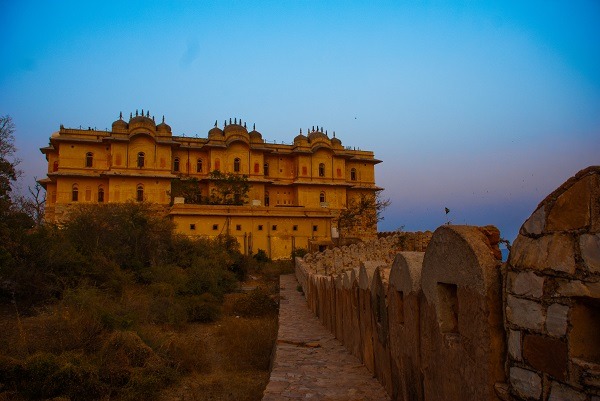
Perched on the Aravalli mountain range, some 400 m above Amber Fort, Jaigarh Fort commands the valley it was built to defend. Constructed of red sandstone, the complex extends 3 km in length and 1 km in width, and houses the Jaivana, considered the world's largest wheeled cannon. This military fortress of the sovereigns of Jaipur preserves a historic foundry, several palaces and an arsenal open to visitors.
Why visit Jaigarh Fort?
Often overshadowed by its neighbour Amber Fort, Jaigarh offers a complementary perspective on Rajasthan's military history. Here, there are no grand palatial halls designed for courtly display: the site was an armed stronghold, equipped with an active cannon foundry, a system of water reservoirs and ramparts designed to withstand siege. The panorama from the bastions sweeps across Sagar Lake, the Amber palace below and the surrounding hills. A visit is less crowded than Amber, allowing time to wander through courtyards, weapons stores and terraces without throngs of tourists.
Fort history
Jaigarh Fort was designed to protect Amber Fort and the road leading to it. Designed by architect Vidyadhar, it was enlarged and renovated by Raja Jai Singh II in the 18th century. Its strategic position and the presence of iron ore deposits in the surrounding area soon made the site a major cannon foundry for the sovereigns of Jaipur.
In 1658, during the Mughal wars of succession, the outpost held firm until Dara Shikoh, the eldest son of Emperor Shah Jahan, was defeated and executed by his brother Aurangzeb. Later, Mughal Emperor Muhammad Shah appointed Jai Singh II as official Qiladar of Jaigarh Fort. It was in the fort's foundries that he had the Jaivana cannon manufactured, whose imposing silhouette is today the symbol of the site.
What to see
The Jaivana Cannon
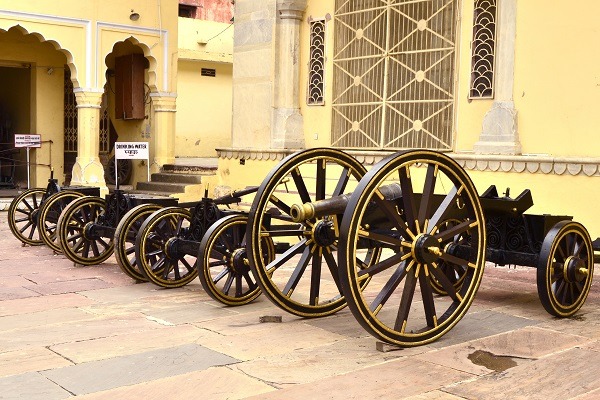
The centrepiece of any visit, the Jaivana measures 6.15 metres in length and weighs 50 tonnes. Manufactured in 1720 in the fort's workshops, it was fired only once, as a test, and its range was then measured at approximately 35 km. The cannon still rests on its original rotating platform, in the courtyard dedicated to it.
Palaces and gardens
The complex contains several residences: Laxmi Vilas, Lalit Mandir, Aram Mandir and Vilas Mandir. Their open halls, jali lattice windows and interior courtyards bear witness to the fort's dual role, both military and residential. The Charbagh garden, divided into four equal parts according to the classical Persian model, separates the buildings and offers a contrast with the severity of the ramparts.
The arsenal and foundry
The arsenal chamber displays swords, muskets, rifles and cannonballs used by Jaipur's armies. The walls feature a series of portraits of former Maharajas, including Sawai Bhavani Singh and Major General Man Singh II. The foundry buildings, where cannons were cast using iron ore extracted locally, remain visible and constitute one of the rare surviving examples in India.
The Awani Darwaza and views
From the Awani Darwaza, one of the fort's monumental gates, the view plunges over Sagar Lake and the underground reservoirs that supplied the garrison. The ramparts also offer several vantage points over Amber Fort below and Nahargarh, perched on a neighbouring ridge.
Practical information
The fort is open daily during daylight hours. Allow 1.5 to 2.5 hours to visit the ramparts, palaces, arsenal and Jaivana courtyard. Entry fees are moderate, with basic admission and possible surcharges for cameras and video equipment; it is advisable to verify conditions on arrival as they change regularly. Wear sturdy walking shoes: the ground is uneven and the complex requires considerable walking.
When to visit
The best period runs from October to March, when daytime temperatures remain comfortable. The monsoon season (July-September) makes paths slippery, while April to June frequently sees temperatures exceeding 40°C with no shade on the ramparts. Early morning or late afternoon visits are most comfortable.
How to get there
Jaigarh Fort is located approximately fifteen kilometres north of Jaipur's city centre. The road typically passes through Amber, and it is common to visit both forts on the same day. Taxis, auto-rickshaws and private vehicles with drivers serve the site from the city. A walking trail also connects Amber to Jaigarh for hikers, but the climb is demanding and not recommended in peak heat.
Nearby
A visit to Jaigarh naturally combines with Amber Fort, located directly below, and Nahargarh, accessible by a scenic road along the ridge. To extend your exploration of Rajasthan's fortresses, several sites deserve a detour: Alwar's City Palace, Deeg Fort and Bagore Ki Haveli in Udaipur each offer their own variations on Rajput military and palatial architecture.
Frequently asked questions
Frequently asked questions
Allow 1.5 to 2.5 hours depending on your pace. The complex spans 3 km and comprises several distinct areas: palaces, Charbagh garden, arsenal, foundry and Jaivana cannon courtyard.
Yes, the two forts are neighbours and complement each other. Half a day at each site, or a full day total, is sufficient to explore both without rushing.
A combined ticket existed in the past, but conditions change regularly. Check at Amber's ticket office on the day of your visit.
No. Manufactured in 1720, it was fired only once, during a test intended to measure its range, estimated at approximately 35 km.
Access is challenging: uneven ground, numerous stairs and significant elevation changes between different areas of the complex. A partial visit remains possible but requires assistance.
Plan your trip
Jaigarh Fort is part of a classic Rajasthan circuit, alongside the forts and palaces of Jaipur, Amber, Jodhpur and Udaipur. To create a bespoke itinerary including these stops, explore our India tours.
Interested in this visit?
We can include it in your personalised itinerary.