Fort Aguada
Fort Aguada
17th-century Portuguese fortification overlooking the Arabian Sea in Goa: ramparts, historic lighthouse, colonial prison museum and Sinquerim beach.
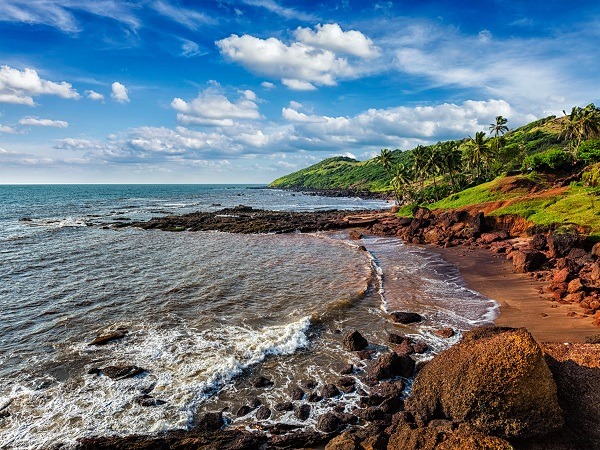
Overlooking the Arabian Sea at the southern tip of Sinquerim beach, Fort Aguada is one of the best-preserved Portuguese fortifications in India. Built in the early 17th century to control the mouth of the Mandovi River, it now houses a lighthouse, a museum and red laterite ramparts opening onto the ocean.
Why visit Fort Aguada?
The site combines three rarely found qualities on a single Goa attraction: clearly legible colonial military heritage, sweeping views of the Goan coast and direct access to Sinquerim beach below. The visit suits both a historical approach and a simple late-afternoon stroll. Plan 1 to 2 hours depending on whether you include the museum housed in the former prison.
History of the fort
Construction of the fort began in 1609 by the Portuguese to protect against Dutch and Marathi invaders, and was completed in 1612. The fort then controlled access to Goa, the Portuguese capital of the Indies, and served as a landmark for ships arriving from Europe.
Its name comes from the Portuguese aguada, meaning "water," referring to the fresh water spring integrated into the fortress. The cisterns could store up to 2,376,000 gallons of fresh water, making it one of the region's most important reservoirs. Crews crossing the Arabian Sea would stop here to resupply before continuing their journey.
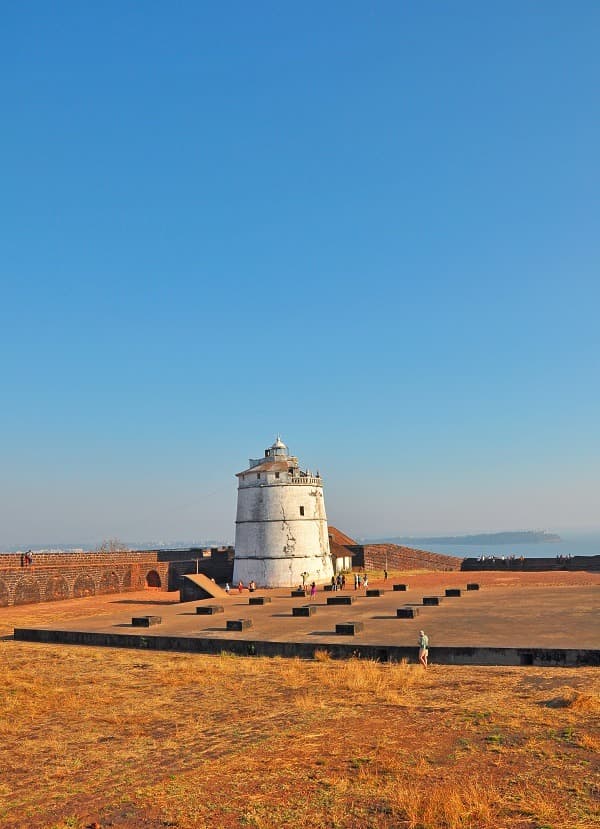
In 1864, a four-storey Portuguese lighthouse was erected on the shore. Later, under Salazar's regime, the fortress was converted into a prison for political opponents, a function it retained until Portuguese control ended in Goa in 1961.
What to see
The ramparts and bastions
The walls, made of red laterite, measure 5 metres high and 1.3 metres thick. The layout follows the hillside and incorporates several bastions facing the sea, former gun emplacements converted into viewpoints over the Arabian Sea and the Bardez coast.
The lighthouse
The four-storey cylindrical lighthouse, erected in 1864, is one of Asia's oldest. Its white silhouette contrasts with the ochre tone of the fortifications. Explanatory panels trace its role in coastal signalling along the Goan shoreline.
The former prison and museum
At the heart of the fort, the former colonial prison used under Salazar now houses a museum dedicated to Goa's history and the struggle for freedom. Exhibitions explore the colonial period, local resistance and the journey of political prisoners. A worthwhile visit to place the fort within the broader context of Indian decolonisation.
The fresh water cisterns
The hydraulic network remains one of the site's most technical aspects. Hatches, vaults and underground galleries testify to the capture and storage system that ensured the fort's self-sufficiency in case of prolonged siege.
Sinquerim beach
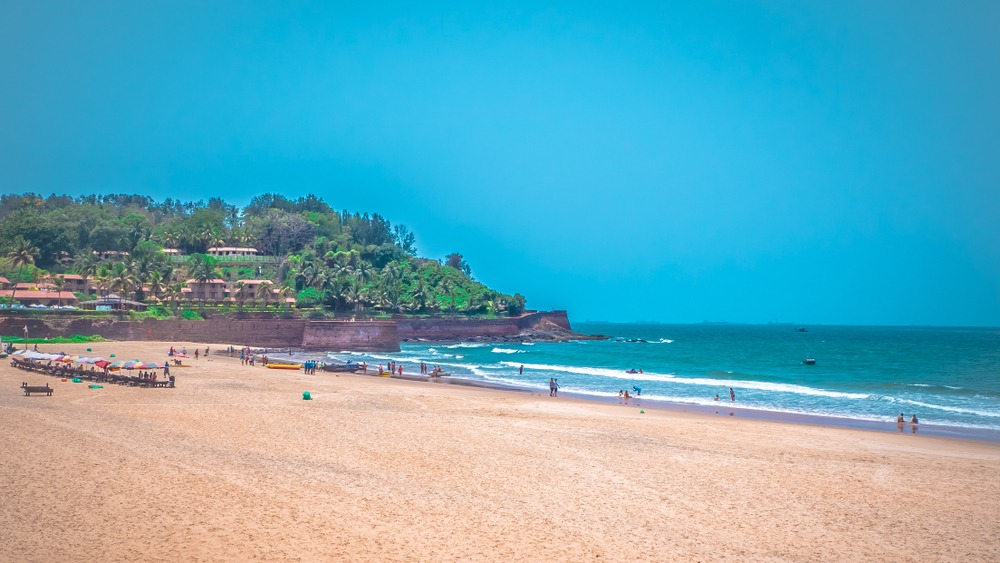
Below the fort, Sinquerim beach is accessible on foot. Quieter than Anjuna or Baga, it allows you to extend your visit with a swim or stroll. A few cafés and operators offer jet-skiing and boat trips along the coast.
Practical information
- Fort access: free for the exterior areas (ramparts, lighthouse, viewpoints).
- Prison museum: paid entry, modest rates, supplement for foreign visitors. Check current conditions before your visit.
- Opening hours: open daily during daytime. It's best to arrive in late afternoon for the light on the ramparts.
- Visit duration: 1 hour for the fort alone, 2 hours including the museum and beach.
- What to bring: hat, water, closed shoes (uneven ground). Little shade on the ramparts.
When to visit
Goa experiences two distinct seasons. The dry season, from November to March, is the most favourable period: pleasant temperatures, clear skies and ideal visibility from the ramparts. From April to May, daytime heat becomes oppressive; choose early morning or late afternoon. The monsoon, from June to September, makes visiting less pleasant (frequent showers, slippery ground), but offers lush vegetation and far fewer crowds.
How to get there
The fort is located at the southern end of Sinquerim beach, in the Candolim district (Bardez municipality, North Goa district). It is approximately 10 km from Baga beach and 15 km from Panjim, the state capital.
- Taxi: the simplest solution from Panjim, Calangute or Baga. Agree on the price beforehand or use a local app.
- Scooter: widely available in Goa, easy to rent from main beach resorts (international licence recommended).
- Local bus: connections from Panjim to Candolim, then a 15-20 minute walk to the fort.
Nearby
The Goa region and southern India contain several complementary sites:
- Anjuna Beach — iconic beach in northern Goa, about twenty minutes by car.
- Bekal Fort — another major coastal fortress in neighbouring Kerala.
- Daria Daulat Bagh — summer palace of Tipu Sultan, to extend the heritage theme.
Frequently asked questions
Frequently asked questions
Include Fort Aguada in your journey
Fort Aguada fits naturally into a trip combining colonial heritage, Goa's beaches and cultural stops in southern India. To build a custom itinerary, explore our trips to India and let our destination specialists guide you.
Nearby
Interested in this visit?
We can include it in your personalised itinerary.