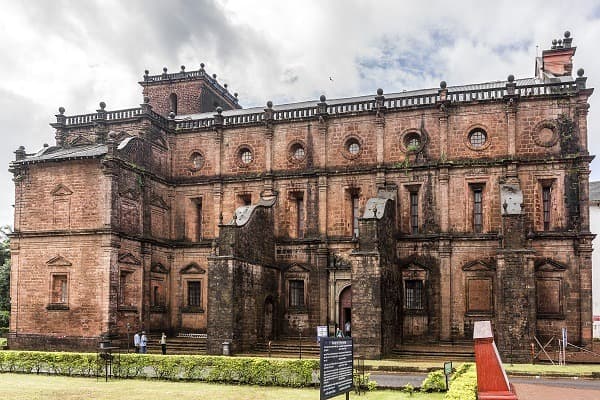
Basilica of Bom Jesus in Goa
Basilica of Bom Jesus in Goa
UNESCO-listed, the Basilica of Bom Jesus in Old Goa houses the tomb of Saint Francis Xavier in a baroque mausoleum designed by Giovanni Battista Foggini.
Inscribed on the UNESCO World Heritage list, the Basilica of Bom Jesus (Basílica do Bom Jesus in Portuguese) stands in Old Goa (Velha Goa), the former capital of Portuguese India. This church of baroque style houses the tomb of Saint Francis Xavier, a Jesuit missionary venerated throughout Asia. A visit here illuminates a lesser-known chapter of the subcontinent: Portuguese colonial heritage and the spread of Christianity in Asia from the 16th century onwards.
Why visit the Basilica of Bom Jesus?
The basilica combines several compelling features that make it a central stop during a stay in Goa:
- Preserved baroque architecture, rare in South Asia, UNESCO-listed since 1986.
- The tomb of Saint Francis Xavier, in a mausoleum designed by Florentine sculptor Giovanni Battista Foggini, a gift from Cosimo III de' Medici.
- Free admission, less than 10 km from Panaji, easy to combine with other monuments of Velha Goa.
- A major liturgical event: the decennial exposition of relics, with the most recent held in December 2024.
History
Construction of the basilica began in 1594 and was completed in 1605, when Goa was the capital of Portuguese India. The Jesuits erected it as a place of worship and burial for one of their most influential members, Francis Xavier.
A companion of Ignatius of Loyola and co-founder of the Society of Jesus, Francis Xavier hailed from the kingdom of Navarre (present-day Basque Country in Spain). He arrived in Goa in 1542 to evangelize India, then continued his mission to Japan and Southeast Asia. He died in 1552 on the island of Sancian, near the Chinese coast. His body, believed to be incorrupt, was repatriated to Goa in 1554 after a long journey via Malacca and Portugal.
The edifice quickly became a site of international pilgrimage, particularly during the decennial expositions of relics. In 1946, Pope Pius XII elevated it to the rank of minor basilica. In 1986, UNESCO inscribed it on the World Heritage list along with the other religious monuments of Velha Goa, in recognition of its role in the Christianization of Asia.
What to see on site
The tomb of Saint Francis Xavier
This is the spiritual heart of the site. The saint's body rests in a finely wrought silver coffin, surmounted by a baroque mausoleum of marble and jasper sculpted by Giovanni Battista Foggini in Florence. The work, a gift from the Grand Duke of Tuscany Cosimo III de' Medici, depicts scenes from the missionary's life. During the decennial expositions, the coffin is lowered to allow the faithful to venerate the relics, to which they attribute healing properties.
The high altar and Jesuit symbolism
Upon entering, the eye is drawn to the high altar, dominated by an imposing statue of Saint Ignatius of Loyola, founder of the Jesuits. Above, the golden emblem IHS (monogram of Christ) is framed by rays and crowned by a representation of the Holy Trinity. Beneath the altar is a scene of the Last Supper, accompanied by an inscription in Konkani: "Hi Mhoji Kudd" ("This is my body"), a rare example of Christian iconography in the local language.
The art gallery
On the upper level, a gallery displays works by surrealist Goan painter Dom Martin, whose compositions revisit Christian iconography with contemporary sensibility. The murals in the nave recount major episodes from Francis Xavier's Asian missionary work.
Practical information
- Admission: free.
- Duration of visit: allow 30 minutes to 1 hour, longer if you include the art gallery.
- Hours: open during daytime Monday to Saturday, and after morning Mass on Sunday. Verify current opening times before visiting, as they may change.
- Masses: daily celebrations in Konkani and English; special monthly ceremony in the Saint Xavier chapel.
- Dress code: clothing covering shoulders and knees required. Avoid tank tops, shorts, and beachwear. A shawl may suffice to cover the shoulders.
- Photography: permitted in the nave, restrictions possible near the mausoleum.
When to visit
Goa is comfortably visited from November to March, during the dry season, when humidity remains moderate. The monsoon, from June to September, makes travel more difficult but offers lush vegetation around the monuments of Velha Goa.
Two major liturgical occasions draw significant crowds: the Feast of Saint Francis Xavier (December 3rd) and the decennial exposition of relics, the most recent held in December 2024. The next is expected in the 2030s. Outside these periods, prefer morning visits to avoid the crowds from pilgrimage buses.
How to get there
The basilica is located in Old Goa, approximately 10 km from Panaji, the state capital. Several options to reach it:
- By air: Dabolim International Airport, about twenty kilometers away; allow approximately 45 minutes by taxi depending on traffic.
- By train: the nearest station is Karmali, 2 km away. Buses and taxis provide the connection.
- By bus: regular connections from Panaji, Margao, and major towns in Goa via Kadamba Transport Corporation.
- By car or two-wheeler: National Highway NH748 leads directly to the site. Parking available on-site.
Nearby
Se Cathedral
Located just across the way, the Se Cathedral is considered the largest church in Asia. Dedicated to Saint Catherine of Alexandria, it is distinguished by its austere Portuguese façade and richly gilded interior altars.
Saint Augustine Tower
A few minutes' walk away, a tall solitary tower rises amid the ruins: this is what remains of the Church of Saint Augustine, built in 1602 by Augustinian monks. It gives a sense of the architectural grandeur that Velha Goa enjoyed in the 17th century.
Old Goa Archaeological Museum
Located in the former Convent of Saint Francis of Assisi, the museum houses sculptures, portraits of Portuguese viceroys, and fragments of Hindu stonework. A useful stop to place the basilica in the broader context of Portuguese India.
Frequently asked questions
Frequently asked questions
Yes, access to the Basilica of Bom Jesus is free. Donations are welcome for the maintenance of the site.
Shoulders and knees must be covered, for both men and women. Avoid tank tops, short shorts, and beachwear. A shawl may be used to cover the shoulders.
The exposition is organized approximately every ten years. The most recent edition was held in December 2024; the next is expected in the 2030s.
Allow 30 minutes to 1 hour for the basilica alone. To also explore the Se Cathedral, Saint Augustine Tower, and the archaeological museum, plan a half-day in Velha Goa.
Yes, daily celebrations take place in Konkani and English. A special Mass is also organized each month in the Saint Xavier chapel.
Planning your trip
The Basilica of Bom Jesus naturally fits into an itinerary combining beaches, Portuguese heritage, and the Goan hinterland. To design a custom itinerary and expand it to other regions, explore our travels in India. You can also extend your discovery of Indian heritage with the Alchi monastery in Ladakh, Anjengo Fort in Kerala, or the State Museum in Bhopal.
Nearby
Interested in this visit?
We can include it in your personalised itinerary.