British Residency, Hyderabad
British Residency, Hyderabad
A Palladian colonial residence from the early 19th century, restored by the World Monuments Fund and reopened in 2022, in the heart of Hyderabad.
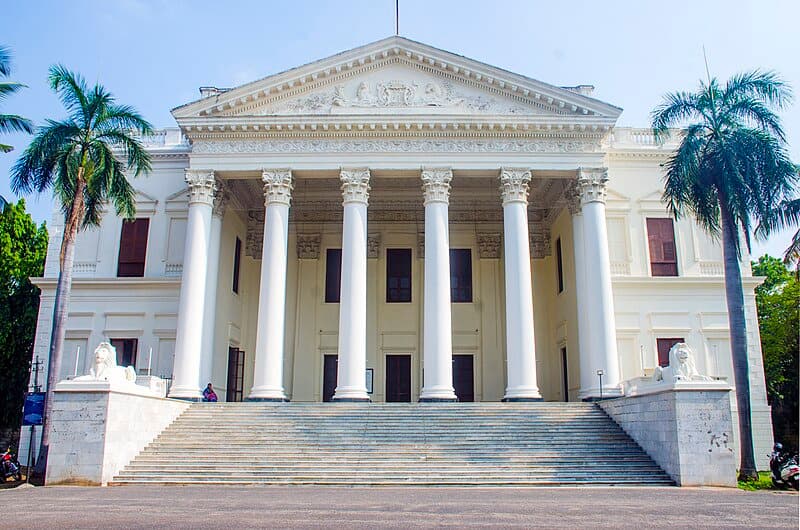
The British Residency in Hyderabad is one of the rare Palladian-style British colonial residences preserved in India. Located on the campus of Telangana Mahila Viswavidyalayam (formerly Women's College), it reopened its doors in April 2022 following an extensive restoration project carried out in partnership with the World Monuments Fund. Behind its columned façade lies the story of a British diplomat who fell in love with a Mughal princess in the late 18th century.
Why visit the British Residency
Three reasons make this site singular in Hyderabad's heritage landscape:
- It is the first building of European Palladian style erected in Hyderabad, executed by local craftsmen using teak wood, lime, and brick.
- The durbar hall ceiling preserves floral and geometric patterns in papier-mâché, a 19th-century European technique now extraordinarily rare in the region.
- The site tells the story of James Achilles Kirkpatrick and Khair un Nissa, immortalized by William Dalrymple in White Mughals — a lesser-known chapter in Indo-British history.
The guided tour, with limited visitor capacity, offers a measured reading of the building, far from the crowds that frequent other city sites.
History
The British Residency is inseparable from James Achilles Kirkpatrick, an officer of the British East India Company. Appointed British Resident in Hyderabad in the late 18th century, he adopted an Indian way of life: wearing Mughal dress, smoking a hookah, and marrying Khair un Nissa, the great-niece of the Nizam's Prime Minister. This scandalous union in the eyes of the Company lies at the heart of William Dalrymple's book White Mughals.
The building was conceived at Kirkpatrick's initiative. The plans were drawn by Lieutenant Samuel Russell, and the construction was financed by the Nizam himself. The residence was completed in the early 19th century. The main building — with its columns, pediment, and marble staircase — exemplifies European Palladian style, rendered in local materials.
For over a century, the building symbolized British authority over the region. Following India's independence in 1947 and Hyderabad's integration in 1948, it was assigned to Osmania University and became the campus of Women's College, now renamed Telangana Mahila Viswavidyalayam.
Over time, the edifice deteriorated. In 2002, the World Monuments Watch listed it among the world's 100 most endangered sites. A lengthy restoration program then began, supported by the World Monuments Fund, the Telangana government, and the university. The British Residency reopened to the public in April 2022.
What to see on site
The durbar hall
The highlight of the visit is the durbar hall, reached by a grand white staircase. The interior preserves a wooden floor, decorative mirrors, and suspended chandeliers. The remarkable feature is the ceiling, entirely adorned with floral and geometric patterns executed in papier-mâché using a 19th-century European technique. The restoration has carefully refined the lighting to showcase this décor.
The two oval drawing rooms
On either side of the durbar hall, two oval-shaped rooms extend the enfilade. Their symmetrical arrangement and restrained decoration illuminate how official reception spaces were organized during the colonial era.
The interpretation center on the upper floor
An interior staircase leads to the former private quarters, now transformed into an interpretation center. Explanatory panels, historic maps, and photographs trace the building's history and Kirkpatrick's story. An audiovisual room screens a documentary on the restoration project, helpful in grasping the scope of the work.
The three monumental gateways
Three historic gateways mark the former official entrances to the residence and retain their original structures:
- Roberts Gate, to the east
- Lansdowne Gate, to the west
- Empress Gate, to the south
The grounds and exterior vestiges
The main building stands within a 63-acre campus. Several period cannons are scattered throughout the grounds, remnants of the British Raj. Certain secondary buildings, now converted into university classrooms or laboratories, preserve architecturally significant elements.
Practical information
The British Residency is located on a women's university campus. Visits are possible exclusively through online reservation in designated time slots. Admission fees remain moderate, with a distinction between Indian and foreign visitors, and a modest additional charge for photography (smartphone or camera). Check current opening hours and rates on the official website before your visit, as these may change.
Allow approximately 1 to 1.5 hours on site to explore the main building, upper floor, and grounds. Modest dress is appreciated, as the site is located within a university institution.
How to get there
The site is located in central Hyderabad, approximately 2 km from the Mahatma Gandhi Bus Stand (MGBS).
- By metro: Osmania Medical College station (red line) or Sultan Bazar (green line), both near the campus.
- By bus: numerous routes serve the MGBS, a 15-minute walk from the site.
- By taxi or rickshaw: the most direct option from Charminar or the old city.
Nearby
The British Residency fits naturally into a day dedicated to Hyderabad's heritage. Within a few kilometers lie the Charminar, the emblematic monument of the old city built in 1591, and further west the Golconda Fort, the former capital of the Qutb Shahi sultans, renowned for its acoustics and royal tombs. These three sites span three distinct layers of Hyderabad's history: medieval sultanate, Mughal city, and British colonial presence.
To extend your exploration of Indian heritage, other sites such as Bekal Fort in Kerala or the Basilica of St. Thomas in Chennai illustrate other encounters between local architectures and European influences.
Frequently asked questions
Frequently asked questions
Yes, visits are exclusively by online reservation, as the building is located on a women's university campus. Time slots are limited in number.
Yes, male visitors are admitted as part of official guided tours booked online. Access remains structured, as the site is located on a women's university campus.
Allow 1 to 1.5 hours to explore the durbar hall, oval drawing rooms, the interpretation center on the upper floor, the audiovisual room, and the grounds (gateways and park).
Yes, for a modest additional fee paid on site, which varies depending on whether you are photographing with a smartphone or camera.
Charminar is about 2 km to the south, accessible by rickshaw in 10-15 minutes. Golconda Fort is approximately ten kilometers to the west, most easily reached by taxi.
Include this visit in your journey
The British Residency perfectly complements an itinerary centered on Hyderabad and the Deccan, combining Mughal heritage, colonial legacy, and Telangana culture. To plan a customized trip incorporating this visit and other stops across the subcontinent, explore our journeys in India.
Interested in this visit?
We can include it in your personalised itinerary.