The Charminar
The Charminar
Erected in 1591 by Muhammad Quli Qutb Shah at the heart of Hyderabad, the Charminar and its four minarets of 56 m embody the Qutb Shahi heritage of Telangana.
The Charminar stands at the center of Hyderabad's old city, in the state of Telangana. Built in 1591 by Muhammad Quli Qutb Shah, this four-minaret monument marks the foundation of the new Qutb Shahi capital and remains today the visual and symbolic landmark of the city, even integrated into Telangana's official emblem.
Why visit the Charminar
The Charminar brings together in a single site several compelling layers for the traveler: late 16th-century Indo-Islamic architecture, an ever-active commercial quarter (Laad Bazaar, Chudi Bazaar), and a wealth of legends that illuminate Hyderabad's history. The monument is protected by the Archaeological Survey of India and features on UNESCO's tentative world heritage list, alongside the Qutb Shahi tombs and Golconda Fort.
Allow 1 to 2 hours for the monument alone, or a half-day if you extend your visit to the bazaars and the nearby Makkah Masjid.
History and legends
The Charminar was erected in 1591 by Muhammad Quli Qutb Shah, the fifth sovereign of the Qutb Shahi dynasty, when he transferred his capital from Golconda Fort to Hyderabad. Its name derives from the Urdu words char (four) and minar (towers), referring to its four minarets.
The exact motivations for its construction remain debated. One tradition recounts that the sultan, faced with a plague epidemic, made a vow to erect a monument if the disease ceased: the Charminar is said to have been built as a sign of gratitude and to mark the city's founding. Another hypothesis links it to the commemoration of the second Islamic millennium (1000 AH). A third interpretation sees it inspired by Shiite tazias, structures evoking Hussain's martyrdom at Karbala.
The monument was built at the intersection of the trade route connecting Golconda to the port of Machilipatnam. The city subsequently organized itself around it in four quadrants. The foundation, 30 feet deep, supports a structure estimated at 14,000 tonnes. The initial cost is valued at 9 lakhs of rupees. In 1670, one of the minarets was struck by lightning and subsequently repaired for 58,000 rupees. In 1820, the Nizam Sikandar Jah undertook further renovations at a cost of 2 lakhs of rupees.
Two legends continue to nourish the local imagination. The first recounts that Muhammad Quli Qutb Shah built the monument in tribute to Bagmati, the woman he loved. The second evokes a secret tunnel connecting the Charminar to Golconda Fort, a supposed escape route for the royal family; no such passage has ever been discovered.
What to see on site
A square and symmetrical structure
The Charminar rests on a square base of 20 meters per side. At each corner, a 56-meter minaret divides into four levels and terminates in a bulbous dome with a lotus-petal base, a signature of the Qutb Shahi style. The four monumental arches open onto the main arteries of the old city:
- Kali Kaman (East gate): formerly reserved for the royal family.
- Makkah Gate (West gate): oriented toward Mecca.
- North Gate: access to the upper-level mosque.
- South Gate: opens toward Char Kaman, a historic crossroads.
The edifice combines granite, limestone, and lime mortar. The stucco decoration blends floral and geometric motifs in an Indo-Islamic fusion of Persian and Indian influences. It is also said that the minarets, beyond their decorative function, contributed to air circulation within the monument. In 1889, clocks were added to each of the four facades.
The rooftop mosque
At the western end of the terrace stands a mosque often presented as Hyderabad's oldest. It is reached after climbing 149 steps. It accommodates 45 prayer spaces and a main gallery used for Friday prayers. The second floor and upper columns are not open to the public.
Details not to miss
On one of the pillars, a discreet cat carving recalls the role played by the city's felines during the plague epidemic, when they hunted the rats that carried the disease. The four minarets also bear names with strong symbolic weight in Islamic history: Ali, Hasan, Hussain, and Muawiya.
Practical information
The Charminar is open daily during daylight hours, with extended morning and afternoon access. Admission is charged, with separate pricing for Indian and foreign visitors; fees remain modest. Fridays and public holidays draw the largest crowds, especially around prayer times. The second floor and upper minaret levels are closed to the public for conservation and safety reasons. Modest dress is appreciated, particularly if you climb to the mosque.
When to visit
Hyderabad enjoys a tropical climate marked by three seasons. The most comfortable period extends from October to February, with milder temperatures and dry air, ideal for visiting the monument and surrounding bazaars. From March to June, the heat intensifies, often exceeding 35–40 °C at midday: favor early morning or late afternoon visits. The monsoon, from July to September, brings showers that may slow circulation in the old city but offers a greener atmosphere.
How to get there
By air
Rajiv Gandhi International Airport at Shamshabad lies 18–20 km from the Charminar. It is served by domestic and international flights. From the terminal, taxi or shuttle services take you to the old city; allow around three-quarters of an hour depending on traffic.
By train
The nearest railway station is Hyderabad Deccan (Nampally), 4–6 km from the monument. It is well connected to major Indian cities. From there, taxi or auto-rickshaw will bring you to the foot of the Charminar.
On site
Once in the city, auto-rickshaws, taxis, and ride-hailing apps readily serve the site: all drivers know the monument. The nearest bus stop, near Makkah Masjid, is roughly 800 meters away. Since the old city is dense and pedestrian-friendly, finishing on foot is often the simplest option.
What to see nearby
The Charminar sits within a dense urban fabric rich in complementary sites.
- Laad Bazaar: a commercial thoroughfare inherited from the Qutb Shahi era, renowned for silks, spices, incense, and perfumed oils.
- Chudi Bazaar: specializing in lac bracelets, highly visual, and traditional jewelry.
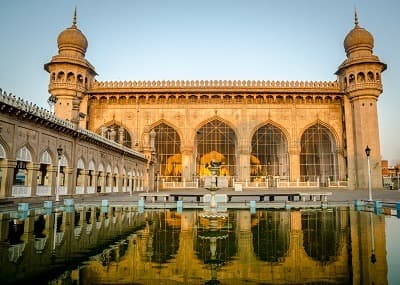
- Makkah Masjid: one of India's largest mosques, whose central arch bricks are, it is said, made from earth brought from Mecca.
- Char Kaman and Gulzar Houz: an ensemble of 16th-century arches framing a fountain that once served as the city's central water point.
- Bhagyalakshmi Temple: abutting the Charminar's base, its antiquity is disputed, with photographs from the 1950s failing to show it at this location.
To extend your discovery of Inde beyond Hyderabad, you may consult other features such as the Alchi Monastery in Ladakh, the State Museum in Bhopal, or Anjengo Fort in Kerala.
Frequently asked questions
Frequently asked questions
Preparing your trip
The Charminar fits naturally into an itinerary combining Hyderabad, Golconda, and Telangana. To build a broader journey anchored at this site, explore our Inde travel ideas.
Interested in this visit?
We can include it in your personalised itinerary.