Bidar Fort
Bidar Fort
A Deccan citadel with 5 km of ramparts, Bidar Fort preserves Bahmani palaces, ancient mosques and medieval defences on UNESCO's tentative list.
Bidar Fort dominates the old city of Bidar in northern Karnataka. This Deccan citadel, encircled by ramparts stretching some 5 km, preserves over thirty Islamic monuments bearing witness to six centuries of successive rulers: Tughlaq, Bahmani, Barid Shahi, Adil Shahi, Mughal and Nizams. Its military architecture, ornate palaces and hydraulic network make it one of the most complete fortified complexes in southern India.
Why visit Bidar Fort
Three elements distinguish this site from other Deccan fortresses:
- Rare dynastic layering: few Indian forts bear such clear traces of six different dynasties, each adding palaces, mosques or defensive modifications.
- A sophisticated defensive system: rhomboidal layout, steep glacis, triple-channel moat carved directly into the basaltic rock of the plateau, 37 octagonal bastions and 7 monumental gates.
- The Rangeen Mahal, an early 16th-century palace, celebrated for its mother-of-pearl inlays on black granite and colourful glazed tiles, remarkable examples of late Bahmani craftsmanship.
The complex has been on UNESCO's tentative list since 2014 under the designation "monuments and forts of the Deccan Sultanate".
History of the fort
From Tughlaq to Bahmani
The Bidar region was captured in 1321–1322 by Prince Ulugh Khan, later Sultan Muhammad bin Tughluq, during the expansion of the Delhi Sultanate towards the Deccan. Tughlaq authority, however, eroded rapidly. In 1347, Governor Hassan Gangu led a successful revolt and founded the Bahmani Sultanate under the name Ala-ud-Din Bahman Shah, with Gulbarga as its first capital.
In 1429, Sultan Ahmad Shah I moved the capital to Bidar, considered better situated and more salubrious. The city then became the political and cultural centre of the Deccan.
The reconstruction by Ahmad Shah Bahmani
It was under Ahmad Shah Bahmani (reign 1422–1436) that the fort took its present form. The reconstruction launched in 1428 mobilised Persian and Turkish architects, who completely redesigned the defences and added madrasas, mosques and palaces. Bidar became an intellectual hub where Persian, Turkish and Indian traditions intersected.
Successive conquests
After the erosion of Bahmani power, the fort passed to the Barid Shahi and then fell to the Bijapur Sultanate in 1619–1620. The 1657 siege led by Aurangzeb, future Mughal emperor, became famous: the stronghold yielded only after the use of incendiary rockets. Official annexation to the Mughal Empire occurred in 1686.
In the 18th century, Bidar entered the orbit of the Nizams of Hyderabad. Salabath Jung, the third son of Asaf Jah I, ruled there from 1751 to 1762. With the partition of the State of Hyderabad in 1956, Bidar was transferred to Karnataka.
What to see inside
The ramparts and gates
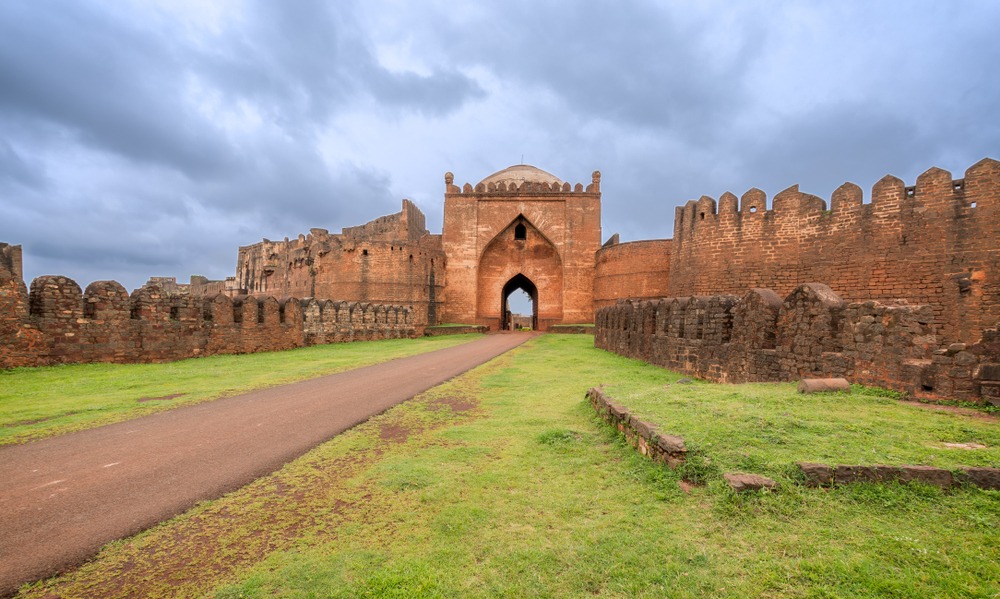
The walls follow an irregular rhomboidal plan, protected by a steep glacis and a triple-channel moat carved directly into the plateau. There are 37 octagonal bastions, including the Munda Burj, the most massive, still equipped with artillery pieces. Seven monumental gates marked the approaches:
- Mandu Darwaza: the main gate
- Kalmadgi Darwaza
- Delhi Darwaza
- Kalyani Darwaza
- Carnatic Darwaza
- Two other gates (No. 3 and No. 4) remain unnamed
The palaces
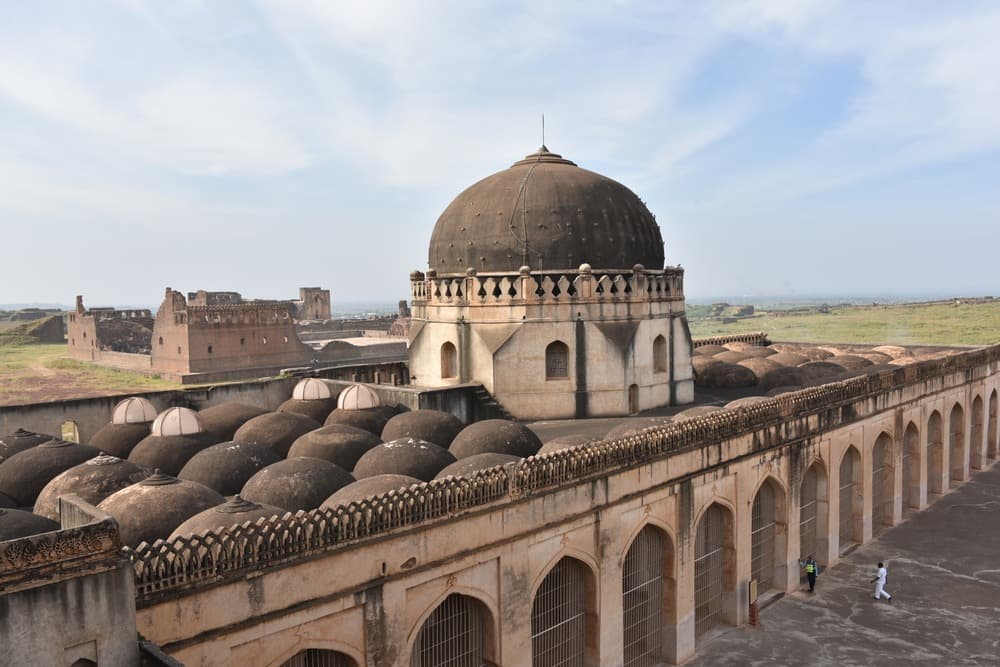
The Rangeen Mahal ("coloured palace"), from the early 16th century, is the most remarkable civil building: glazed tiles, wooden sculptures and mother-of-pearl inlays on black granite. The Takht Mahal, the throne room, hosted Bahmani and Barid Shahi coronations. Further on, the Diwan-i-Am (public audiences) and Diwan-i-Khas (private audiences) follow Mughal court conventions.
The mosques
The Solah Khamba Masjid, or Mosque of Sixteen Columns, built in 1423 by Qubil Sultani, is one of the oldest mosques in the Deccan still in use. Its central dome and hypostyle prayer hall illustrate early Bahmani architecture. The Jami Masjid completes the fort's religious ensemble.
Practical information
The site is open daily during daytime hours. Exact opening times vary by source and season: it is best to check locally or at the tourist office the day before your visit. A modest entrance fee is generally charged by the Archaeological Survey of India.
Allow 1.5 to 2.5 hours to walk the ramparts, main palaces and mosques. The terrain is extensive and offers little shade: bring a hat, water and closed shoes, as some areas are in ruins.
When to visit
The most pleasant period runs from October to March, when temperatures on the Deccan plateau remain comfortable and monsoon rains have ceased. April and May are very hot, with temperatures exceeding 40°C. The monsoon (June to September) makes visiting less comfortable but offers greener vegetation around the ramparts.
How to get there
By air: the most convenient international airport is Hyderabad, approximately 2.5 hours' drive from Bidar. Bidar also has a small airport, but with very few commercial flights.
By train: Bidar railway station is connected to Hyderabad, Bangalore and several Karnataka towns. Services are, however, less frequent than those serving Hyderabad.
By road: buses connect Bidar to Hyderabad, Gulbarga and Bangalore. A car with driver remains the most flexible option for combining Bidar with other Deccan heritage sites.
Nearby
Bidar deserves a stay of one or two days before moving on to other stages of Indian heritage. To prepare your visit, consult the Bidar guide. Heritage fortress enthusiasts can extend their journey to Anjengo Fort in Kerala, while history and museum lovers will appreciate the Bhopal State Museum. Further north, Alchi Monastery offers a Buddhist counterpoint to the Islamic heritage of the Deccan.
Frequently asked questions
Frequently asked questions
Allow approximately 1.5 to 2.5 hours to walk the ramparts, main palaces (Rangeen Mahal, Takht Mahal) and the Solah Khamba Masjid. A half-day allows for a more contemplative visit.
Not yet. The site has been on UNESCO's tentative list since 2014 under the designation "monuments and forts of the Deccan Sultanate", with a view to possible inscription as a World Heritage site.
October to March, when temperatures remain pleasant on the Deccan plateau. Avoid April–May (intense heat) and the monsoon from June to September.
Hyderabad is the most convenient gateway. The road connects the two cities in approximately 2.5 hours by car or taxi. Buses and trains also serve the route.
Accessibility is limited: uneven terrain, stairs, old ramps and a lack of modern facilities. The approaches to the main gates, however, remain navigable.
Plan your trip
Bidar Fort naturally fits into an itinerary devoted to Deccan heritage, often less frequented than the major tourist routes of Rajasthan or Kerala. To build a tailor-made journey combining historical sites, landscapes and encounters, explore our suggestions for travel in India.
Interested in this visit?
We can include it in your personalised itinerary.