Great Himalayan Crossing
Ancestral Trek Through the Highlands of Ladakh and Zanskar, From Leh to the Lost Monasteries of the Transhimalaya
Duration
25 days
Ideal seasons
Jun, Jul, Aug, Sep
Style
Expeditions
Comfort
classique
Travelers
Solo, With friends, groupe
The spirit of travel
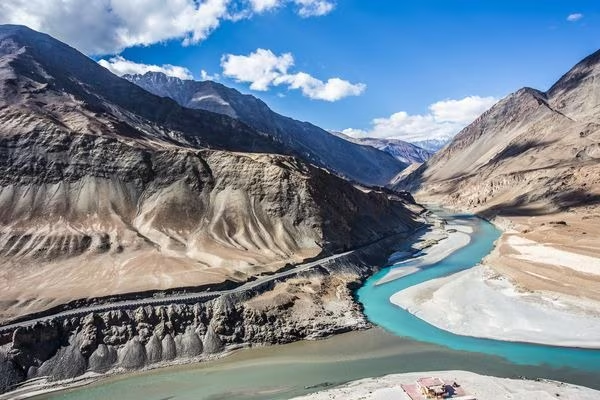
This exceptional trek is among the longest and most remote itineraries of the Transhimalaya, in regions that have remained untouched by mass tourism. The journey begins in Leh, a former trading post on the Silk Road, where the first days are devoted to discovering the Buddhist monasteries of Hemis, Thiksey and Matho as well as acclimatization. The hike then sets off from the village of Kanji, following ancient shepherds' and caravan routes through Ladakh and Zanskar. Walkers cross several high-altitude passes such as Yogma La and Sniugutse La, traverse landscapes punctuated by white chortens and perched villages, and follow the Tsarap Chu river to the isolated Phuktal Gompa monastery. The crossing of Phirtse La pass, at 5450 meters, opens the door to the Lahaul valley and Himachal Pradesh. The circuit ends at Keylong Serai before a transfer to Manali, nestled in the lush Kullu valley, then a stop in Chandigarh to admire its architecture designed by Le Corbusier and Nek Chand's Rock Garden.
A physically demanding experience, but rich in spectacular landscapes and authentic cultural immersion.
The stages of your journey
Highlights
Day-by-day itinerary


From Delhi to Leh by plane
Today, we are transferred to the airport to board a flight to Leh. The journey allows us to enjoy a panoramic view of the Himalayas (flight subject to seasonal weather conditions). Upon arrival, we are welcomed by the agency representative and taken to the hotel. We spend the rest of the day exploring the area for the first time. We discover the city, its streets, its markets, its royal palace and its monastery. Acclimatization begins slowly. Leh is located at 3500 m altitude.

Visit to Leh - Matho - Thiksey - Hemis
Today, we visit the 3 main gompas (monasteries) located in Leh. We discover the Thikse Monastery which belongs to the Gelugpa school (the yellow hats). Perched at the summit of a hill, its red and white constructions are visible for kilometres. A new temple has been designed within the complex, and houses a magnificent representation of the Future Buddha.
We then continue with a visit to the Hemis Monastery belonging to the Drukpa school (red hats). This monastery stands out from other Gompas in Ladakh not only because of the grandeur of the place, but also because of its rich collection of ancient relics and 17th century wall ornaments. The site is now part of UNESCO World Heritage.
Our tour continues with a visit to the Matho Monastery located in Thikse, on the opposite bank of the Indus River. This monastery was founded in the 16th century and is the only one belonging to the Sakya school.

Leh - Local Exploration
In the morning after breakfast, we set out to discover the treasures of Leh, starting with the Leh Palace. Built in the 17th century, it is the presidential palace of King Singge Namgyal. Resembling the Potala in Lhasa, but smaller, the Leh Palace is now in ruins. This nine-story monument was abandoned when the royal family moved to Stok Palace in the 1830s. We then visit the Shanti Stupa, located on the Changspa hill. This Stupa was founded by a Japanese Buddhist organization, called "Japanese for World Peace". The construction of the monument commemorates 2500 years of Buddhism, while promoting world peace. We continue our outing at the Namgyal Tsemo Monastery whose creation dates back to the early 15th century. It is known for its three-level statue of Maitrieya Buddha. Located on a mountain peak, behind the Leh Palace, the monastery offers panoramic views of the surrounding countryside, the Indus River, and the snow-capped peaks of Zanskar.

Enroute Leh - Lamayuru - Kanji (3850 m)
Today, we leave Leh to reach an 11th-century monastery at Lamayuru. Among the oldest and largest monasteries in Ladakh, the Gompa at Lamayuru houses around 150 monks. After this visit, we head towards Kanji where we set up our camp. This village is home to a small number of families whose livelihoods are centered on agriculture in the surrounding farms.

Trek to Kanji and Shilla Kong (4,700m)
We are beginning our first hiking day heading towards Shilla Kong, also known as Yogma La. The pass offers breathtaking views of the surrounding mountain range. We are free to explore the surroundings upon arrival. We spend the night at a camp.
Hiking Time: 6 hours

Trek to Shilla Kong - Sniugutse La (5.100 m) - Sisir La (4.850m) - Photoksar (4 300 m)
Our second trekking day takes us into the heart of the valley from where we descend the passage leading to Sniugutse La (3450m). From there, we enjoy the panoramic view of the surroundings and take the opportunity to capture the mountains in photos. We continue our trek to our campsite located at the edge of the stream. The long descent along Sisir La (4850m) allows us to regain our energy. The trail extends only a few hundred meters before reaching the pass. Here, the view of the mountain range is simply incredible. We continue our epic journey with an ascent towards the village of Photoksar. It nestles between high mountain walls and lush pastures, dominated by an abandoned Gompa in the heart of the hills.
Journey duration: 7 hours

Trek to Photoksar and Singi La (4,530m)
This morning, we start the day with a steep descent to Singi La. At over 5,000 m altitude, the pass offers breathtaking views of the glaciers, followed by a gradual path along the mountain to our camp located at the foot of Singi La.
Journey duration: 7 hours

Trek to Singi La Base - Kiupa La (4.480m) - Margum La (4.420m) - Ennemis (4.020 m)
Today, one hour of hiking on a ridge allows us to enjoy magnificent views of Nierag Valley and the Zanskar River. After descending the gentle slope to the villages of Gongma and Skiumpata, we begin a very steep descent to Kiupa La (4480 m). From there, the steep slope continues for 1,000 meters, then 300 meters more to a small passage that marks the edge of the Lingshed Valley. We then enjoy an easy trek to Lingshed and our camp set up near the village monastery.
Walking Time: 7 hours

Trek to Lingshed - Hanuma La (4.750m) - Snertse (3.830m)
This morning, a long and gradual descent takes us to Hanuma La. The trail winds through gorges and past sheep. This is followed by a two-and-a-half-hour descent. Crossing the bridge, we make our way down a sandy slope, while enjoying breathtaking views of the mountains and valleys. Our excursion ends at our camp set up near the sheep enclosures of Snertse.
Duration: 7 hours

Trek at Snertse - Parfi La (3.970m) - Hanumil (3.380m)
Today, we start our trek with a steep descent along a wild trail in the Zanskar region to Pase Parfi La (3.970 m). The pass marks the border between Zanskar and Ladakh. The hike to the plateau takes us approximately four hours. We then continue our hike on the left bank of the river and cross a moraine plateau, before heading towards the Pidmo bridge. From there, we still need to climb for two hours to reach our next camp at Hanumil. In the afternoon, we rest while admiring the views of the entrance to the Zanskar river gorges.
Journey duration: 7 hours
Trek to Hanumil - Pishu (3.540 m)
Today, our hike takes place along the Zanskar River, amid desert landscapes. We visit the village of Pidmo and discover a simple way of life, focused on livestock farming according to traditional practices that have remained unchanged for centuries. We arrive at Pishu, located on the banks of the Zanskar River, in the afternoon.
Walking Time: 6 hours
Trek to Pishu - Karsha (3,600 m) - Padum - Raru
Today, we have the opportunity to visit the convent at Pishu, before starting a trek following the Zanskar river on flat terrain, then a gradual climb to Rinam (3,550 m). On the other side of the river, we catch sight of the Tongde monastery.
Starting from the Zanskar River, at the meeting point of its two tributaries, the Doda and the Tsarap, and then we head towards Padum, the capital of the ancient kingdom Zanskar. This village hosts a significant community of Buddhists and Sunni Muslims.

Trek to Raru - Galbok (3,960 m)
Today, our adventure allows us to appreciate the panoramas over many villages and picturesque landscapes along the Tsarap River. We cross through a magnificent canyon punctuated with climbs and descents. This part of the circuit also offers us magnificent views amid sparse vegetation. Our night camp awaits us at Galbok.
Walking Time: 7 hours

Trek to Galbok - Phuktal - Purne (3,890m)
Today, we walk along the right bank of the Tsarap river to reach the glorious valley. An improvised bridge leads us to a small plateau adorned with chortens and prayer flags. On site, we have the privilege of enjoying a breathtaking view of the Phuktal monastery. Established on a limestone cliff, this architectural gem is one of the most stunning sites in the Zanskar valley. Monk residences are located at the bottom of the hill. Inside, we can find an inscription by Csoma de Körös (Hungarian historian, 1825-1826), one of the first foreign travelers to visit Zanskar. The temples of Phuktal monastery contain an interesting collection of ancient Thangkas (Tibetan paintings). After the visits, we resume our journey to Purne.
Journey duration: 6 hours

Trek to Purne - Teta - Tangtse

Trek to Tangtse - Zingchen (4.650 m)

Trek to Zingchen - Phirtse La (5.450m) - Chumik Marpho (4.800m)
Today's trek involves climbing a high pass. We cross several streams to reach our camp at Chumik Marpho. Although the trek is a bit challenging, the views of the Lahaul peak are breathtaking, making us forget the fatigue during a few stops.
Walking Time: 7 hours

Chumik Marpho (4,800 m) - Trek on the banks of Lingti Khola
In the morning, we travel along the path at the edge of the Lingti river through shallow waters, before the weather warms up. The long walk follows the course of the river throughout the day. We reach the confluence of the Tsarap and Lingti by passing through various spurs and ancient Mani walls.
Journey duration: 6 hours

Trek to Lingti Khola - Keylong (4.510 m)
To Keylong
Today, we embark on a long trek to reach our camp via the Baralacha La pass. The final hours of the walk present a challenging test, but this adventure through the heart of alpine pastures is worth experiencing. Along the way, your patience and perseverance will be tested, especially at points where the water level is quite high. But the experience promises to be smooth and safe in the company of our professional team.
Trekking Time: 5 hours

Keylong to Manali via Baralacha La (5,029m)
Today, we set off in the morning for a long adventure in the heart of the Himalayan landscapes until Manali. This beautiful mountain station is located in the foothills of the Himalayas, on the banks of the Beas River. The valley is known for its diverse agricultural activity, particularly for the cultivation of fruits (apples and pears). We take advantage of this stopover to appreciate the beauty of the Chandra Valley, surrounded by snow-capped peaks.
Exploration of Manali
Today, we visit the village of Old Manali, as well as the temples of Rishi Manu and the goddess Hadimba. In the afternoon, we stroll along the road serving the city center, then take a tour of the Buddhist monastery. We then head to the Tibetan market to add a touch of spice to the day's discoveries.

From Manali to Chandigarh by car
Today, a long but interesting car journey awaits us. Our trip starts early in the morning and passes through plains, across green valleys until Chandigarh. We arrive in the late afternoon at Chandigarh, the shared capital of the States of Punjab and Haryana. This city is actually a gateway to many mountain stations in Himachal Praddesh, Jammu and Kashmir and the northern parts of Punjab.

From Chandigarh to Delhi by car
Today, we head to Delhi. After arrival and check-in at the hotel in the afternoon, we explore New Delhi. We drive along Rajpath lined with government buildings from the British era and designed by Lutyens. We discover the India Gate and the Presidential Palace. Then, we visit the beautiful Humayun's Tomb from the Mughal era and predecessor of the famous Taj Mahal. We also visit the impressive Qutab Minar.

Transfer and Departure from International Airport
Hotel check-out and transfer to the international airport, or any other convenient point for the return journey to your respective countries.
Price per person
Indicative price per person, based on double room. Each trip is customized according to your preferences.
This trip can be tailored to your preferences
This itinerary provides an excellent foundation for discovery, but it can be fully customized. Our local advisors build each trip tailored to your budget, dates and preferences.
Not included
- International flights
- Domestic flights: (Leh - Delhi)
- The travel package indicated above is not valid during the period: From December 20, 2026 to January 10, 2027. There will be a surcharge for Christmas and New Year during this period.
- Travel Insurance
- Indian visa fees
- Tips for local guide, trekking guide and other trekking staff
- Personal expenses, souvenirs and beverages
- Rescue and Evacuation Services
- Insurance for baggage loss and repatriation, as well as rescue expenses insurance
Included
- Accommodation for 16 nights in full board, in tent / camp, double room basis
- 03 nights half board at the hotel in Leh, double/twin room basis
- 2 nights at the hotel in Delhi with breakfast, double/twin room basis
- 01 nights at the hotel in Chandigarh with breakfast, double/twin room basis
- 2 nights at the hotel in Manali with breakfast, double/twin room basis
- All terrestrial transport included in the program in a private air-conditioned vehicle, with an English-speaking driver
- Equipment and supplies for camping and cooking during the trek (Excluding personal equipment)
- English-speaking local guide during the 18 days of trekking (D:06 to D:23)
- Professional English-speaking guide for the entire duration of your stay
- Hyperbaric chamber during the trek
- First Aid Kit
- Government taxes known to date
Practical Information
Registration is considered firm and final after payment of a deposit of 30% of the total price and acceptance of the specific terms of sale.
The balance must be paid no later than 45 days before the departure date.
See our specific terms of sale for full details.
In the event of cancellation by the traveller, the following fees apply:
- Plus de 60 jours avant le départ : 40 % du prix total (acompte retenu)
- Entre 60 et 30 jours avant le départ : 50 % du prix total
- Moins de 30 jours avant le départ : 100 % du prix total
We strongly recommend taking out cancellation insurance. See our specific terms of sale for full details.
The information below applies to travelers who are nationals of the European Economic Area (EEA), Switzerland and Canada traveling to India for a tourist stay. Entry rules may evolve, so we recommend that you verify the information with the official authorities before your departure.
Passport
To enter India, your passport must be valid for at least six months from the date of entry into the country and contain at least two blank pages for immigration stamps.
The document must be in good condition (no damaged, torn or altered pages).
Tourist Visa – e-Visa (Tourist eVisa)
Nationals of the European Economic Area, Switzerland and Canada must be in possession of a valid visa to enter India. There is no visa exemption for a tourist stay.
The most common solution is the Tourist eVisa, available online on the official Indian government portal. It is available for several durations:
Tourist eVisa 30 days (double entry),
Tourist eVisa 1 year (multiple entries, maximum stay of 90 days per visit),
Tourist eVisa 5 years (multiple entries, maximum stay of 90 days per visit).
The application must be submitted online at least 4 days before your arrival date and at most 120 days before. The eVisa is linked to your passport and is available only at certain designated airports and ports of entry.
Arrival and Immigration
When passing through immigration, Indian authorities may ask for:
confirmation of your eVisa (printed document or digital version),
an exit ticket from the territory (return flight or onward journey),
proof of sufficient financial resources for the duration of your stay,
the address of your first accommodation in India.
Health and Vaccinations
No vaccine is officially mandatory to enter India from the EEA, Switzerland or Canada, except in the case of transit through a country at risk of yellow fever (a yellow fever vaccination certificate will then be required).
As a preventive measure, health authorities generally recommend the following vaccinations:
hepatitis A and hepatitis B,
typhoid,
tetanus-poliomyelitis,
rabies (depending on planned activities),
Japanese encephalitis (depending on regions and length of stay).
Antimalarial treatment may be recommended depending on the regions you visit and the time of year. Consult a doctor or international vaccination center before your departure.
Traveling with Children
Minors must be holders of their own valid passport and their own eVisa covering the duration of the stay.
In certain European countries, when a minor travels without one of their parents, an exit authorization from the territory may be required according to the regulations of their country of residence.
Other Nationalities
Entry conditions may vary depending on nationality. Travelers concerned should inquire with the Indian embassy or consulate in their country of residence.
To participate in our trips, it is strongly advised to be insured for repatriation assistance and medical expenses abroad.
Your local agency encourages you to review the specific policy developed with our partner CHAPKA ASSURANCES and AXA ASSISTANCE.
To subscribe to an insurance policy, learn about coverage and rates, follow the link below.
CAP EXPLORER: The comprehensive insurance solution designed for a worry-free trip!
Choose the plan that best suits your needs:
Explorer'Multirisque
Explorer'Annulation
Explorer'Assistance
Explorer' Complémentaire Carte Bancaire
Specific to our trips, we strongly recommend subscribing to them.
If you choose to subscribe to one of these plans, the policy detailing all coverage and claims notification procedures are available on the insurer's website.
Your local agency will be aware of this, but only the participant is responsible for complying with the claims notification procedures. The participant must therefore keep this policy with them throughout their trip.
Chapka — Cap Explorer
Our insurance partnerTravel with peace of mind with our partner Chapka. Cancellation, repatriation, medical expenses, baggage… All the coverage for a worry-free trip.
Travel with peace of mind — I'll handle the insuranceFrequently asked questions
A tourist visa is required. The e-visa can be applied for online before departure (approximately 25 USD). Your passport must be valid for at least 6 months beyond your entry date and you must have two blank pages available. We guide you through the process. Before booking, verify the specific conditions applicable to your nationality with the consular authorities of your destination.
Go to the My Trips section to find all your projects.
You can send a message to your host directly from the Tea Lounge.
For a tailor-made quality trip, expect between 140 and 230 euros per day and per person, including accommodation, meals, internal transportation, and English-speaking guide. International flights (600-900 euros round trip) are additional. India offers incredible diversity of experiences at varying price points.
Your documents are accessible in the Documents tab of your trip.
Absolutely. We tailor each itinerary to suit your travel profile. For families, we prioritize relaxed pacing, family-friendly accommodations, educational and entertaining activities, and comfortable private transfers. Our English-speaking local guides know how to capture children's attention with age-appropriate stories and anecdotes.
It's simple. You exchange with our local team to define your wishes, budget and dates. You receive a detailed itinerary proposal within 48 hours. You refine every detail together until it's perfect. You confirm and travel with peace of mind. Your local agency remains available 7 days a week throughout your trip.
In case of emergency, contact your local agency immediately.
Payment is generally made in two installments.
Our agency is part of the Nomadays network, registered in France. You benefit from APST guarantee (Association Professionnelle de Solidarité du Tourisme) which covers 100% of your funds. Secure payment, repatriation insurance included, and English-speaking assistance 24/7 on the ground throughout your stay.
Let's talk about your adventure — Indian Himalayas
India's Thousand Faces Expert, based in New Delhi
India can surprise, disorient or amaze you all in one day. My role is to help travelers find their own pace to truly enjoy the country.
— Mandeep