Humayun's Tomb
Humayun's Tomb
India's first grand garden mausoleum, Humayun's Tomb in New Delhi blends Persian-Mughal architecture with geometric gardens. A UNESCO World Heritage Site that inspired the Taj Mahal.
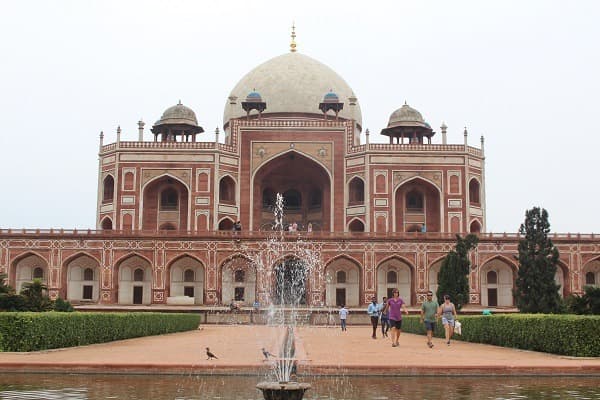
Humayun's Tomb rises at the heart of New Delhi, in the Nizamuddin neighbourhood. Built in the 16th century for the Mughal emperor Humayun, it stands as India's first grand garden mausoleum. Its Persian-Mughal architecture directly inspired the Taj Mahal. Inscribed on the UNESCO World Heritage list since 1993, the site brings together geometric gardens, fountains and roughly twenty subsidiary tombs within a single walled enclosure.
Practical information at a glance
- Entrance : paid admission (rates differ for Indian residents and foreign visitors)
- Hours : open sunrise to sunset, daily
- Suggested duration : 1.5 to 2 hours for the complete site
- Access : Jawaharlal Nehru Stadium metro station (Purple Line) or JLN Stadium, then a short walk or auto-rickshaw
- Dress code : no strict requirement, but smart casual attire recommended
- Accessibility : main garden pathways are accessible; access to the central mausoleum involves steps
What to see
The central mausoleum dominates the complex: a double marble dome set upon a lofty red sandstone platform. The facades alternate Persian arches with white marble inlays. Surrounding it, the Charbagh — a garden divided into four quadrants by water channels — structures the space according to Islamic paradise symbolism. The enclosure also holds the tomb of Isa Khan, a 16th-century Afghan nobleman, and several octagonal pavilions.
History and context
Humayun, the second Mughal emperor, died in 1556. His widow Bega Begum commissioned the mausoleum and engaged Persian architect Mirak Mirza Ghiyas. Construction was completed around 1572. This was the first time a formal Charbagh garden framed an imperial tomb in India — a model later replicated in Agra and Lahore. In 1857, the last Mughal emperor Bahadur Shah Zafar took refuge here before his capture by the British.
Highlights of the visit
The central mausoleum
Climb onto the platform to examine the details: white marble marquetry on red sandstone, ogival arches, Quranic calligraphy. The inner funerary chamber is austere, centred on Humayun's cenotaph. The double dome, visible from afar, reaches approximately 47 metres in height.
The Charbagh
The four garden quadrants, irrigated by shallow channels, offer a tranquil stroll. Early morning light casts long shadows that accentuate reflections in the water and the sandstone's colour. It remains one of Delhi's finest surviving Mughal gardens.
The tomb of Isa Khan
At the entrance to the site, this small octagonal mausoleum predates the main tomb chronologically. Its Lodi-Afghan style contrasts with Mughal architecture: lower proportions, more restrained ornamentation. It deserves a stop before or after visiting the central mausoleum.
The subsidiary tombs
The enclosure contains roughly twenty graves of imperial family members and nobles. Some remain anonymous. They trace the evolution of Mughal style across several decades.
Photography tips
Morning light (shortly after opening) is ideal: the sun strikes the mausoleum's eastern façade and reflections in the channels are sharp. In late afternoon, the western façade takes on a golden hue. From the platform, a low-angle framing emphasises the dome. Drones are prohibited without special authorisation from the Archaeological Survey of India.
Location and access
The tomb sits in the Nizamuddin East neighbourhood, south of New Delhi. The nearest metro station is Jawaharlal Nehru Stadium (Purple Line / Line 7). From there, allow approximately 10 to 15 minutes on foot or a few minutes by auto-rickshaw. The site lies close to the Nizamuddin Auliya dargah, a heavily visited Sufi shrine, and within reasonable distance of Purana Qila.
Nearby attractions
- Nizamuddin Auliya Dargah — 14th-century Sufi shrine, animated by qawwali sessions on Thursday evenings.
- Purana Qila — 16th-century Mughal fortress with archaeological museum and lake.
- Lodi Garden — urban park housing tombs of the Lodi and Sayyid dynasties, ideal for a morning walk.
- Safdarjung's Tomb — Delhi's last great Mughal mausoleum, less frequented, with similar architecture.
Frequently asked questions
October to March offers pleasant temperatures. Avoid May-June (extreme heat) and the monsoon season of July-August (high humidity). Winter (December-January) provides soft light, ideal for photography.
Yes, shoes must be removed before entering the central funerary chamber. Shoe covers or a storage area are typically provided on site.
Yes, both sites are within a few minutes' walk of each other. The dargah is particularly lively on Thursday evenings during qawwali sessions. Allow half a day for both.
Photography is allowed throughout the site, including inside the mausoleum. Drones require prior authorisation from the Archaeological Survey of India.
Allow 1.5 to 2 hours to explore the central mausoleum, gardens, Isa Khan's tomb and subsidiary tombs. A guided tour may add an additional hour.
Accredited guides offer their services at the site's entrance. The Archaeological Survey of India and certain local agencies also provide thematic tours by advance booking.
Photos
Interested in this visit?
We can include it in your personalised itinerary.