Beliefs and Religions in India
Beliefs and religions flourish throughout India. Hinduism, one of the world's oldest religions, gave rise to numerous dissenting movements. Buddhism is the most famous among them.
Beliefs and religions flourish throughout India. Hinduism, one of the world's oldest religions, gave rise to numerous dissenting movements. Buddhism is the most famous among them. Sikhism attempted an impossible reconciliation between Islam and Hinduism. Jainism, at the crossroads between Hinduism and Buddhism, is characterized by its strict respect for all animal life. Discover here everything you need to know about Indian religions, as well as the finest religious sites and experiences not to be missed if you plan to explore India.
Religions in India by percentage
The latest figures, compiled in 2011, show the following distribution within the population:
- Hinduism: 79.8%
- Islam: 14.2%
- Christians: 2.3%
- Sikhs: 1.7%
- Buddhists: 0.7%
- Jains: 0.4%
Hinduism
The most important religion of the Indian subcontinent, Hinduism structures the entire society. Deeply vibrant, it is characterized by numerous colorful festivals that punctuate Indian life. The belief in reincarnation leads to behaviors quite different from those observed in the West. The current life flows from actions, good or bad, accomplished in previous lives. For a Westerner, one must seize one's destiny during a single lifetime. For an Indian, it is better to seek spiritual improvement for the next life, with the ultimate goal of reaching Nirvana to escape the cycle of reincarnations.
Hindu Gods
There are millions of gods and goddesses in the Hindu pantheon, sometimes venerated locally, sometimes on a national scale. Among this multitude, three stand out: Brahma, Shiva, and Vishnu. They form what is called the Trimurti, a central concept of Hinduism.
Brahma, Shiva, and Vishnu, the principal gods of Hinduism
Brahma, the creator of the world, symbolizes the origin of all existence. He is represented with four heads. His worship is today marginal, with very few temples dedicated to him.
Vishnu, the protector, maintains the balance of the world. He descends to Earth in various forms called avatars when an imbalance threatens cosmic order. Krishna and Rama are his most popular avatars. His worship lies at the heart of several devotional traditions (bhakti) that remain very vibrant throughout India.
Shiva, the destroyer, symbolizes the transformation necessary for regeneration. He is both an ascetic withdrawn in the Himalayas and a family god surrounded by his wife Parvati and his son Ganesha. Temples dedicated to Shiva are among the most numerous and visited in India.
Other gods of Indian mythology
Alongside these three major figures, other deities hold a central place in the daily lives of the faithful. Ganesha, the elephant-headed god, is invoked to remove obstacles before any undertaking. Lakshmi, goddess of prosperity, is celebrated during the Diwali festival. Kali, meanwhile, a fearsome form of the goddess, embodies the destruction of evil forces. Each region, each caste, even each family, possesses its own tutelary deities.
Rituals, castes, and spirituality
Hindus practice a great diversity of rituals, from daily puja at home to collective ceremonies in temples. Each sanctuary is dedicated to a specific deity, and its structure reflects cosmic symbolism. Millions of the faithful undertake pilgrimages each year to sacred places such as Varanasi or the banks of the Ganges.
The caste system, though abolished by law, remains deeply entrenched. It divides society into four hierarchical categories, based on the karma accumulated in previous lives. This structure influences social role, religious duties, and the spiritual destiny of each individual.
Islam in India
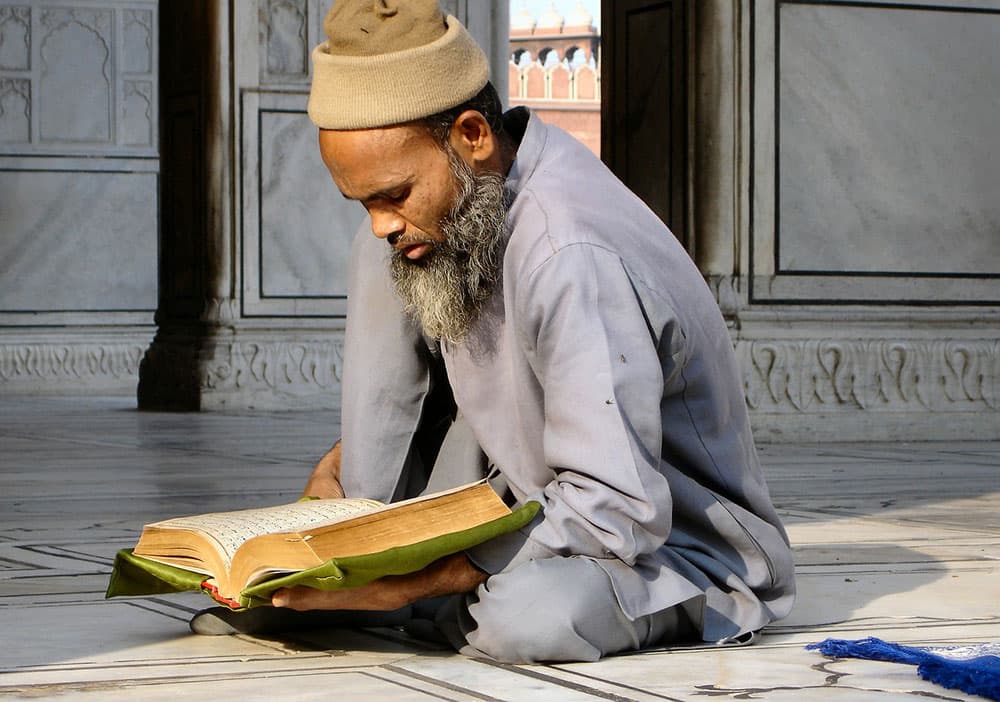
The second religion of India by number of adherents, Islam brings together approximately 14% of the population. Indian Muslims are predominantly Sunni, though there are also Shia communities. This minority is concentrated in the North of the country, notably in the states of Uttar Pradesh, West Bengal, Bihar, Jammu and Kashmir, and Assam. In the south, Karnataka stands out for its more significant Muslim presence.
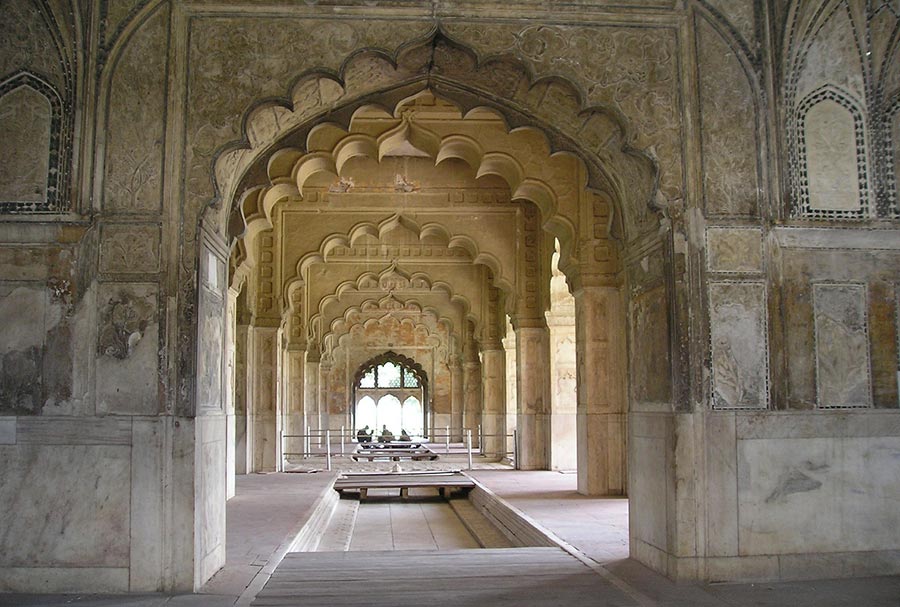
Islam became established in India from the 7th century thanks to Arab merchants, then strengthened with the Muslim invasions of India, under the Delhi Sultanate and the Mughal Empire. It left a lasting imprint on architecture (the Taj Mahal is a celebrated example), cuisine, music, and language (Urdu is of Indo-Persian origin).
Despite its ancient roots, the Muslim community sometimes faces political and social tensions, particularly in regions marked by communal rivalries.
Christianity
Minority but well-established, Christianity represents approximately 2.3% of India's population. It became established very early, according to tradition, through the apostle Saint Thomas, who is said to have arrived in South India in the 1st century. This ancient Church is known as the Church of Saint Thomas Christians.
Christianity later developed with Portuguese, French, and British missions from the 15th century onward. It is today the majority religion in certain states of the South (Kerala, Goa) and the Northeast (Nagaland, Mizoram, Meghalaya). You will find Catholics, Protestants, as well as autonomous Eastern Churches.
Indian Christians are active in education, health, and social work. They manage numerous schools, hospitals, and NGOs, often renowned for their effectiveness.
Sikhism
Sikhism is a monotheistic religion born in the 15th century in Punjab, in northwestern India, under the impetus of the spiritual master Guru Nanak. It advocates the unity of God, equality among men, the rejection of castes, and the importance of active and honest living.
Sikhs are recognized by their turbans, beards, and specific attire called the five Ks (including the famous kirpan, a symbolic dagger). Their place of worship, the gurdwara, is open to all, without distinction of religion or caste. The Golden Temple of Amritsar is their most sacred sanctuary.
With approximately 1.7% of India's population, Sikhs form an influential community, notably in the military, police, and transport sectors.
Buddhism
India is the birthplace of Buddhism, founded in the 6th century B.C. by Siddhartha Gautama. Although few in number today (0.7%), Indian Buddhists are present in certain regions such as Maharashtra, Ladakh, and Sikkim. This low percentage is explained by the decline of Buddhism in India from the 7th century onward, in favor of Hinduism and Islam.
Buddhist renewal was initiated in the 20th century, notably by B.R. Ambedkar, a major figure in the struggle for Dalit rights, who encouraged conversion to Buddhism to escape the caste system.
Jainism
An austere and ancient religion, Jainism emerged at the same time as Buddhism. It rests on the absolute principle of non-violence (ahimsa) toward all living beings. Jains follow a very strict code of life, aimed at causing no harm, even involuntarily, to insects or microorganisms. This is why some wear a veil over their mouths or sweep the ground in front of them as they walk.
This religion does not recognize a creator god, but teaches that each living being possesses a soul (jiva) capable of reaching liberation through asceticism and knowledge. Jains are few in number (0.4%), but very influential in commerce and business.
Other religions
India is also home to more discrete religious minorities: the Zoroastrians (or Parsis), established mainly in Mumbai, who arrived from Persia in the 10th century; the Jews of Cochin in Kerala, today very few in number; and animist tribes scattered throughout central and northeastern India, who maintain traditional cults blending local deities and forces of nature.
Religion and daily life
In India, religion is not confined to the private sphere. It permeates daily life in gestures, clothing, meals, greetings, and social relations. Vegetarianism, for example, is widespread, especially among Hindus, Jains, and certain Buddhists. Fasting, prayer, and domestic rituals punctuate the days of many believers. Each home possesses an altar where family deities are honored. In the streets, one encounters processions, religious festivals, sadhus (ascetics), and symbols such as Sikh flags and garlands of flowers. Religion also influences marriages, births, cremations, and partner choice.
The cow is a sacred animal for Hindus. A symbol of fertility, gentleness, and generosity, it embodies the nourishing mother (gau mata). As such, it must not be killed or eaten. In many states, cattle slaughter is strictly prohibited. One often sees cows wandering freely through cities and countryside, respected by all, even when they block traffic.
Religion and politics
Religion also plays an important role in the country's politics. India's Constitution guarantees religious freedom, but intercommunal tensions are frequent. Hindu nationalism, supported by the BJP party, advocates an Indian identity centered on Hinduism, which raises concerns among minorities. Anti-conversion laws exist in certain states. Regional parties sometimes mobilize religious groups to consolidate their electoral base. The country's recent history is marked by religious conflicts, such as the 2002 riots in Gujarat or the destruction of the Babri Mosque in Ayodhya.
The most renowned religious sites in India
Temples, mosques, and sanctuaries abound in India. During your visit, you can explore the most well-known ones. Among these, one may cite:
- Varanasi (Uttar Pradesh): a sacred city of Hinduism, situated on the banks of the Ganges. A place of cremation, prayer, and purification.
- Amritsar (Punjab): a holy city of Sikhism, famous for the Golden Temple (Harmandir Sahib), open to all.
- Bodhgaya (Bihar): a major Buddhist site where Siddhartha Gautama attained enlightenment beneath the Bodhi tree.
- Ajmer (Rajasthan): a major pilgrimage destination for Muslims, housing the tomb of the Sufi saint Khwaja Moinuddin Chishti.
- Rameswaram (Tamil Nadu): a sacred Hindu city, one of the four major sanctuaries (Char Dham) of the religion, associated with the Ramayana epic.
- Velankanni (Tamil Nadu): the country's principal Christian sanctuary, dedicated to Our Lady of Good Health, much frequented by Indian Catholics.
- Shravanabelagola (Karnataka): a holy place of Jainism, renowned for its monumental statue of Gomateshvara.
The finest religious experiences in India
- Attend the Aarti on the ghats of Varanasi: a fire ceremony on the Ganges, vibrant with fervor and emotion.
- Participate in the Kumbh Mela: the world's largest religious gathering, organized every 12 years in four sacred cities.
- Stay in an ashram: a spiritual retreat experience, meditation and yoga in a Hindu center.
- Share a meal in a gurdwara: in Sikh temples, the langar (free canteen) offers a moment of fraternity and equality.
- Walk the streets of Pushkar or Haridwar: these spiritually steeped cities offer complete immersion in religious India.
- Visit the caves of Ellora and Ajanta: masterpieces of rock-cut architecture blending Buddhist, Hindu, and Jain art.