Assam
Assam, poetically nicknamed the "land of the red river and blue hills," reveals itself as one of northeastern India's best-kept treasures. With an area of 78,438 km², this fascinating state seduces with its raw authenticity, endless tea plantations and exceptional biodiversity.
Assam, poetically nicknamed the "land of the red river and blue hills," reveals itself as one of northeastern India's best-kept treasures. With an area of 78,438 km², this fascinating state seduces with its raw authenticity, endless tea plantations and exceptional biodiversity. Traversed by the majestic Brahmaputra and home to the world's largest population of one-horned rhinoceroses in Kaziranga National Park, Assam promises a unique immersion in a universe where ancestral traditions and wild nature coexist harmoniously.
History of Assam State
Origins and etymology of the name Assam
The name Assam finds its roots in the history of the Ahom dynasty, a Tai people who ruled the region for over six centuries. According to the most accepted etymology, "Assam" derives from the Ahom term "Asom" or "Axom", meaning "unequaled" or "without equal" in their ancestral language.
This appellation testifies to the pride of a kingdom that successfully resisted Mughal invasions. The Ahom, originally from Burma, settled in the Brahmaputra valley in the 13th century and gradually transformed the ancient kingdom of Kamarupa.
Modern Assam preserves this historic designation, perpetuating the memory of these ancient sovereigns who shaped the unique cultural identity of this northeastern Indian region.
The Ahom dynasty and ancient kingdoms
Founded in 1228 by Sukaphaa, a Shan prince from Burma, the Ahom dynasty profoundly transformed the political landscape of Assam for nearly 600 years. This medieval kingdom flourished in the Brahmaputra valley, progressively absorbing local populations such as the Morans and Borahis.
The Ahom rulers established their first capital at Charaideo before moving the seat of power to Garhgaon. Their innovative administrative system, the Paik, organized society around military and civil service, creating a remarkably stable state structure.
This dynasty successfully resisted Mughal invasions, notably during the famous Saraighat battle in 1671 under the command of general Lachit Borphukan. The Ahom preserved Assam's independence until 1826, when British annexation followed the Yandabo treaty.
British colonial period and independence
The British took control of Assam in 1826 following the Yandabo treaty, ending six centuries of Ahom rule. This annexation was part of London's colonial strategy to secure the eastern frontiers of the Indian Empire against Burmese threats.
British administration profoundly transformed the local economy by developing tea plantations from 1840 onwards, drawing on labor imported from central India. This massive immigration policy durably altered the region's demographic composition.
Assam joined India's independence movement in the 20th century, with leaders like Gopinath Bordoloi emerging as emblematic figures of the local Congress. The state regained its freedom in 1947, initially encompassing present-day Arunachal Pradesh, Meghalaya and Nagaland.
Where is Assam located in India?
Geographic location and borders
Strategically positioned in northeastern India, Assam occupies an area of 78,438 km² in the Brahmaputra valley. The state shares borders with no fewer than seven Indian states: Arunachal Pradesh, Nagaland, Manipur, Mizoram, Tripura, Meghalaya and West Bengal.
Internationally, Assam borders Bangladesh for 263 kilometers and Bhutan to the north. This unique geographic position makes the state an essential crossroads between the Indian subcontinent and Southeast Asia.
Guwahati, the economic capital, stands as the natural gateway to this little-known region. Voyageinde accompanies you to discover these territories at the foothills of the Himalayas, where each border tells a different story of this particularly unique part of India.
The Brahmaputra, vital artery of the state
Traversing present-day Assam for 725 kilometers from east to west, the Brahmaputra constitutes the geographic and economic backbone of the state. This majestic river, the third largest in the Indian subcontinent, has shaped for millennia the valley that is home to over 35 million people.
Its annual floods, though sometimes devastating, enrich the soil with fertile silt, allowing rice cultivation and supporting the region's intensive agriculture. The river also serves as an essential transport route, connecting Guwahati to tea production centers at Dibrugarh and Jorhat.
The Brahmaputra's banks harbor Kaziranga National Park, a global sanctuary for the one-horned rhinoceros, and Majuli island, the world's largest inhabited river island. This vital artery remains the beating heart of Assamese identity.
Terrain and landscapes between plains and hills
The Brahmaputra valley reveals gently sloping terrain, characterized by vast alluvial plains dotted with hills of rounded shape. This gentle topography extends over nearly 100 kilometers in width, creating a patchwork of verdant landscapes where flooded rice fields intermingle with tea plantations.
Surrounding hills, with altitudes varying between 300 and 2,000 meters, harmoniously frame this fertile plain. To the north, the foothills of Arunachal Pradesh sketch a mountainous horizon, while to the south, the hills of Meghalaya and Nagaland offer more pronounced relief.
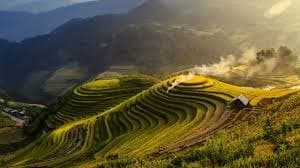
This unique geographic configuration favors terrace farming on gentle slopes and intensive agriculture in flat areas, creating landscapes of striking beauty.
Why is Assam unique?
World's leading black tea producer
Assam dominates global black tea production with nearly half of India's output distributed across 2,500 different gardens. This region represents 13% of global production, consolidating India's position as the second-largest producer after China.
Vast plantations extend along the Brahmaputra and over the foothills of the Himalayas, benefiting from ideal tropical climate conditions with rainfall reaching 300 mm per day during monsoon season. These exceptional conditions allow four annual harvests, the most prized being the summer pick.
Assam tea distinguishes itself through its robust malty notes and characteristic copper color, serving as the base for celebrated English breakfast teas and Earl Grey blends appreciated worldwide.
Exceptional biodiversity and endemic fauna
Assam constitutes one of India's two recognized biodiversity hotspots, belonging to the eastern Himalayan region. This exceptional richness flourishes across five national parks and eighteen wildlife reserves, harboring species found nowhere else on Earth.
The Indian one-horned rhinoceros symbolizes this remarkable fauna, with over 2,400 individuals recorded in Kaziranga alone. Among endemic species, the golden langur survives only in this region, while the pygmy hog remains one of the planet's rarest mammals.
The Dibru-Saikhowa forests and Karbi Anglong district hills also preserve populations of hoolock gibbons, India's only great apes, and Ganges dolphins in the Brahmaputra's waters.
Cultural mosaic and tribal traditions
More than twenty distinct tribes inhabit the hills and plains of this state, each preserving its ancestral customs and unique language. The Bodos, Mishings, Karbis and Rabhas form the largest communities, perpetuating millennial traditions through sacred dances, bamboo craftsmanship and seasonal festivals.
These Tibeto-Burman peoples excel in silk weaving, particularly the precious golden Muga silk, exclusive to this region. Their authentic villages offer a fascinating glimpse of a lifestyle harmonious with nature, where each ceremony is accompanied by traditional songs and colorful rituals celebrating agricultural cycles and local deities.
Essential sites to visit in Assam
Kaziranga National Park and one-horned rhinoceroses
Inscribed on the UNESCO World Heritage list since 1985, Kaziranga National Park stands as the essential sanctuary for the Indian one-horned rhinoceros. This 430 km² reserve today protects over 2,400 rhinoceroses, representing two-thirds of this emblematic species' global population.
Created in 1905 at the initiative of Lady Curzon, wife of the British viceroy, the park benefits from a unique ecosystem blending alluvial grasslands, tropical forests and marshland zones. Voyageinde organizes morning and evening jeep safaris offering the best opportunities to observe these peaceful giants in their natural habitat.
The reserve also harbors an exceptional density of Bengal tigers, Asian elephants and over 400 bird species, making each safari an unpredictable adventure in the heart of Assamese wild nature.
Majuli Island, world's largest river island
In the heart of the Brahmaputra, Majuli island extends over more than 400 km² and constitutes the planet's largest inhabited river island. Accessible only by ferry from Jorhat, this sacred land harbors 22 satras (Vaishnavite monasteries) where monks have perpetuated since the 15th century unique artistic traditions blending dance, theater and song.
The island reveals a fragile ecosystem threatened by river erosion, which gnaws annually at its banks. The 160,000 inhabitants, primarily from the Mishing tribe, live in stilt houses amid organic rice fields cultivating a hundred traditional varieties.
Voyageinde offers you the opportunity to discover this cultural sanctuary of Assam before climate change irreversibly alters its authentic character.
Kamakhya Temple in Guwahati
Dedicated to the goddess Kamakhya, this millennia-old sanctuary majestically rises atop Nilachal hill and constitutes one of the 51 most venerated Shakti Peethas in India. According to Hindu mythology, it was here that the reproductive organs of goddess Sati fell, making this place a unique spiritual center devoted to divine feminine power.
The temple's architecture harmoniously blends tantric influences and local Assamese styles, featuring its characteristic dome and ornamental sculptures. The inner sanctuary houses a natural rock fissure, venerated as a symbol of fertility and creation.
The Ambubachi Mela festival, celebrating the goddess's annual menstruation, attracts thousands of tantric pilgrims each June from across the world to participate in these unique ancestral rituals.
Practical Info ● Address : Nilachal Hills, Kamakhya, Guwahati, Assam 781010 ● How to get there : 8 km from Guwahati center, accessible by taxi or local bus (30 minutes travel) ● Opening hours : 5:30am-1:00pm and 2:30pm-10:00pm ● Entry fee : free ● Note : photography prohibited inside the main sanctuary. Dress modestly covering arms and legs to respect religious traditions
Manas National Park and its wildlife
At the foothills of the Himalayas, Manas National Park protects exceptional endemic fauna across 391 km² of tropical forests and alluvial grasslands. Traversed by the eponymous river which bestows unique landscapes, this sanctuary harbors species found nowhere else like the pygmy hog, golden langur and Assam hare.
Unlike Kaziranga specialized in rhinoceroses, Manas distinguishes itself through remarkable diversity with 55 recorded mammal species and 380 bird species. Bengal tigers, Asian elephants and clouded leopards roam this preserved ecosystem where reintroduction programs have enabled the return of the Indian rhinoceros after its local disappearance.
Morning safaris reveal this extraordinary biodiversity in intact natural setting, far from tourist crowds.
Guwahati, Assam's dynamic capital
Historic heritage and religious sites
Guwahati preserves living traces of the Kamarupa-Palas kingdom which established its capital here between the 4th and 12th centuries. This ancient city reveals remarkable architectural heritage today, blending Hindu and Buddhist influences in its numerous sacred edifices.
The Umananda temple, erected on the Peacock Island in the middle of the Brahmaputra, constitutes one of the region's oldest Shiva sanctuaries. According to local legend, the demon Narakasura founded this sacred city, explaining the exceptional concentration of temples on surrounding hills.
The Navagraha temples and Basistha Ashram complete this unique spiritual geography, where each site recounts a facet of Assamese history. These monuments testify to the cultural richness inherited from dynasties that shaped this crossroads region's identity between India and Southeast Asia.
Modern life and urban development
Economic capital of northeastern India, Guwahati experiences accelerated urban transformation since obtaining smart city status in 2016. The Assam government invests massively in modern infrastructure with the construction of Brahmaputra Riverfront, the city's new green lung spanning 4,645 m² that revitalizes river banks.
The metropolis benefits from the Smart City Mission program modernizing public transport, street lighting and waste management. New shopping centers like City Centre Mall now stand alongside contemporary residential complexes in Beltola and Hatigaon neighborhoods.
This rapid urban expansion attracts thousands of migrants annually from rural Assam zones, making Guwahati a metropolis of nearly one million inhabitants that reconciles cultural heritage with future ambitions.
Gateway to northeastern India
Strategically positioned at the confines of the Indian subcontinent, Guwahati assumes the essential role of crossroads for accessing the seven sister states of the Northeast. Its Lokpriya Gopinath Bordoloi International Airport, India's tenth busiest, serves daily Delhi, Kolkata and Mumbai, while its railway connections efficiently link the region to the national network.
The city concentrates administrative headquarters of major regional transport companies and houses the headquarters of Northeast Frontier Railway, facilitating transfers to Arunachal Pradesh, Meghalaya or Nagaland. This privileged position naturally transforms Guwahati into the ideal departure point for exploring this entire eastern Himalayan region, where Voyageinde organizes multi-state circuits adapted to your adventure desires.
Tea plantations and Assam's flavors
Discovering traditional tea gardens
At daybreak, Assam's traditional tea gardens awaken in a golden mist caressing century-old tea bushes. These historic estates like Mokalbari, founded in 1876, or Tonganagaon, created in 1927, perpetuate orthodox cultivation methods inherited from the British colonial era.
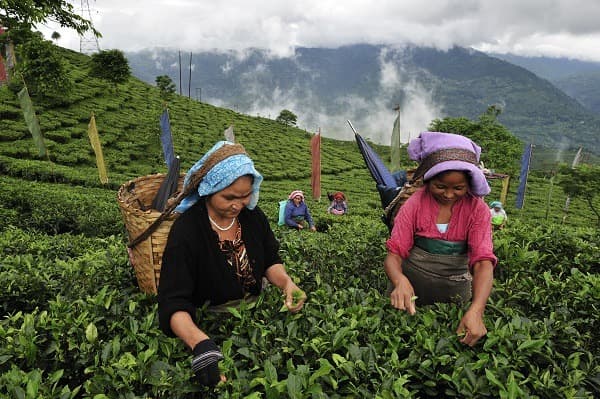
Harvesters, dressed in colorful saris, traverse rows of Camellia sinensis assamica from dawn to select the "two leaves and a bud" that will produce the finest brews. This endemic variety, discovered in 1823, naturally produces robust teas with characteristic malty notes.
Tea gardens extend over hundreds of hectares along the Brahmaputra and over Himalayan foothills, creating a unique landscape of verdant hills punctuated by colonial bungalows where planter families still live, guardians of centuries-old traditions.
Tasting famous Assamese black tea
Assam's black teas reveal robust and malty flavors that characterize this region. This copper-colored liquor exudes subtle woody aromas, accompanied by sweet spice notes and honey that linger pleasantly on the finish.
Tasting is ideally practiced in the morning, when the high caffeine content and tea's robustness provide an energizing start. Connoisseurs particularly appreciate GFOP and TGFOP grades, composed of terminal buds and the following two leaves, which concentrate the finest aromatic qualities.
You can savor this Assam tea plain to fully appreciate its authentic chocolatey flavors, or accompany it with a splash of milk according to British tradition which reveals its malty sweetness.
Manufacturing process and harvest
Assam tea harvest occurs according to two distinct periods: the first flush from late March to May, then the second flush from June to August, considered superior for its characteristic golden tips.
Harvesters manually select terminal buds accompanied by the two youngest leaves, transported in bamboo baskets to transformation workshops located near the plantations.
The CTC method (Crush, Tear, Curl) dominates Assamese production, grinding and rolling leaves to create uniform granules. Premium orthodox teas follow a more traditional process: withering for 12 to 18 hours, manual rolling, controlled oxidation then final drying which fixes the malty aromas so prized by connoisseurs.
Assamese culture and traditions
Assamese language and linguistic diversity
Assamese constitutes the state's official language since 1960, spoken by approximately 13 million speakers, representing 48.8% of the total population. This Indo-European language, the easternmost of its linguistic group, coexists with over forty other idioms reflecting the region's exceptional ethnic richness.
Tribal communities preserve their ancestral languages belonging to Sino-Tibetan, Austro-Asiatic and Tai-Kadai families. Bengali remains significantly present, particularly in the Barak valley, while Bodo enjoys co-official status in certain autonomous districts.
This linguistic mosaic testifies to Assam's complex migratory history, where each community contributes to shaping this crossroads state's unique cultural identity between India and Southeast Asia.
Colorful festivals and local celebrations
The enchanting rhythms of dhol drums resonate throughout the valley during Bihu, the emblematic festival celebrated three times yearly according to the agricultural calendar. Rongali Bihu in April marks the Assamese new year with traditional dances where women, dressed in luminous mekhela sadors, gracefully dance around men playing the pepa (buffalo horn flute).
Bodo tribes simultaneously organize Baishagu, their own spring celebration punctuated by ancestral rituals and community feasts. The Ambubachi Mela at Kamakhya temple attracts thousands of tantric pilgrims each June honoring the mother goddess.
These authentic festivities offer visitors total immersion in the Assamese soul, where each song and gesture perpetuates millennial traditions transmitted generation after generation.
Traditional craftsmanship and Assam silk
Sualkuchi, nicknamed the "Manchester of the East", concentrates nearly 3,000 weavers specialized in producing muga, pat and eri silk on the Brahmaputra's banks. This textile city perpetuates millennial techniques where looms are transmitted from father to son within Muslim families, while Hindu craftspeople devote themselves to pattern design and commercialization.
Muga silk, true "golden fiber" with natural golden luster, exclusively serves to make the mekhela chador, traditional dress of Assamese women. Its distinctive yellow color and exceptional durability make it a sought-after raw material, once reserved for the royal family.
Artisan villages throughout Assam also offer bamboo objects, metal xorai trays and ecological eri textiles. Voyageinde accompanies you to discover these authentic workshops where local craftsmanship represents a vital economic sector for many rural households.
Local gastronomy and culinary specialties
Typical rice and fish-based dishes
Rice and fish constitute the pillars of Assamese gastronomy, reflecting this state's riverine geography traversed by the Brahmaputra. Local chefs traditionally prepare masor tenga, a sweet-sour fish curry perfumed with lemongrass and tamarind, served with steamed fragrant rice.
Freshwater fish such as rohu and hilsa come in varied preparations: fried with local spices, steamed in banana leaves or simmered in sauces based on mustard and turmeric. Khaar, an emblematic dish prepared with vegetables and dried fish, derives its unique taste from ash cinders of banana stems conferring a characteristic alkaline flavor.
These culinary specialties are savored accompanied by sticky rice or local basmati rice, creating taste associations revealing the full richness of Assamese terroir products.
Tribal influences in cuisine
Assam's tribal communities bring authentic dimension to local gastronomy through ancestral preservation techniques and surprising ingredients. Bodo and Mising tribes master bamboo shoot fermentation becoming khorisa, the sour-sweet condiment essential to traditional curries.
These mountain populations also consume silkworms, red ant eggs and various insect larvae rich in protein, prepared sautéed with local spices. Tribal women harvest over 3,000 varieties of wild medicinal herbs integrating them into culinary preparations.
Proximity with Myanmar and China influences these tribal cuisines privileging umami flavors and smoking techniques, creating a unique gastronomic heritage within northeastern India.
What is the climate in Assam?
Tropical monsoon and marked seasons
Assam benefits from a tropical monsoon climate characterized by three distinct seasons rhythming local life. The summer monsoon, from June to September, brings abundant precipitation often exceeding 2,500 mm annually, transforming landscapes into verdant treasures.
Assam's hills rank among the world's wettest regions, with records exceeding 12 meters annual rainfall in certain areas. This humid period nourishes tea plantations and feeds the Brahmaputra, but can complicate travel.
The dry season extends from October to May, offering ideal conditions for exploring national parks and navigating the river. Temperatures vary from 10°C in winter to 35°C before monsoon, creating climate contrasts that shape this state's exceptional ecological richness.
Best time to visit the state
October to March represents the optimal period to discover Assam, with pleasant temperatures oscillating between 15°C and 25°C. During these months, rainfall absence facilitates travel to national parks allowing ideal wildlife observation conditions.
November and December offer particularly clement climate for Kaziranga safaris and Majuli island excursions. Cool mornings reveal spectacular mists over the Brahmaputra, creating magical atmosphere for photography.
January to March perfectly suits trekking in the hills and tea plantation visits, when tea bushes bud before first harvest. Avoid June to September, period of intense monsoon when roads may become impassable.
Practical travel advice
Flight remains the fastest means to reach Guwahati from the Indian capital, with approximately 2.5 hours flight time. Air India, IndiGo and SpiceJet operate daily services to Lokpriya Gopinath Bordoloi airport, situated 21 km from downtown.
Train constitutes an economical alternative with the Rajdhani Express connecting New Delhi to Guwahati in approximately 27 hours. This service runs twice daily traversing West Bengal landscapes before reaching the Brahmaputra valley.
For tight budgets, overnight buses ensure connection in 36 hours via Siliguri, though this option proves more tiring over the 1,500 kilometer route.
Local transport and travel
Moving within Assam reveals the diversity of transport means typical of northeastern India. Colorful auto-rickshaws traverse Guwahati's streets and constitute the most practical means for short urban distances, with negotiable fares oscillating between 20 and 100 rupees depending on destination.
Reaching tea plantations and remote villages, local buses offer authentic experience in contact with Assamese populations. These vehicles regularly serve Jorhat, Dibrugarh and Tezpur, allowing access to the region's main tea gardens.
Car rental with driver remains the privileged option for exploring national parks and Majuli island with total freedom. Voyageinde organizes these private transfers transforming each journey into discovery of the Brahmaputra valley's authentic landscapes.
Accommodations and recommendations
Assam offers varied accommodation range adapted to all budgets and travel styles. Guwahati concentrates the most diverse supply, from family guesthouses to 5-star hotels like Radisson Blu, recognized for its Brahmaputra views.
Tea plantations offer unique experiences in their renovated colonial bungalows, where you sleep at the heart of century-old gardens. These heritage properties around Jorhat and Dibrugarh combine historic charm and modern comfort.
Near national parks, eco-lodges privilege nature immersion with stilt cabins and equipped safari tents. Expect between €30 and €150 nightly depending on chosen standard, breakfast generally included in charming establishments.