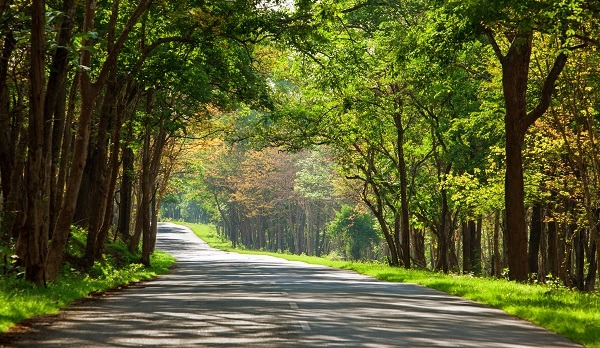
Gibbon Wildlife Sanctuary
Gibbon Wildlife Sanctuary
India's last stronghold for the Hoolock gibbon, this Assam sanctuary concentrates rare biodiversity across 21 km² of tropical forest, to discover near Jorhat.
Gibbon Wildlife Sanctuary is a protected area established in Assam. Formerly known as the "Hollongapar Forest Reserve," it covers approximately 20.98 km². This moist tropical forest harbors a diverse array of fauna and flora, including bamboos and orchids, and is particularly renowned for its primate populations.
History
Gibbon Wildlife Sanctuary was originally a forest reserve established on August 27, 1881. Its alternate name, "Hollongapar Forest Reserve," derives from the abundance of Hollong trees, or Dipterocarpus macrocarpus, found throughout the site. The sanctuary was an integral part of the Patkai mountain forests.
Over time, the area became fragmented. Tea gardens and small villages gradually emerged in its vicinity. In 1924, plantations were introduced to enhance the forest's development and productivity. This practice ultimately benefited the site's biodiversity. Today, Gibbon Wildlife Sanctuary is home to the Hoolock Gibbon, India's only great ape and one of the world's 25 most endangered primates.
Exploring Gibbon Wildlife Sanctuary
Surrounded by picturesque tea gardens and traditional villages, Gibbon Wildlife Sanctuary will undoubtedly enchant nature enthusiasts. Towering Hollong trees dominate the forest canopy, while the understory is carpeted with Mesua Ferrea trees.
Despite its modest size, the sanctuary harbors numerous mammals, including Assamese macaques, tigers, elephants, leopards, jungle cats, giant squirrels, Indian civets, wild boar, and sambar deer. However, the sanctuary's true stars remain the Hoolock Gibbon and the Bengal slow loris, the only nocturnal primate visible in northeastern India. Beyond these, discover 219 bird species and several reptiles, including the Indian python, Indian cobra, lizards, Indian tent turtle, and more.
Practical Information
Opening Hours and Admission Fees
Gibbon Wildlife Sanctuary welcomes visitors daily, Monday through Sunday, from 8 AM to 5 PM. Admission rates are as follows:
- Indian nationals: 50 Rs
- Foreign visitors: 500 Rs
- Camera fee: 500 Rs
Gibbon Wildlife Sanctuary is located approximately 19 km from Jorhat city center and 5 km from Mariani.
By air, Jorhat Airport is the nearest airport to the forest, 22 km away. It is connected to Kolkata and other major destinations across India. The closest international airports to Jorhat are located in Guwahati and Imphal.
If traveling by train, Meleng Station is the nearest railway station, located at the forest's edge and served by a rail line that passes through the sanctuary. Alternatively, you can disembark at Jorhat Town Station in the city center.
By road, take NH 37 to reach Jorhat and then the sanctuary. Buses also connect the sanctuary to Mariani, just 5 km away.
Want to discover this destination?
Our local advisors design your tailor-made trip.