Monsoon Palace
Monsoon Palace
Perched at 944 m on Bansdara mountain, Monsoon Palace dominates Udaipur, Lake Pichola and the Aravalli range. History, architecture and visiting advice.
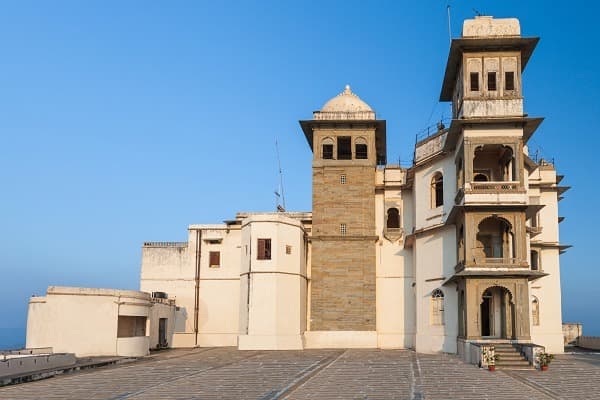
Perched at 944 metres altitude on the peak of Bansdara mountain, the Monsoon Palace (or Sajjangarh Palace) dominates Udaipur, Lake Pichola and the Aravalli range. Built in the late 19th century by Maharana Sajjan Singh, this white marble palace combines Rajasthani architecture with a panoramic vantage point, with a wildlife sanctuary accessible by safari at its feet.
Why visit Monsoon Palace
The site brings together three attractions rarely found together around Udaipur:
- A 360° viewpoint over Lake Pichola, the old city and the Aravalli hills, particularly striking in late afternoon.
- Late 19th-century Rajasthani architecture blending white marble, domes, jharokas and turrets, in a partially incomplete state that tells a singular story.
- A wildlife sanctuary at its feet, traversable by mini-van, with varied fauna and bird-watching opportunities.
The palace also served as the setting for the James Bond film Octopussy, filmed in 1983.
History: an unfinished monsoon observatory
Maharana Sajjan Singh began construction of the building in the late 19th century with a precise ambition: to make it a nine-storey astronomical centre designed to observe monsoon clouds over the region — hence the name "Monsoon Palace" that has remained in use. The building was also intended to serve as a summer residence for the royal family and provide work for the inhabitants of Bansdara.
Sajjan Singh died prematurely at 26, while the palace was only partially built. His successor, Maharana Fateh Singh, completed the building but abandoned the original astronomical observatory project. The palace was subsequently used as a monsoon residence by the house of Mewar.
In the 20th century, the site enjoyed a second cinematic life hosting the filming of Octopussy, the thirteenth James Bond film, which features it as the residence of villain Kamal Khan.
What to see on site
Palace architecture
The building exemplifies late 19th-century Rajasthani vocabulary: white marble, domes, fountains, jharokas (corbelled balconies) and tall turrets. A vast central courtyard serves several rooms and quarters, with walls bound in lime mortar. Inside, several marble pillars bear finely carved floral motifs. The interior layout, partially unfinished, remains sober — the palace's main interest lies in its volume, light and openings.
The views
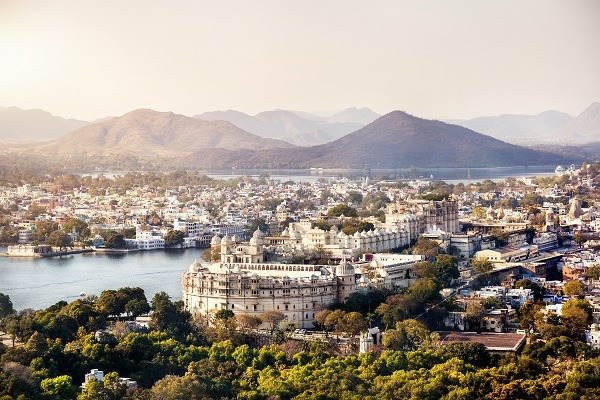
From the terraces, the view encompasses Lake Pichola, City Palace, the silhouette of the old city and the Aravalli range. It is one of the rare vantage points that allows you to grasp Udaipur's geography at a glance.
The wildlife sanctuary
Created in 1987, the Sajjangarh Wildlife Sanctuary extends at the foot of the palace. It is home to tigers (rare), sambhars, wild boar, hyenas, leopards, jackals, reptiles and rich birdlife. Mini-van excursions allow you to explore it, generally in late afternoon. Watch out for monkeys around parking areas and viewpoints: they are known for stealing food and shiny objects.
When to visit
The most comfortable period for ascending Monsoon Palace runs from October to March, when temperatures remain moderate and skies are clear. The monsoon (July-September) has its own appeal: the Aravalli vegetation turns green, clouds gather over the palace and fully justify its name — at the cost of sometimes reduced visibility.
Regardless of season, the most sought-after time slot is sunset, when the hills pass through every shade of ochre. Plan to arrive about an hour early to have time to visit the palace and settle in.
Practical information
- Opening hours: open daily during daylight hours until sunset. Exact timings vary by season and should be verified before your visit.
- Admission fees: moderate entry, with separate rates for foreign and Indian visitors. Additional charge if you arrive in your own vehicle (parking).
- Duration of visit: allow 1 to 2 hours for the palace and its terraces, longer if you combine it with the sanctuary.
- What to bring: water, sturdy shoes (trails and stairs), sun protection. Keep an eye on your bags around monkeys.
How to get there
Monsoon Palace is located about 10 km from Udaipur city centre. The road winds in switchbacks over the final kilometres and access is necessarily by vehicle from the sanctuary entrance, either with your driver or with official vehicles available at the entry. Taxis and auto-rickshaws from town easily serve the base of the sanctuary. Combining the ascent with sunset remains the most common option.
Nearby
Monsoon Palace is part of a natural circuit around Udaipur and its palaces. To extend your visit, several complementary sites in India are worth combining:
- Bangalore Palace — another example of royal residence with mixed influences, in the south of the country.
- Bandhavgarh National Park — to take the safari experience further after Sajjangarh sanctuary.
- Ajit Singh Memorial — another site linked to the history of the Maharanas and Rajputs.
- State Museum of Bhopal — to deepen understanding of Central India's historical and artistic context.
Frequently asked questions
Frequently asked questions
Including Monsoon Palace in your journey
Monsoon Palace naturally fits into a stay of several days in Udaipur, between City Palace, Lake Pichola and excursions into the Aravalli. To build a complete itinerary in Rajasthan or beyond, consult our trips to India and their recommended stops.
Interested in this visit?
We can include it in your personalised itinerary.