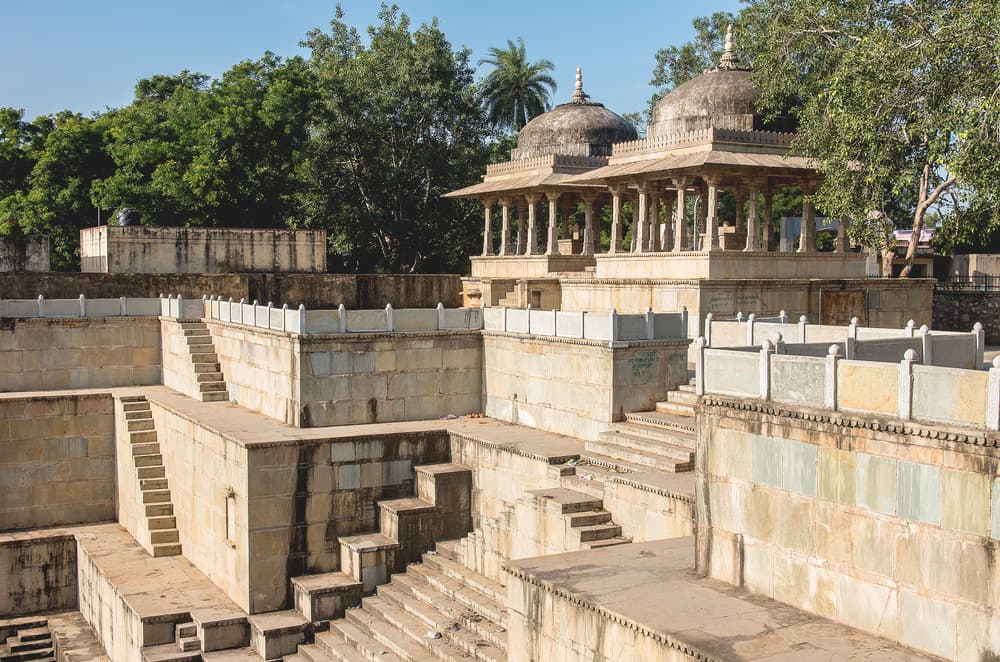
Dabhai Kund
Dabhai Kund
Dabhai Kund, a monumental stepwell in Bundi, showcases the hydraulic engineering of Rajasthan. Free access, peaceful atmosphere, remarkable geometry.
The Dabhai Kund, sometimes called Jail Kund, is one of the most impressive stepwells in Bundi, Rajasthan. Less visited than other monuments in the city, this vast sandstone reservoir illustrates the hydraulic ingenuity developed in this semi-arid region and the central role of water in local community and religious life.
Why visit Dabhai Kund
Three main reasons justify a detour to this site:
- Remarkable geometric architecture: hundreds of symmetrical steps structure the walls and create perspectives that shift throughout the day.
- An off-the-beaten-path site: visitor numbers remain low, allowing for a peaceful visit conducive to observation and photography.
- A useful complement to the classic stepwell circuit of Rajasthan, alongside Raniji Ki Baori and Nagar Sagar Kund.
History of Dabhai Kund
Dabhai Kund, also known as Jail Kund, is generally dated to the 16th century, during the reign of the Chauhan rulers. Some historians place it in the 17th century instead, attributing its construction to local merchants. Both hypotheses coexist in the literature, lacking definitive sources.
The structure addressed a key challenge in Rajasthan: storing and managing rainwater in an area where drought is recurring. Built in sandstone, it served as a community reservoir and also hosted purification rituals, making the site both a social and religious space.
With the spread of modern water supply systems, the kund lost its practical function. Today it survives as a testament to stepwell architecture and one of the finest examples of this tradition in Bundi.
What to observe on site
The site consists of a monumental rectangular reservoir whose walls are entirely lined with steps. There are commonly more than 700 of them, arranged with great geometric precision, though this frequently cited figure is difficult to verify exactly.
The appearance of the place varies considerably depending on the season:
- During the monsoon, the basin fills with water and reflects the ochre walls, accentuating the sense of depth.
- In the dry season, the steps are fully exposed, showcasing the complexity of their arrangement.
The atmosphere remains quiet and contemplative. Plan 30 minutes to 1 hour to walk around the site and descend a few levels.
Practical information
- Access: free, open year-round.
- Fee: none.
- Visit duration: 30 minutes to 1 hour.
- Location: in the heart of Bundi, about 15 minutes on foot from the center.
- What to bring: sturdy shoes (steps can be slippery after rain), water, sun protection.
The site is not permanently monitored: stay cautious near the edges, especially with children.
When to visit
The best time to visit Bundi and Dabhai Kund runs from November to March, when temperatures are manageable and skies are clear. The monsoon (July-September) fills the basin and offers a different perspective, but the steps become slippery. May and June should be avoided due to extreme heat, often exceeding 40°C in this part of Rajasthan.
For photography, choose early morning or late afternoon: raking shadows accentuate the geometry of the steps.
How to get there
Bundi is primarily reached by road or train. As a reference:
- From Kota: approximately 40 km, the nearest gateway (major railway station).
- From Jaipur: approximately 210 km, accessible by car or bus.
- From Udaipur: approximately 270 km, by private vehicle or via Chittorgarh.
Bundi railway station is connected to Jaipur and Kota. Once in town, local rickshaws and taxis can reach the kund in minutes, or you can walk from the center.
Nearby, in Bundi
The visit combines easily with other sites in the old town:
- Raniji Ki Baori: the most famous stepwell in Bundi, built in 1699 by Queen Nathavati. More ornate than Dabhai Kund, it stands out for its sculpted arches.
- Nagar Sagar Kund: twin stepwells located near the central market, another testament to the importance of water in Bundi.
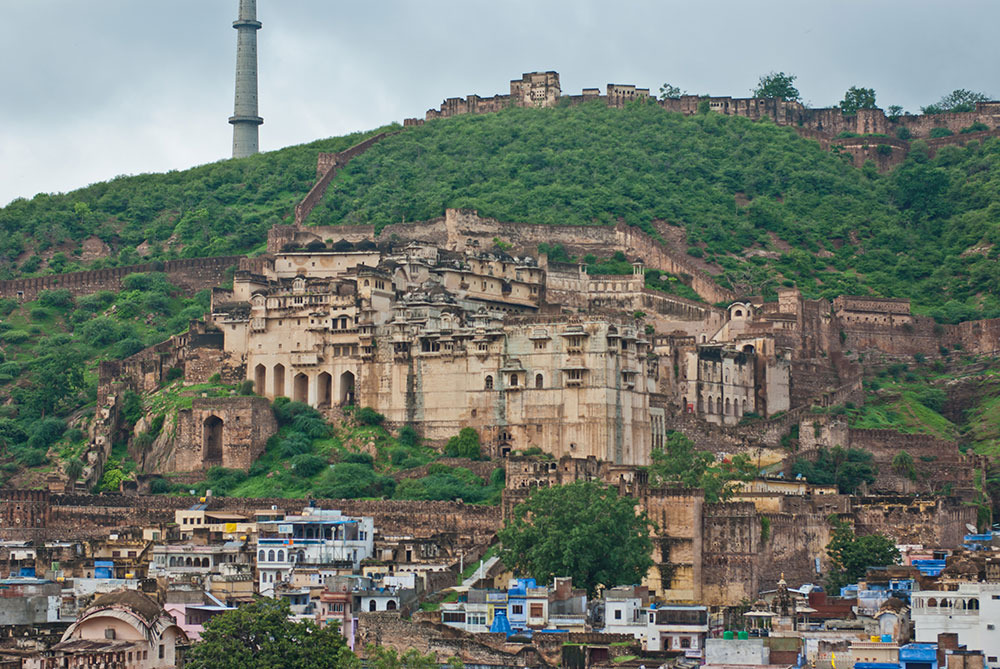
- Garh Palace: vast palace complex renowned for its murals.
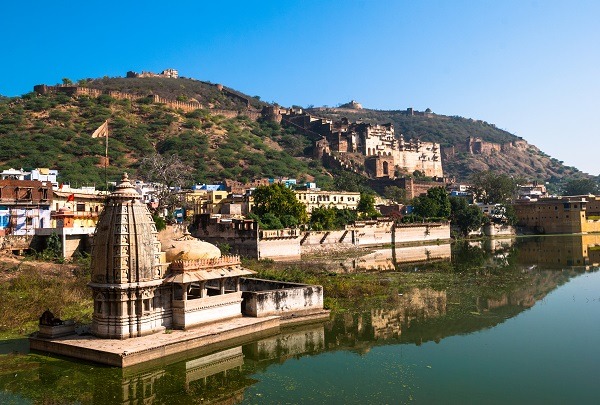
- Taragarh Fort: 14th-century fortress overlooking the city, offering a panoramic view of Bundi.
- Sukh Mahal: small lakeside palace that inspired Rudyard Kipling during his stay in Bundi.
Frequently asked questions
Frequently asked questions
No. Access is free and the site remains open year-round, with no time restrictions.
Plan 30 minutes to 1 hour, depending on whether you descend several levels of steps.
Yes, in the dry season, though with caution: the steps are irregular and there are no handrails. During the monsoon, the basin is partially filled with water.
November to March for comfortable weather. The monsoon (July-September) offers a water-filled site, but the steps become slippery.
Yes, but with caution around children due to the absence of barriers along the steps.
Plan your journey
Dabhai Kund fits naturally into a Rajasthan itinerary, complementing essential stops like Jaipur, Udaipur, or Pushkar. To build a personalized route, consult our India journeys or explore other sites in the region.
Interested in this visit?
We can include it in your personalised itinerary.