Bara Imambara
Bara Imambara
An 18th-century Shiite sanctuary in Lucknow, Bara Imambara combines a giant vaulted hall without pillars, a legendary maze, and a unique social history.
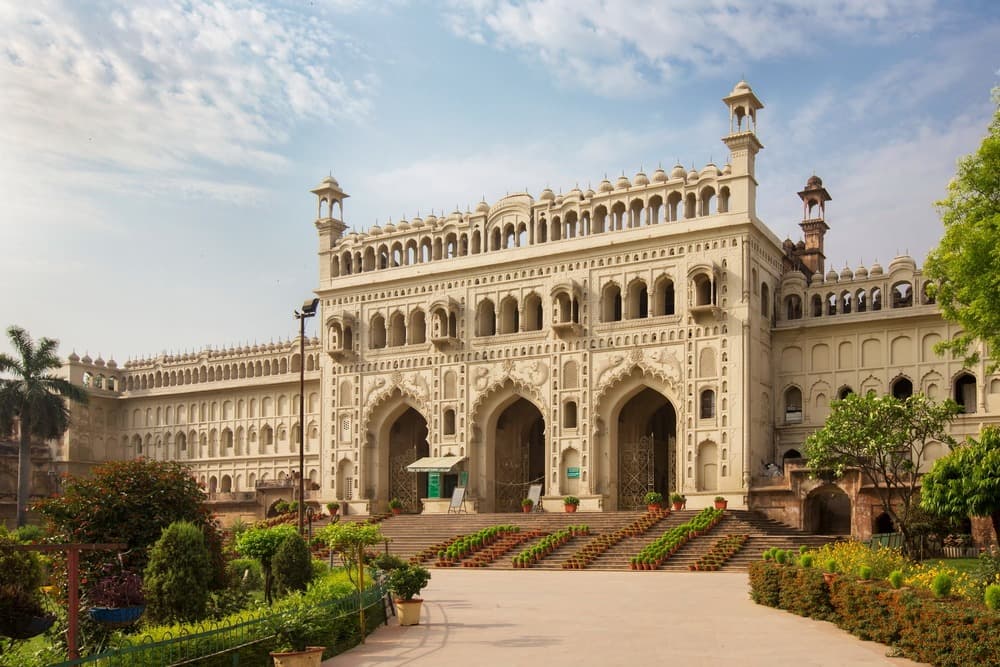
Bara Imambara, also known as Asafi Imambara, is a vast Shiite religious complex built in late 18th-century Lucknow, capital of Uttar Pradesh. Commissioned by Nawab Asaf-ud-Daula, it combines sanctuary, mosque, stepwell, and maze in a blend of Mughal, Persian, and Rajput styles. It is also one of the world's largest vaulted spaces constructed without beams or pillars.
Why Visit Bara Imambara
The site brings together several attractions rarely found in a single Indian monument. Its Bara Hall — 50 m long, 16 m wide, 15 m high — is considered one of the world's largest vaulted halls without beams or pillars. Its maze, the Bhool Bhulaiya, retains a reputation as a challenge for visitors. And behind the stone lies a singular social history: the edifice was born from an employment programme intended to aid a population ravaged by famine.
Bara Imambara is also an active Shiite sanctuary, used every year during the month of Muharram for commemorations in memory of Imam Hussain, grandson of the Prophet Muhammad, martyred at the Battle of Karbala in 680.
History: A Construction Project Born from Famine
Construction took place between 1784 and 1791, under the authority of Nawab Asaf-ud-Daula, sovereign of the Awadh kingdom. At that time, the region was devastated by famine that plunged tens of thousands into destitution. Rather than distribute alms, the Nawab chose to finance a major construction project capable of employing over 20,000 workers and guaranteeing them sustained income.
Tradition recounts a continuous construction-demolition system: by day, workers from the people built; by night, impoverished nobles anxious to preserve their dignity came to demolish part of the work, which also provided them with discreet remuneration. This mechanism prolonged the project over eleven years, until the famine ended. Several historians see in it a pre-Keynesian approach to fighting poverty through public spending.
The total cost is estimated between 500,000 and 1,000,000 rupees of the period, with an annual budget for maintenance and decoration between 400,000 and 500,000 rupees — considerable sums for the 18th century.
What to See on Site
The Bara Hall, An Architectural Marvel
The central hall is the most striking element of the complex. Painted in pistachio green and white, adorned with chattris (small decorative domes) and stucco motifs, it extends with no beam or pillar supporting its roof. The structure rests on a system of interlocking Lakhauri bricks bound by mortar of lime mixed with rice husk ash, a technique that ensured the building's durability and stability on marshy ground. The walls reach nearly 20 feet thick, naturally regulating interior temperature.
The Bhool Bhulaiya, The Maze
On the top floor of the main building runs a network of narrow corridors, staircases, and interconnected passages designed both to lighten the roof load and to confound potential intruders. There are 489 identical doors. Legend speaks of 1,024 entrances and only two exits — a claim more folkloric than factual, yet very much alive. A whispering gallery allows a barely audible whisper to be heard from one end to the other. A guide is highly recommended for venturing into it.
Mosque, Stepwell, and Monumental Gate
- Naubat Khana: pavilion of musicians, which once announced the arrival of dignitaries.
- Asafi Mosque: to the west of the complex, it houses the mausoleum of Nawab Asaf-ud-Daula.
- Shahi Baoli: a stepwell fed by a spring, designed to remain cool in summer.
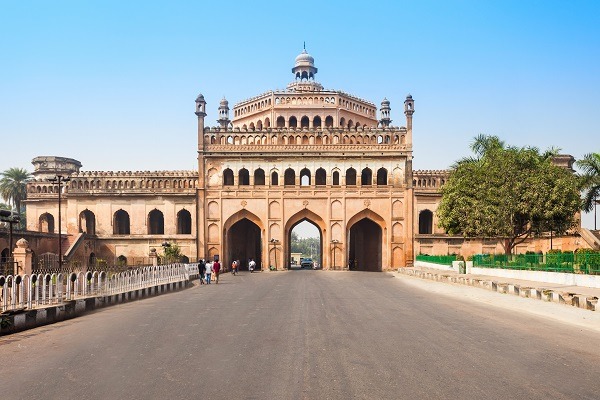
- Rumi Darwaza: monumental gate 18 m high inspired by Ottoman architecture, marking the entrance to the historic quarter.
During Muharram, devotees bring taziyas, miniature replicas of sanctuaries, in tribute to Imam Hussain.
Practical Information
- Closed days: Mondays.
- Hours: open during the day, from morning until late afternoon. Best to arrive early to avoid crowds and heat.
- Admission: moderate entrance fee, with separate rates for Indian and foreign visitors. The ticket generally grants access to multiple monuments within the complex.
- Dress code: modest clothing, head covering mandatory (scarves provided at entrance), shoes must be removed before entering the sanctuary.
- Guide: recommended, particularly for the Bhool Bhulaiya. A flashlight can be useful in dark passages and at Shahi Baoli.
Plan 1.5 to 2.5 hours for a complete visit including the maze.
When to Visit
The best period spans October to March: pleasant temperatures and clear skies. The monsoon, from June to September, makes visiting less enjoyable, and April to June experience intense heat (often exceeding 40°C in Lucknow).
For a richer experience, the month of Muharram (Islamic calendar, therefore variable year to year) sees Bara Imambara fulfill its primary function as a Shiite sanctuary, with processions, taziyas, and mourning ceremonies. Crowds are significant and certain areas may be reserved for devotees.
How to Get There
The monument is located in the old city of Lucknow, in the Husainabad quarter.
- By air: Chaudhary Charan Singh international airport is about 14-15 km away. Taxis and ride-sharing services connect to the historic centre in 30 to 45 minutes depending on traffic.
- By train: Lucknow Charbagh station, about 5 km away, is well connected to the rest of the country. Rickshaws, taxis, and ride-sharing services provide connections.
- On foot: the quarter is walkable, with main monuments located close to one another.
Nearby
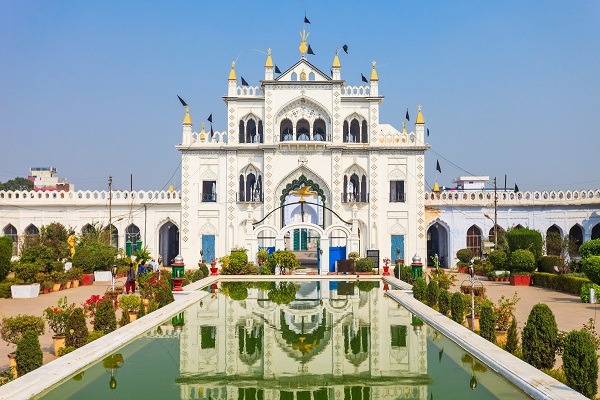
The Husainabad quarter concentrates several monuments worth visiting in sequence: the Chota Imambara, smaller but renowned for its chandeliers and ornaments, the Rumi Darwaza just next door, as well as the Husainabad Clock Tower and the Picture Gallery. Half a day to a full day allows you to cover everything.
To extend an Indian itinerary around heritage and architecture, you can also consult our guides on the Alchi monastery in Ladakh, the Ajit Singh Memorial, or Anjengo fort in Kerala.
Frequently Asked Questions
Frequently asked questions
It is not mandatory for the main complex, but highly recommended for the Bhool Bhulaiya, where 489 identical doors make orientation very difficult. A guide also helps you understand historical anecdotes and architectural details.
Bara Imambara is an active Shiite sanctuary. Clothing covering shoulders and knees is expected, the head must be covered (scarves provided on site), and shoes removed before entering the prayer hall.
The maze occupies the top floor of the main building and is integral to the circuit. The ticket generally includes access to multiple elements of the complex (Bara Imambara, mosque, Shahi Baoli, sometimes Chota Imambara).
The Chota ("small") Imambara, built in 1838 by Muhammad Ali Shah, is later and smaller. It stands out for its highly ornate interior decoration, crystal chandeliers, and calligraphy. Bara Imambara, meanwhile, emphasizes architectural achievement and volume.
Yes, it is closed on Mondays. During Muharram days, certain areas may be reserved for religious ceremonies.
Including Bara Imambara in an India Trip
Lucknow fits naturally into a Northern India circuit, between Delhi, Agra, and Varanasi. To build a custom itinerary incorporating Bara Imambara and the heritage of Awadh, consult our India trips.
Interested in this visit?
We can include it in your personalised itinerary.