Vadodara
Vadodara
A former princely capital of Gujarat, Vadodara combines the magnificent Laxmi Vilas Palace—one of India's largest—with nationally renowned museums and a vibrant cultural scene shaped by the visionary reign of Sayajirao Gaekwad III.
Vadodara — formerly Baroda — is Gujarat's third-largest city, approximately 110 km southeast of Ahmedabad. Once the capital of the Gaekwads, it brings together Marathi palaces, nationally ranked museums, and a thriving artistic scene nurtured by the M.S. University's fine arts faculty. Less visited than Ahmedabad or Jaipur, it offers unmediated access to collections and princely architecture rarely matched in western India.
Practical Information at a Glance
- Access: Central railway station with excellent connections from Mumbai (approx. 4 hours via Shatabdi) and Ahmedabad (approx. 1.5 hours).
- Airport: Vadodara Airport (BDQ), domestic flights to Mumbai, Delhi, Bangalore.
- Recommended duration: 2 to 3 days to cover the palace, museums, and ghats.
- Dress code: Modest clothing recommended for temples and Laxmi Vilas Palace.
- Best time to visit: October to March (mild weather, Navratri celebrations in September–October).
What to See
The Laxmi Vilas Palace dominates the city: built in 1890 for Maharaja Sayajirao Gaekwad III, it covers an area larger than Buckingham Palace. Its architecture blends Indo-Saracenic, Baroque, and Gothic styles. Inside, a collection of armor, sculptures, and paintings by Raja Ravi Varma is partially open to the public.
The Baroda Museum (Sayaji Baug) houses Egyptian antiquities, Mughal sculptures, and a gallery of European paintings — a remarkable assemblage for a provincial Indian city. The surrounding Sayaji Baug park serves as the city's green lung, alive from dawn onwards.
The Vishwamitri Ghats, along the river of the same name, offer a more intimate setting than the great ghats of northern India. Marsh crocodiles (mugger) are regularly spotted from the riverbanks.
History and Context
Vadodara came under Marathi Gaekwad control in the 18th century. The reign of Sayajirao Gaekwad III (1875–1939) marked a turning point: he abolished child labor, instituted compulsory education, and endowed libraries and museums. The city then became a cultural and educational center attracting artists and intellectuals. This progressive legacy remains palpable in the density of its cultural institutions.
Highlights of Your Visit
Laxmi Vilas Palace
A tour of the public wing reveals reception halls adorned with Venetian mosaics and stained glass. The adjoining polo grounds, still in use, remind visitors that the Gaekwad family continues to reside in part of the palace.
Baroda Museum and Sayaji Baug
Allow at least two hours for the galleries. The section of medieval Indian sculptures and the collection of Mughal miniatures are particularly rich. The park also houses a zoo and planetarium.
Navratri in Vadodara
The city is renowned for its Navratri celebrations: the garba and dandiya dances fill stadiums and entire neighborhoods for nine nights. The atmosphere surpasses that found in most other Gujarati cities.
Mandvi Quarter and Old City
The lanes around Mandvi Gate are home to ornately carved havelis, textile merchants, and small temples. The Kirti Mandir temple, a mausoleum of the Gaekwad family, merits a stop for its restrained architecture and interior frescoes.
Etiquette and Visiting Rules
- Remove your shoes before entering temples and the Kirti Mandir.
- Keep shoulders and knees covered in places of worship.
- Photography is prohibited in certain rooms of Laxmi Vilas Palace — respect the posted signs.
- Avoid visiting temples outside their worship hours.
Photography Tips
The façade of Laxmi Vilas Palace is best lit in late afternoon, when golden light accentuates the ochre sandstone. At the Vishwamitri Ghats, dawn offers raking light and crocodiles are most active early in the morning. In the old city, narrow lanes photograph best between 8 and 10 a.m., before traffic picks up.
Location and Access
Vadodara lies in central Gujarat, on the Mumbai–Delhi railway corridor. The central station is within walking distance or a short rickshaw ride from most sites. Laxmi Vilas Palace is south of the city center; Sayaji Baug is more central. Auto-rickshaws and local ride-sharing apps serve the entire city. Accessibility for visitors with limited mobility remains constrained in the old city and along the ghats.
In the Surrounding Area
- Ahmedabad — approximately 110 km to the northwest, UNESCO World Heritage, stepwell architecture and pol neighborhoods.
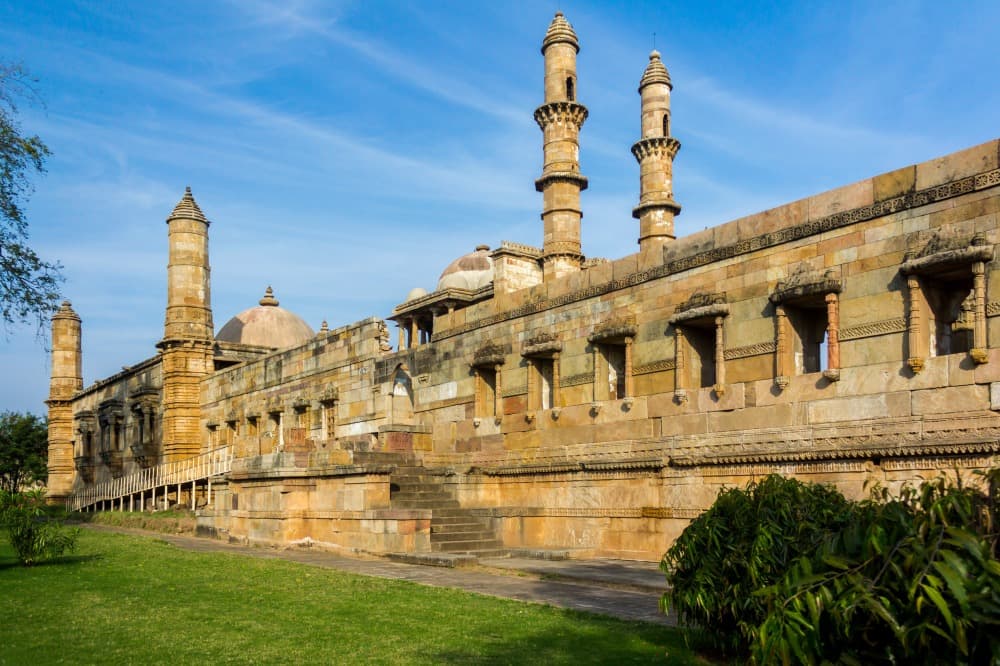
- Champaner-Pavagadh — UNESCO site about 45 km away, medieval mosques and fortress on a volcanic plateau.
- Surat — approximately 150 km south, historic port and celebrated Gujarati gastronomy.
- Lothal — Indus Valley Civilization archaeological site, accessible as a day trip from Vadodara.
Frequently asked questions
October through March offers pleasant temperatures. If you wish to experience Navratri, plan your visit for September or October according to the Hindu lunar calendar.
Neat attire is requested — shoulders and knees should be covered. Unlike temples, there is no requirement to remove shoes in the palace's tourist areas.
Yes, Champaner-Pavagadh is approximately 45 km away. A half-day on site is sufficient for the main monuments; wear sturdy shoes for the climb to the fortress.
At the Baroda Museum, photography without flash is generally permitted in permanent galleries. At Laxmi Vilas Palace, certain rooms explicitly prohibit it — follow the signage on site.
Auto-rickshaws are the most convenient option. Agree on the fare before boarding or ask for the meter to be used. Local ride-sharing apps also operate in the city.
Two days allow you to cover the palace, museum, Sayaji Baug, and the old city. A third day is valuable if you plan an excursion to Champaner-Pavagadh.
Photos
Want to discover this destination?
Our local advisors design your tailor-made trip.