Man Singh Palace
Perched on the Gwalior Fort plateau, Man Singh Palace (15th century) impresses with its towers adorned in blue and yellow glazed tiles, inner courtyards, and historic underground chambers.
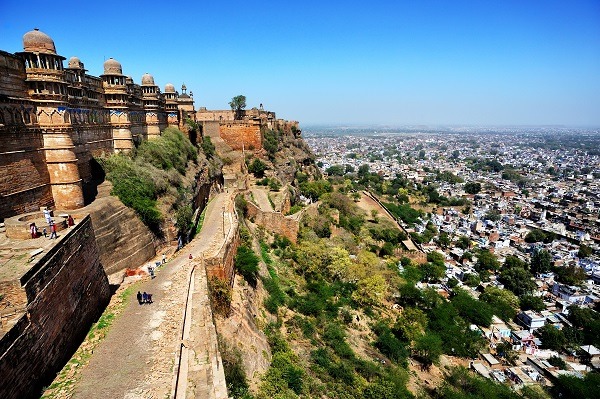
Man Singh Palace has dominated Gwalior Fort since the late 15th century. Commissioned by Raja Man Singh Tomar, it stands as one of the finest surviving examples of medieval Rajput architecture in Central India. Its façades adorned with blue and yellow glazed tiles, cylindrical towers, and inner courtyards represent a rare testament to palace craftsmanship that predates the Mughal era.
Practical Information at a Glance
- Access: within Gwalior Fort, reachable via the ascending road on the east side (Gwalior Gate) or by stairs on the west side (Urvahi Gate)
- Admission: combined Gwalior Fort ticket required (different rates for Indian residents and foreign visitors)
- Recommended duration: 1 to 1.5 hours for the palace alone, 3-4 hours for the entire fort
- Dress code: no religious obligation, but modest attire recommended
- Audio guide: available on-site in multiple languages
What You'll See
The palace is organized around two main courtyards linked by galleries. The exterior façades are covered in glazed ceramic tiles depicting ducks, elephants, and tigers—a rare technique in Rajput architecture. Inside, royal apartments, underground baths, and audience halls reveal the organization of 15th-century court life.
- Cobalt blue and saffron yellow glazed tiles adorning the towers
- Women's quarters (zenana) with intricately carved stone screens (jalis)
- Underground chambers that served as a state prison during the Mughal period
- Terraces offering unobstructed views over the city of Gwalior
History and Context
Man Singh Tomar ruled Gwalior from 1486 to 1516. He commissioned this palace as his primary residence atop the rocky plateau overlooking the plain. Following Mughal conquest, the fort—and palace—became a state prison. Aurangzeb notably imprisoned his brother Murad Baksh here. The British classified the site as a protected monument in the 19th century.
Highlights of Your Visit
The Glazed Ceramic Façades
The palace's round towers are clad in hand-painted tile friezes. This polychrome decoration, unusual for North India, testifies to artistic exchanges with Central Asia and Persia. Morning light best reveals the brilliance of the colors.
The Underground Chambers
Beneath the palace, several levels of rooms carved into the rock once served as cool summer quarters and, later, as cells. The atmosphere here is striking, and local guides are familiar with the stories of Mughal prisoners held within.
The Terraces and Views over Gwalior
From the upper terraces, your gaze sweeps across the lower city, the Sas-Bahu temple, and on clear days, to the plains of Madhya Pradesh. This is also the best vantage point to grasp the full expanse of the fortified plateau.
Photography Tips
Morning light (between 8 a.m. and 10 a.m.) illuminates the east-facing façades and brings out the rich blues of the ceramics. In late afternoon, the western towers glow golden. Avoid midday: harsh light flattens contrast and obscures the detail of the tiles. Inside, the stone screens filter diffuse light ideal for architectural portraiture.
Location and Access
Man Singh Palace sits at the summit of Gwalior Fort, on a sandstone plateau rising approximately 100 meters above the city. Gwalior railway station, well connected to Delhi, Agra, and Bhopal, lies just a few kilometers away. Auto-rickshaws and taxis readily reach the foot of the fort. The road up by vehicle is passable; the Urvahi staircase on the west side is more strenuous but passes remarkable Jain rock-cut sculptures. Wheelchair access is limited due to interior stairs.
Nearby
- Sas-Bahu Temples — two 11th-century temples dedicated to Vishnu, a short walk away on the fort plateau.
- Teli ka Mandir — 8th-century temple with a hybrid Indo-Dravidian style, among the fort's oldest structures.
- Urvahi Jain Rock-Cut Sculptures — colossal figures carved into the cliff face along the western access path.
- Ghaus Muhammad's Tomb — 16th-century Mughal mausoleum in red sandstone, below the fort.
- Tansen's Tomb — memorial to the legendary court musician of Akbar, near Ghaus Muhammad's Tomb.
Frequently asked questions
No. The palace is included in the general admission ticket for Gwalior Fort, with different rates for foreign visitors and Indian residents.
Allow 1 to 1.5 hours for the palace alone. If visiting the entire fort (temples, rock sculptures, archaeological museum), plan for a full half-day.
October through March offers pleasant weather. Summer (April–June) is very hot on the exposed plateau. The monsoon (July–September) brings cooler temperatures but can make stairs slippery.
Yes. The fort, Ghaus Muhammad's Tomb, and Tansen's Tomb can comfortably be visited in a single day from the city. Start at the fort in the morning for optimal light and cooler temperatures.
Photography is generally allowed in outdoor spaces and courtyards. Some interior areas may have restrictions; inquire with the site attendant.
Wheelchair accessibility is very limited. The palace features numerous narrow stairs and uneven floors. The vehicle access road reaches the main entrance, but the interior remains challenging without full mobility.
Interested in this visit?
We can include it in your personalised itinerary.