Gwalior Fort
Perched on a hundred-meter sandstone outcrop, Gwalior Fort brings together the blue-tiled Tomara Palace, 8th-century temples, and monumental Jain sculptures carved directly into the cliff face.
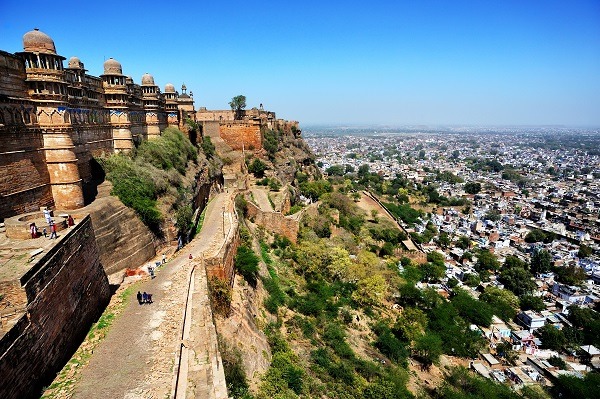
Perched atop a red sandstone outcrop that rises nearly a hundred meters above the city of Gwalior, Gwalior Fort stands as one of India's best-preserved fortresses in the central region. Built and remodeled between the 8th and 16th centuries, it houses palaces adorned with blue and yellow ceramic tilework, Jain temples carved into the rock, and ancient reservoirs. The Mughal emperor Akbar reportedly called it the "pearl among the fortresses of India."
Practical Information at a Glance
- Admission: Paid entry (differentiated rates for Indian residents and foreign visitors); separate tickets for certain interior monuments
- Recommended duration: 2 to 3 hours for the main circuit
- Dress code: No strict requirement, though modest dress is recommended in temples
- Access: Two vehicular roads (east and north sides); the uphill walking path along the north approach passes the Jain sculptures
- Sound and light show: Evening spectacle regularly held on-site (check schedules on arrival)
What You'll Find Here
The summit plateau stretches roughly three kilometers in length. It encompasses several distinct areas: the Man Mandir Palace, a masterpiece of 15th-century Rajput architecture featuring cylindrical towers covered in blue, turquoise, and yellow ceramic mosaics; the Gujari Mahal, now an archaeological museum; the Sas-Bahu temples, dedicated to Vishnu; and the Teli ka Mandir, an 8th-century temple with an unusual rectangular plan blending Dravidian and Nagara styles.
History and Context
Local legend attributes the fort's founding to a local chief named Suraj Sen, cured of leprosy by the sage Gwalipa in the 6th century. Historically, the site is documented from the 8th century onward. It passed successively under the control of the Gurjara-Pratihara, the Kachchhapaghata, the Tomara—who gave it its current character—then the Lodi, Mughals, and finally the Maratha Scindia. Each period left a visible architectural imprint.
The fort also served as a state prison under the Mughals: Emperor Aurangzeb had the Sikh Guru Tegh Bahadur executed here in 1675, and the site remains a place of remembrance for the Sikh community.
Highlights of Your Visit
Man Mandir Palace
Built by Raja Man Singh Tomara between 1486 and 1516, this palace is the fort's most photographed monument. Its exterior facades are covered with friezes of ducks, elephants, and flowering plants in colored ceramic. The underground chambers, once used as a Mughal prison, are accessible and well-preserved.
Jain Sculptures of the North Cliff
The path ascending toward the north gate runs past a series of monumental Jain sculptures carved directly into the rock face between the 7th and 15th centuries. Some representations of tirthankaras reach several meters in height. Several figures bear the marks of mutilation from Mughal invasions, which only deepens their historical significance.
Teli ka Mandir
This 8th-century temple is the oldest and tallest structure on the plateau. Its oblong-shaped tower, unusual in northern Indian architecture, reflects influences from the Deccan. Restored in the 19th century by the British, it once served as a coffee storage facility before being returned to worship.
Sas-Bahu Temples
These two 11th-century temples, dedicated to Vishnu, are renowned for their intricate sculptural work. The larger temple (the "mother-in-law") features a richly ornamented three-tiered portico; the smaller one (the "daughter-in-law") is more modest but better preserved in its details.
Photography Tips
Early morning light works best for the ceramic facades of Man Mandir Palace, which face east. The Jain sculptures on the north cliff are best illuminated late in the morning. From the western rampart, views over Gwalior city are clearest in late afternoon. Photography is permitted in most areas; check restrictions at the entrance to the Gujari Mahal museum.
Location and Access
The fort rises in the center of Gwalior and is visible from across the city. Gwalior Railway Station, well-served by trains from Delhi, Agra, and Jhansi, lies about two kilometers away. Auto-rickshaws and taxis provide shuttle service. Two vehicular roads allow you to drive up; the walking ascent along the north path (past the Jain sculptures) is more scenic but demanding. Accessibility for people with reduced mobility is limited on the plateau due to uneven terrain.
Nearby Attractions
- Gujari Mahal (Archaeological Museum) — at the foot of the fort, it houses remarkable medieval sculptures including a 10th-century Salabhanjika.
- Tomb of Tansen — mausoleum of the legendary court musician of Emperor Akbar, in the Hazira quarter; a pilgrimage site for Indian musicians.
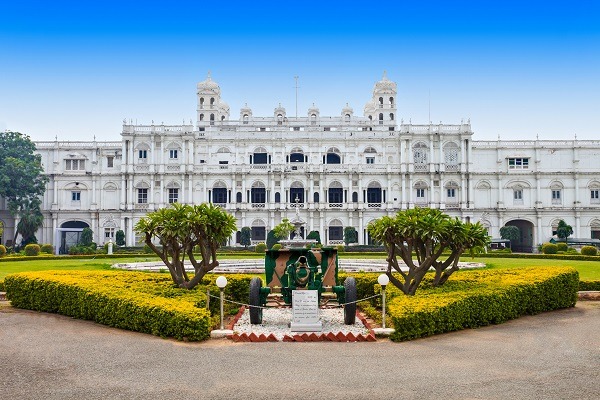
- Jai Vilas Palace — 19th-century residence of the Scindia dynasty, featuring a private museum and two of the world's largest crystal chandeliers.
- Gwalior Sun Temple — modern temple inspired by Konark, a few kilometers from the city center.
Interested in this visit?
We can include it in your personalised itinerary.