Jama Masjid of Delhi
Jama Masjid of Delhi
Built by Shah Jahan in the 17th century, the Jama Masjid dominates Old Delhi with its marble domes, minarets and vast red sandstone courtyard.
The Jama Masjid is one of the largest mosques in India and a major landmark of Old Delhi. Erected in the 17th century by Mughal Emperor Shah Jahan, to whom we also owe the Taj Mahal, it impresses with its scale, white marble domes, slender minarets and vast red sandstone courtyard. A living place of worship, it remains an architectural and historical landmark for anyone visiting New Delhi.
Why visit the Jama Masjid
The Jama Masjid brings together three complementary interests. Architecturally, it represents the pinnacle of Mughal art under Shah Jahan, with its blend of red sandstone and white marble. Historically, it has witnessed the decline of the Mughal Empire, British occupation and the birth of independent India. Humanly, it remains an active mosque, frequented every Friday by several thousand worshippers, and it sits at the heart of Old Delhi, just steps from the Red Fort and Chandni Chowk market.
History
The Jama Masjid, or Masjid-i-Jehan-Numa, meaning "mosque that reflects the world", was built between 1650 and 1656 in Shahjahanabad, today known as Old Delhi. More than 5,000 workers from India, Persia, Central Asia and even Europe participated in its construction, under the supervision of Sadullah Khan, Shah Jahan's vizier. To mark the inauguration, the sovereign called upon an eminent imam from Bukhara to lead the first prayer.
From its beginnings, the mosque was as much a political symbol as a religious sanctuary. It embodied the emperor's authority, who attended the great Friday prayer there each week. Like other buildings commissioned by Shah Jahan, it combined aesthetics, power and spirituality.
When the British captured Delhi in 1803, they initially allowed the mosque to serve its religious purpose. But after the 1857 uprising, the site was confiscated, worship was prohibited and it was converted into a barracks. Its destruction was even considered. It was finally returned to the Muslim community in 1862, under strict surveillance by colonial authorities.
In 1947, the Jama Masjid served as a platform for Abul Kalam Azad, a figure in the independence struggle, who delivered a speech there calling on Muslims to remain in India after Partition. More recently, the esplanade has regularly hosted rallies and public addresses, illustrating the enduring role of the site in the capital's public life.
What to see on site
The esplanade can accommodate up to 25,000 worshippers. Three white marble domes crown the prayer hall, framed by two minarets approximately 40 meters high. The building combines red sandstone and white marble, with inlays of black and white stones characteristic of Mughal architecture.
The great gates and access
Three monumental gates provide access to the mosque. The eastern entrance, once reserved for the emperor, is the most imposing. The north and south gates welcomed the general population. Wide stone staircases lead to the raised platform and emphasize the sense of monumentality upon arrival.
The courtyard
The sahn, or inner courtyard, measures nearly 100 meters on each side. At the center, a white marble basin serves for ritual ablutions. From the arcades enclosing the space, there are direct views of Old Delhi's alleys.
The prayer hall
The prayer hall extends over more than 60 meters in length. It is punctuated by seven niches oriented toward Mecca and decorated with black and white marble evoking a large prayer carpet. Three domes crown it, topped with gilded spires. The atmosphere is serene and quiet outside prayer times.
The minarets
The two minarets, alternating red sandstone and white marble, frame the façade. One of them is generally accessible to visitors: its 130 steps lead to a panoramic gallery from which you can see the Red Fort and the jumble of Old Delhi's rooftops.
Practical information
- Opening hours: open daily outside prayer times, with closures during midday. Check the day's hours upon arrival.
- Admission: free entry for visitors. A modest fee is charged for photography and for access to the minaret.
- Dress code: shoulders, arms and legs covered, head covered for women. Tunics and scarves are provided at the entrance. Shoes are removed before entering the courtyard.
- Duration of visit: allow 45 minutes to 1.5 hours, depending on whether you climb the minaret.
When to visit
The best time to visit the Jama Masjid is during the cool and dry season, from October to March. The heat and humidity of the monsoon, between June and September, make the visit grueling, especially as the marble courtyard is in direct sunlight.
As for timing, prefer the morning for the light on the red sandstone and lighter crowds, or late afternoon for golden light. Avoid the great Friday prayer in mid-morning, during which access for non-worshippers is restricted, as well as the five daily prayer times.
Nearby
The mosque sits at the heart of a very dense neighborhood:
- The Red Fort, just across, the former Mughal imperial residence.
- Chandni Chowk market, just a few minutes' walk away, with its alleys dedicated to spices, textiles and street food.
- The Sunehri Masjid, a small mosque with golden domes.
- The Gurudwara Sis Ganj Sahib, a major Sikh temple on Chandni Chowk.
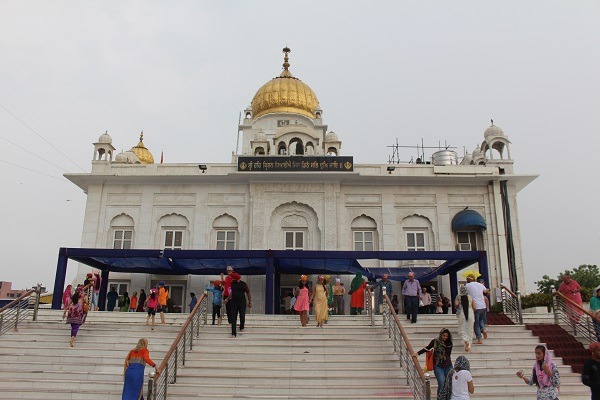
To further explore the capital's places of worship, the Gurudwara Bangla Sahib offers another glimpse into Delhi's religious diversity.
How to get there
The nearest metro station is Chawri Bazar, on the Yellow Line, about ten minutes' walk away. Jama Masjid station on the Violet Line also serves the site. Taxis, autorickshaws and cycle-rickshaws run continuously from other parts of New Delhi. On foot, it's about 10 minutes from the Red Fort, through the lively alleys of Chandni Chowk.
Frequently asked questions
Frequently asked questions
Yes, non-Muslim visitors are welcome outside prayer times. Access is restricted during the great Friday prayer in mid-morning and during the five daily prayers.
Clothing covering shoulders, arms and legs is required. Women must also cover their heads. If needed, a tunic and scarf are provided at the entrance against a small deposit. Shoes are removed before entering the courtyard.
Entry to the mosque is free. A modest fee is charged for photographing the interior as well as for access to the minaret.
Yes, one of the minarets can be visited. You must climb 130 steps to reach the panoramic gallery. Access may be restricted to men or subject to conditions depending on the period: check on site.
Allow 45 minutes to 1.5 hours depending on whether you climb the minaret, and how much time you spend observing the courtyard and prayer hall.
Plan your visit
The Jama Masjid is part of a classic Old Delhi itinerary, between the Red Fort, Chandni Chowk and places of worship. To build a coherent stay around Delhi and beyond, consult our travels in India.
Nearby
Interested in this visit?
We can include it in your personalised itinerary.