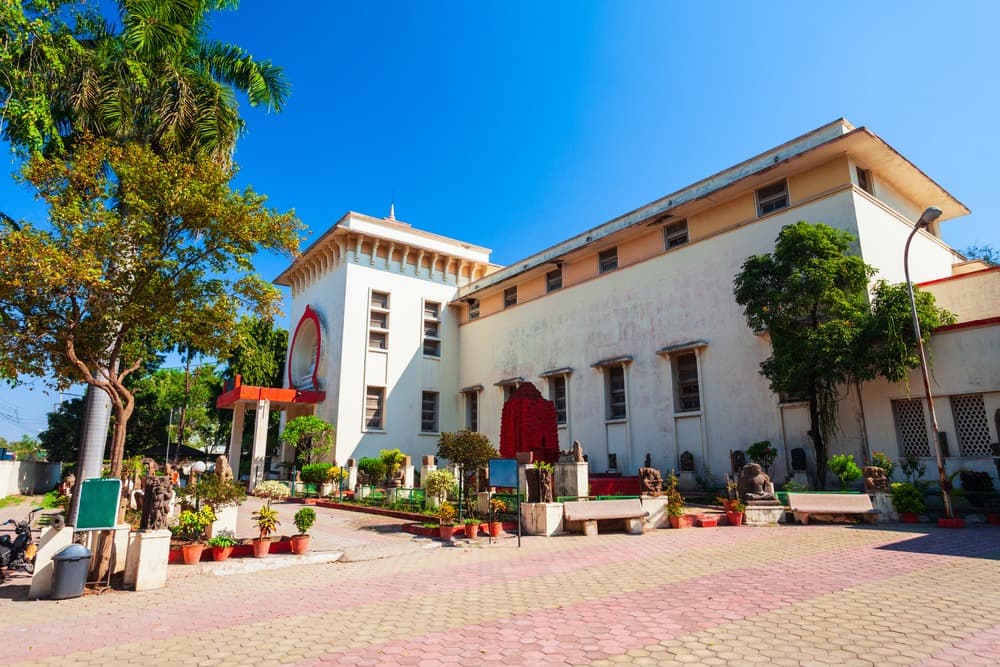
Indore Central Museum
Indore Central Museum
Founded in 1929, Indore Central Museum brings together Paramara sculptures from Hinglajgarh, prehistoric remains from Malwa, and medieval collections from Madhya Pradesh.
Indore Central Museum: a survey of ancient Madhya Pradesh
Located near the city's general post office, Indore Central Museum preserves a collection of artifacts spanning nearly seven millennia of regional history. Medieval sculptures, prehistoric tools, weapons, and coins paint a rich portrait of Madhya Pradesh, from prehistory to modern times.
Why visit Indore Central Museum
This museum appeals to travelers seeking to understand the archaeological foundations of Madhya Pradesh before exploring sites across central India. Three elements make it a worthwhile stop:
- A series of Paramara-style sculptures from the Hinglajgarh site, rarely seen outside Madhya Pradesh.
- Prehistoric remains dated to 4,000–5,000 years before the present era, testifying to ancient human occupation of Malwa.
- A brief visit (plan 1–1.5 hours) that fits easily into a day in Indore.
Museum history
Indore Central Museum was established in 1929 as a regional institution, during the reign of the Holkar dynasty, which ruled the princely state of Indore. The Holkar family, a branch of the Maratha Confederacy, had made the city an important administrative and cultural center of central India as early as the 18th century.
The bulk of the stone collection comes from recovery campaigns at the Hinglajgarh archaeological site in Mandsaur District, where ruins of 11th and 12th-century temples once stood. These sculptures, transferred to the museum for protection, form the heart of the collection today.
What to see in the galleries
The museum is organized into two thematic galleries, designed to follow a chronological progression.
Gallery 1: prehistory and ancient Malwa
The first hall assembles the oldest remains, dated to 4,000–5,000 years before the present era, unearthed in Madhya Pradesh. You will observe:
- hand-knapped and polished stone tools;
- quartz sickles;
- personal ornaments and small domestic objects from western Malwa.
These pieces document the region's earliest farming communities and their techniques.
Gallery 2: sculptures, coins, and weapons
The second gallery is devoted to medieval and pre-medieval Hindu and Jain statuary. Paramara-style sculptures from Hinglajgarh occupy a central place, notably including representations of Harihara (the combined form of Vishnu and Shiva), as well as Shiva and Parvati seated upon Nandi, the divine bull. The gallery also presents a numismatic collection spanning several dynasties, along with a body of weapons and armor illustrating the military history of central India.
Practical information
- Location: downtown Indore, near the general post office, accessible by rickshaw or taxi from most neighborhoods.
- Visit duration: 1–1.5 hours depending on your interest in archaeology.
- Admission: modest entry fee; confirm current rates on-site.
- Hours: open during daytime on non-holiday days; some Indian museums close one day per week—check before visiting.
- Guides: guides may be available on-site to comment on the collections.
When to visit Indore
The most comfortable period to visit Indore and Madhya Pradesh runs from October through March, when temperatures remain moderate and monsoon rains have ceased. Museum visits remain pleasant year-round, however, since the galleries are indoors.
Combine with other sites
Indore Central Museum fits well into a broader itinerary across central India. To extend your archaeological exploration of the region, the State Museum in Bhopal offers complementary collections on Madhya Pradesh. Nature enthusiasts can then venture to Bandhavgarh National Park, one of central India's tiger sanctuaries. For a strikingly different take on Himalayan religious art, the Alchi monastery in Ladakh makes an interesting counterpoint.
Frequently asked questions
Frequently asked questions
Plan 1–1.5 hours to walk through both galleries at a leisurely pace. A quicker visit is possible if you focus on the Paramara sculptures.
Devi Ahilyabai Holkar Airport in Indore is served by regular flights to Mumbai, Delhi, Ahmedabad, Hyderabad, Kolkata, Jaipur, Nagpur, Raipur, and Bhopal. The city is also connected by train to major Indian cities and by an extensive road network.
The museum features medieval and pre-medieval Hindu and Jain sculptures, prehistoric remains from Malwa, as well as a numismatic collection and holdings of weapons and armor.
October through March offers the most favorable climate in Indore and across Madhya Pradesh more broadly.
Plan your trip
Indore Central Museum fits logically into a circuit dedicated to Madhya Pradesh's heritage. To craft an itinerary combining archaeological sites, wildlife, and princely cities, explore our India travel suggestions.
Interested in this visit?
We can include it in your personalised itinerary.