Hingolgadh Nature Education Sanctuary
Hingolgadh Nature Education Sanctuary
Located 20 km from Jasdan in Gujarat, Hingolgadh Nature Education Sanctuary protects 654 hectares of biodiversity and a princely fort, managed by GEER Foundation.
Located in Rajkot district, Gujarat, the Hingolgadh Nature Education Sanctuary protects a transitional ecosystem between northern India's dry forests and Saurashtra's semi-arid zones. Spanning nearly 654 hectares, it combines wildlife observation, educational purpose and princely heritage around the eponymous fort.
Why visit Hingolgadh Sanctuary
Three aspects make this site singular among India's reserves. First, its biodiversity: approximately 230 bird species have been recorded, alongside mammals like nilgais (blue bulls), chinkaras (Indian gazelles), jackals, hyenas and wolves. Second, its dual natural and heritage identity, inherited from Hingolgadh fort whose former forest estates now form the sanctuary. Finally, its educational function: for four decades, GEER Foundation has developed a structured environmental awareness program here, making it a unique case in western India.
Site history
Before becoming a protected area, the site was known as Motisari Vidi, a private forest attached to the heritage fort of Hingolgadh, residence of local rulers. The transition to conservation unfolds in stages: in 1973, the area is placed under protection; in 1980, it obtains official wildlife sanctuary status; in 1984, its management is entrusted to the Gujarat Ecological Education and Research (GEER) Foundation.
This final step transforms the site's purpose. Beyond simple preservation, the sanctuary becomes a learning ground for schools, associations and researchers. The fort itself remains tied to this history: it testifies to an era when these forests served as hunting grounds for Saurashtra's princely families.
What you can experience on site
Landscapes and wildlife
The sanctuary spans approximately 654 hectares, at the interface between the northern dry deciduous forest and Saurashtra's semi-arid zones. This positioning explains its habitat diversity. During monsoon, arid hills don a green cloak that attracts mammals and birds seeking food.
Wildlife-wise, the sanctuary harbors herbivores (nilgais, chinkaras, hares, mongooses, porcupines) and more elusive carnivores (jackals, hyenas, wolves). Birdwatchers observe raptors, migratory birds and songbirds among the 230 recorded species. The site also counts 19 snake species, three of them venomous.
Educational facilities
The sanctuary organizes three-day, two-night nature camps, primarily for Gujarat schools and junior colleges. Two installations enhance the visit:
- the Snake House, presenting local species and clearly distinguishing venomous from non-venomous snakes;
- the Cacti House, dedicated to plants adapted to dry climates.
Explanatory panels and specialized guides facilitate ecosystem understanding for individual visitors.
Hingolgadh Fort
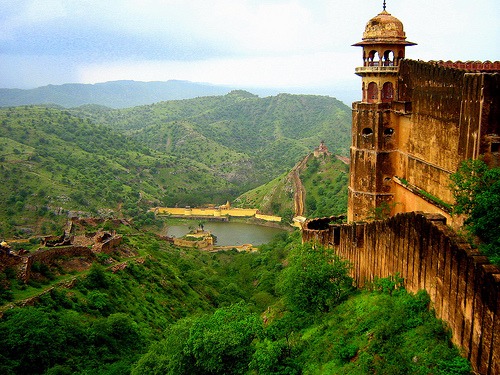
The fort overlooks the sanctuary and logically complements the visit. This former princely residence preserves several rooms furnished with antique furniture, photographs and historical objects that trace the lives of the region's ruling families. Its traditional architecture illustrates Saurashtra's princely dwelling codes.
When to visit
October to March remains most favorable: bearable temperatures and presence of migratory birds. Summer, scorching and dry, is best avoided. Monsoon (June-September) greens the landscapes but renders some roads impassable.
How to get there
The sanctuary lies approximately 20 km from Jasdan, in Rajkot district.
- By car: from Rajkot (70 km), expect about an hour's drive.
- By train: the nearest station is Gondal, 32 km away.
- By air: Rajkot domestic airport is the most convenient entry point from other Indian regions.
From Jasdan, taxis and private vehicles provide access to the sanctuary entrance.
Practical information
Sanctuary entry remains moderately priced for individual visitors, with different rates for foreign nationals. Residential camps require advance booking, with costs varying by duration and included services. Bring closed-toe shoes, water and sun protection: vegetation cover is partial and trails cross exposed areas.
Nearby attractions
Gujarat and western India broadly offer complementary sites to extend your discovery:
- the Ajit Singh Memorial, a historic landmark in neighboring Rajasthan;
- the State Museum of Bhopal, to deepen understanding of Indian regional history and art;
- Amar Sagar Lake, a scenic stop in the Thar Desert;
- the Anjengo Fort, to explore another facet of India's fortified heritage.
Frequently asked questions
Frequently asked questions
The sanctuary sits approximately 20 km from Jasdan, in Rajkot district, Gujarat. Rajkot, 70 km away, serves as the main entry point.
October to March, when temperatures are moderate and migratory birds are present. Avoid summer, which is intensely hot, and monsoon, which complicates travel.
Approximately 230 bird species, nilgais, chinkaras, jackals, hyenas and wolves, as well as 19 snake species including three venomous ones. Carnivore discretion makes their sighting unpredictable.
Yes. The Snake House, Cacti House and explanatory panels make the visit accessible to children. The sanctuary also organizes three-day, two-night nature camps for Gujarat schoolchildren.
For a simple visit, no. For residential camps organized by GEER Foundation, advance booking is mandatory.
Extend your discovery
Hingolgadh Sanctuary sits in a Gujarat region still underfrequented by international tourism, where princely heritage, endemic wildlife and local culture converge. To build an itinerary including this region, consult our customized India trips.
Interested in this visit?
We can include it in your personalised itinerary.