Fort Saint George
Fort Saint George
Britain's first stronghold in India, Fort Saint George in Chennai houses a colonial museum, the country's oldest Anglican church and the seat of the Tamil Nadu legislature.
Fort Saint George stands on the waterfront of Chennai, along the Bay of Bengal, in southern India. Britain's first stronghold on Indian soil, it marks the birth of the modern city and concentrates several centuries of colonial, military and political history within its walls. Today, the complex still houses active Tamil Nadu institutions, which sets it apart from purely heritage forts.
Why visit Fort Saint George
The site holds threefold appeal. Historically, it is the founding nucleus of Madras and one of the East India Company's earliest trading posts in South Asia. Architecturally, it brings together within the same walls a seventeenth-century Anglican church, a colonial museum, the former Wellesley House banquet hall and a monumental flagstaff. Politically, it still houses a seat of the Tamil Nadu Legislative Assembly, making it a living place rather than a static monument.
The visit will particularly interest travellers drawn to the British colonial period, to the military history of the eighteenth and nineteenth centuries, and to the genealogy of great transatlantic institutions (Yale University, for instance, owes its name to a former parishioner of St Mary's Church).
History of the fort
The fort was built in 1644 by the English East India Company, founded in 1600 and locally established a few years earlier on land acquired from a local leader. The completion of construction coincided with the festivities of Saint George's Day, which gave the edifice its name. The ramparts, some of which reach six metres in height, enclosed a garrison designed to protect nascent commercial activities.
The site changed hands several times during the eighteenth century. Occupied by the French between 1746 and 1749 during the War of Austrian Succession, it was returned to the British by the Treaty of Aix-la-Chapelle. Over the following decades, the fort functioned as a residence for East India Company officials and as a strategic military base for operations in southern India.
In the mid-twentieth century, around 1945, the compound was seized by activists of the Indian Independence Movement. After 1947, it was integrated into Tamil administration. Administrative headquarters were briefly relocated in March 2010, transforming the former complex into the Central Institute of Classical Tamil, before being re-established at the fort after the 2011 elections under Jayalalitha Jayaram's administration. The complex is managed by the Archaeological Survey of India.
What to see on site
The compound can be explored on foot and is organised around four main focal points: the museum, St Mary's Church, Wellesley House and the flagstaff. The ramparts, moat and several period cannons punctuate the walk.
Fort Saint George Museum
Completed in 1795, the building first served as the Bank of Madras before being repurposed as a museum space. It houses uniforms, coins, medals, paintings, letters and official documents from the colonial period. At the entrance stands a statue of Lord Cornwallis, shipped from Great Britain by boat; its sculpted scene depicts the handing over of Sultan Tipu's sons to East India Company officials, a significant episode of the Anglo-Mysore Wars.
St Mary's Church
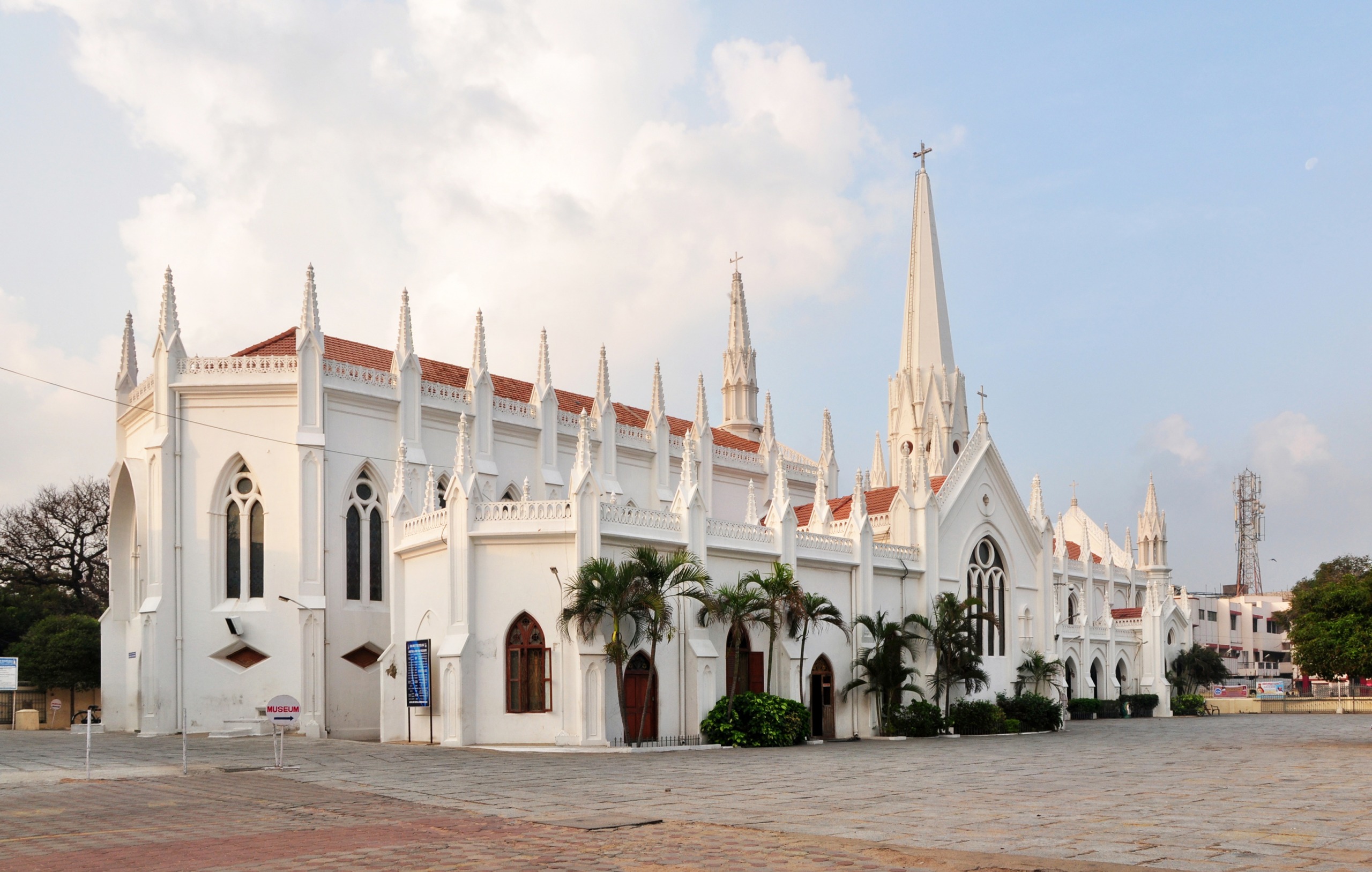
St Mary's is India's oldest Anglican church, dubbed "the Westminster Abbey of the East" because of the number of prominent British figures buried or commemorated within it. The oldest British tombstones on the subcontinent are found within its grounds. The first marriage recorded in its registers is that of Elihu Yale, an East India Company merchant posted in Madras and namesake of Yale University, whom he later endowed.
Wellesley House
Named after Governor-General Richard Wellesley, this former banquet hall preserves a series of portraits of senior Raj officials. The cannons taken from Tipu Sultan at the fall of Seringapatam (1799) are displayed on the adjacent ramparts.
The Flagstaff and surroundings
The fort's flagstaff, or Flagstaff, rises to 46 metres and remains one of the tallest of its kind in India. Outside the complex, on Rajaji Salai, a commemorative arch echoes the fort's façade: its foundation stone was laid on 30 October 2012 to mark the Diamond Jubilee of the Tamil Nadu Legislative Assembly. The fort also houses a garrison of troops in transit to southern India and the Andaman and Nicobar Islands.
Practical information
- Visit duration: allow 1.5 to 2.5 hours to explore the museum, church and surroundings.
- Admission fees: moderate entry fee for foreign visitors, symbolic tariff for Indian residents, free for children. Fees are set by the Archaeological Survey of India and revised regularly.
- Access: some administrative areas remain closed to the public as the fort still houses active institutions.
- Photography: permitted outside, restricted inside the museum.
When to visit
Chennai enjoys a tropical warm and humid climate throughout the year. The most pleasant period for visiting the fort extends from November to February, when temperatures drop to around 22-28 °C and humidity remains manageable. Avoid May and June (intense heat, often exceeding 38 °C) as well as October-November, the season of the north-east monsoon marked by sometimes cyclonic downpours. A morning visit, upon opening, helps avoid both heat and crowds of school groups.
How to get there
The fort is located in the George Town district, immediately adjacent to Chennai Central Station and the port. From Chennai International Airport, allow 30 to 45 minutes travel time by taxi depending on traffic. The nearest suburban railway station is Chennai Beach, just a few minutes' walk away. Rickshaws and ride-hailing taxis remain the most convenient means of reaching the site, with Chennai Metro also serving Central Station.
Nearby
The George Town district lends itself to a complementary half-day walk: wholesale markets, old churches, Parthasarathy Temple. Travellers wishing to extend their exploration of colonial fortifications in India can move on to other sites on the subcontinent.
- Fort Anjengo, another trading post on the west coast founded by the British in the early eighteenth century.
- State Museum Bhopal, to delve deeper into the diversity of Indian museum collections.
- Ajit Singh Memorial, a place of remembrance linked to the national movement.
Frequently asked questions
Frequently asked questions
No. The complex still houses a seat of the Tamil Nadu Legislative Assembly and a military garrison. The museum, St Mary's Church, Wellesley House and certain surroundings are accessible to the public, but administrative and military buildings remain closed.
A complete visit to the museum, church and exterior perimeter takes between 1.5 and 2.5 hours. Allow more time if you wish to consult detailed museum explanations or extend into George Town.
Elihu Yale, an East India Company official posted in Madras, was the first to celebrate his wedding at St Mary's Church in the fort. His fortune, partly built there, later financed the Connecticut college that took his name: Yale University.
Access to the exterior perimeter is free. Museum entry is paid: reduced rate for Indian visitors, standard rate for foreigners, free for children. As amounts are regularly reviewed, check on site or with the Archaeological Survey of India.
November to February, with milder temperatures and lower humidity. Avoid April-June (intense heat) and October-November (north-east monsoon).
Include Fort Saint George in your itinerary
Chennai is a fitting gateway to explore Tamil Nadu and the Dravidian south. Fort Saint George fits naturally into a circuit combining colonial heritage, Tamil Nadu temples and the Coromandel coast. To build a tailor-made itinerary, consult our India travel suggestions.
Interested in this visit?
We can include it in your personalised itinerary.