Mudumalai National Park
Mudumalai National Park
A founding Tiger Reserve under Project Tiger, Mudumalai protects the forests and grasslands of the Nilgiri. Wild elephants, gaur and dholes inhabit this corridor spanning Tamil Nadu, Karnataka and Kerala.
Mudumalai National Park stretches across the foothills of the Nilgiri Mountains, at the convergence of Tamil Nadu, Karnataka and Kerala. India's first tiger reserve established under Project Tiger, it shelters deciduous forests, grasslands and waterways that draw elephants, gaur, leopards and exceptional birdlife. It remains one of the rare places to observe wild elephants in significant numbers in their natural habitat.
Quick Facts
- Admission : paid entry; separate rates for Indian residents and foreign visitors
- Access : main gate at Theppakadu, on the Ooty–Mysore highway (NH 181)
- Safaris : in official minibuses run by the forest department, morning and afternoon departures only
- Recommended duration : 1 to 2 days to combine safari and guided trekking
- Best season : October to June; the park partially closes during monsoon (July–September)
- Dress code : neutral colours (khaki, green, beige) recommended; avoid white and strong fragrances
- Accessibility : limited; forest trails are unpaved
Wildlife Encounters
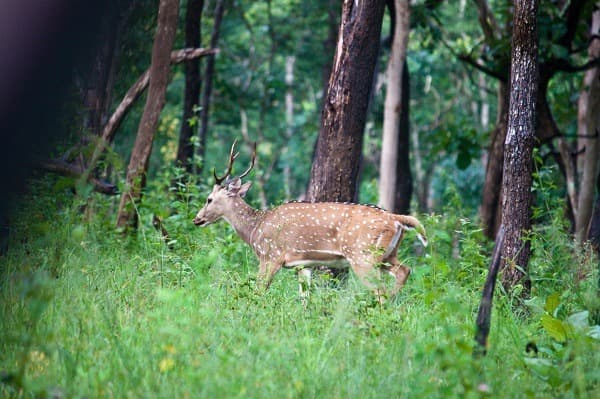
Mudumalai is home to one of Asia's largest populations of wild elephants on the subcontinent. Indian bison graze at forest edges at dawn. Leopards, dholes (Asian wild dogs) and sloth bears are present but elusive. The park records over 200 bird species, including the red-billed hornbill and Indian peafowl.
History and Context
Mudumalai has been a protected forest since 1940. In 1974, it became one of nine founding reserves under Project Tiger. Today it forms part of the Nilgiri conservation complex, inscribed as a UNESCO World Heritage biodiversity zone within the Western Ghats. This ecological corridor links Mudumalai to Bandipur, Nagarhole and Wayanad.
Highlights of Your Visit
Minibus Safari at Theppakadu
The official forest department safari remains the safest and most regulated way to explore the park's core. Early morning departures offer the best chances of spotting elephants and gaur before the heat builds.
Theppakadu Elephant Camp
Managed by the forest department, this camp houses domesticated elephants used in park management operations. A visit allows you to witness their morning bathing ritual in the Moyar River — a rare photographic moment.
Guided Treks in the Buffer Zone
Marked trails in the buffer zone enable guided walks with forest rangers. Dry deciduous forest gives way to dense bamboo groves at higher elevations.
Nocturnal Spotting from Lodges
Several peripheral lodges have illuminated watering holes. Leopards and civets occasionally appear after sunset.
Photography Tips
Golden light at dawn (6 a.m.–8 a.m.) is ideal for photographing moving elephants. Use a telephoto lens — approaching animals is strictly forbidden. Inside the minibus, remain silent and avoid flash photography. Bamboo groves provide striking backgrounds for gaur shots.
Location and Access
Mudumalai lies approximately 67 km from Ooty (Udhagamandalam) via the mountain road through Gudalur, and about 80 km from Mysore on the Karnataka side. The nearest railway station is Mysore; the most accessible airport is Coimbatore (approximately 160 km away). Regular buses connect Ooty to Theppakadu. Taxis and private vehicles are available from Ooty or Mysore.
Nearby Attractions
- Bandipur National Park — contiguous tiger reserve on the Karnataka side, same ecological corridor.
- Ooty (Udhagamandalam) — Nilgiri hill station, botanical gardens and colonial lake within 70 km.
- Nagarhole National Park — another Nilgiri complex reserve, renowned for leopards and elephants.
- Wayanad Reserve — on the Kerala side, dense forests and coffee plantations bordering the park.
Photos
Want to discover this destination?
Our local advisors design your tailor-made trip.