Bishnupur
Bishnupur
A former Malla capital listed with UNESCO, Bishnupur reveals its terracotta temples, Baluchari saris and the birthplace of the Bishnupur Gharana.
Located in Bankura district in West Bengal, India, Bishnupur is a city steeped in history, art, and spirituality. A former capital of the Malla dynasty, it is renowned for its terracotta and laterite temples—an exceptional example of the period's artistic and architectural prowess. Whether you're a history enthusiast, art lover, or simply curious to explore a rich and authentic culture, Bishnupur is an unmissable destination.
History
Once founded as Mallabhum, Bishnupur was the heart of the Malla dynasty for nearly 1,000 years, from the late 7th century until the decline of the Mughal Empire. The city's history traces back to the Gupta period, when it was ruled by local kings who paid tribute to Samudragupta. However, it was under the Malla that Bishnupur reached its zenith.
In the 17th century, King Jagat Malla decided to move his kingdom's capital to Bishnupur, marking the beginning of an era of prosperity. Under the patronage of Malla rulers such as Veer Hambir, Raghunath Singha, and Bir Singha, the city transformed into a genuine cultural and religious center. The Malla, devoted Vaishnavites, constructed numerous temples dedicated to Radha and Krishna, many built in terracotta. These structures bear witness to the skill of local artisans and the religious and cultural importance Bishnupur held during this era.
The Malla's influence on Bishnupur remains visible today, both in its impressive monuments and in its living traditions. These temples and other ancient structures have not only shaped the city's identity but also contributed to its global recognition. Indeed, in 1997, Bishnupur's temples were inscribed on UNESCO's Tentative World Heritage List.
Temples and Attractions in Bishnupur
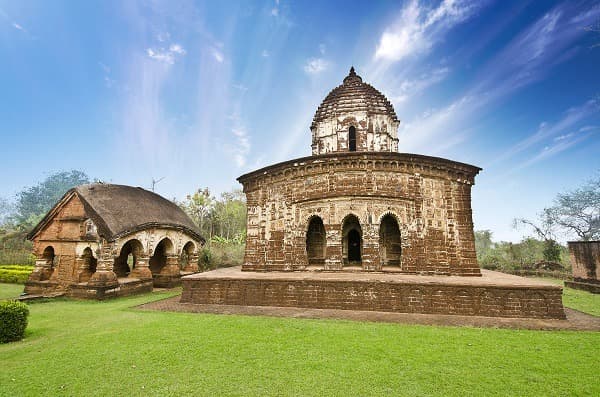
Constructed between the 16th and 18th centuries, these temples are true masterpieces, adorned with intricately detailed sculptures depicting Hindu mythological scenes, religious motifs, and representations of daily life. Each of Bishnupur's monuments displays a distinct architectural style, showcasing the exceptional craftsmanship of local artisans from that era. Here are some of the city's must-see temples and monuments:
- The Mrinmoyee Temple, dating to 997, is one of the city's oldest temples. Dedicated to the goddess Durga, this temple is the site of one of Bengal's oldest Durga Puja celebrations, which begins with solemn rituals and continues with the offering of vegetable sacrifices.
- The Rasmancha, erected in 1600 by King Bir Hambir, is Bishnupur's oldest terracotta temple. This monument, unique in its design, stands out for its pyramidal structure resting on a laterite platform. Its roof is surrounded by vaulted galleries adorned with lotus motifs, creating a magical atmosphere during the Ras festival, a celebration dedicated to the divine.
- The Jorbangla Temple, built in 1655 by King Raghunath Singha, is another remarkable example of terracotta architecture. It features a traditional "Do Chala" form, with two sloping roofs, and its detailed sculptures tell famous episodes from the Mahabharata and Ramayana. The Jorbangla Temple is particularly appreciated for its bas-reliefs depicting mythological scenes, such as "Bhisma on his Bed of Arrows" and "The Marriage of Ram and Sita".
- The Shyam Rai Temple, built in 1643, is famous for its 5 characteristic pinnacles and terracotta frescoes. It is adorned with scenes from Hindu mythology, including episodes from the Ramayana, Mahabharata, and Krishna's adventures. One of the most striking frescoes is the Raschakra, depicting Krishna dancing among the Gopis.
- The Madanmohan Temple, constructed in 1694 by King Durjane Singh, is dedicated to Krishna. It remains an active place of worship. Its terracotta architecture, typical of the region, features panels decorated with scenes from Hindu epics.
Beyond its temples, Bishnupur is also known for its historic fortification. The Gar Darja (fort gates) are impressive remnants that once protected the city against invaders. These gates, equipped with secret chambers and terraces, testify to the military ingenuity of the period.
The Dalmadal Kaman, a cannon built in 1742, is another testament to the city's military past. Weighing 12 tons and measuring 3.5 meters long, it was used to defend the kingdom against Maratha invasions. It stands near the Chinnamasta Temple, a sacred site dedicated to the headless goddess, where locals venerate this deity with great fervor.
For those interested in Bishnupur's history and art, the Acharya Yogesh Chandra Purakirti Bhawan Archaeological Museum is an essential stop. It houses sculptures from the 10th to 12th centuries, ancient manuscripts, folk arts, textile samples, and period photographs.
Among other notable temples in the region are the Sareswar and Saileswar Temples, located in Dihar, approximately 8 km from Bishnupur. These twin temples, dedicated to Shiva, are striking examples of Oriya Deul architecture and are pilgrimage sites during Mahashivratri and Gajan festivals.
A Center of Music and Art
Bishnupur, a true cultural haven, is also celebrated for its profound musical influence, particularly through the Dhrupad School and the Bishnupur Gharana. Founded between the 16th and 17th centuries under the patronage of Malla rulers, the Dhrupad school of Indian classical music marked an important turning point in the region's musical history. It fostered the emergence of a distinctive musical style, particularly appreciated for its ritualistic and spiritual performances, which continues to influence Indian classical music today.
The Bishnupur Gharana, one of the major streams of Hindustani classical music, also emerged in Bishnupur. This musical style primarily concentrated on the Dhrupad and Khayal genres, integrating local elements and refined techniques that enriched Bengal's musical heritage. The support of Malla sovereigns enabled many talented musicians to emerge from this school. Their legacy endures through local performances and concerts that attract visitors fascinated by traditional melodies that still resonate through the city's streets.
Craftsmanship and Local Products
Baluchari saris, symbols of Bengali elegance, are among Bishnupur's most prized artisanal treasures. Woven in silk, they are adorned with complex patterns and mythological or historical scenes, often inspired by Hindu epics. Watching weavers at work in their studios is a fascinating experience that reveals the meticulous process of creating these refined fabrics.
Another emblematic craft of Bishnupur is the sculpture of terracotta Bankura horses. These imposing sculptures, sometimes exceeding 1.5 meters in height, are used in Hindu rituals and symbolize West Bengal's cultural heritage. Sold directly in workshops, primarily along Chinnamasta Road and at Dalmadal Para, these terracotta horses are highly valued objects, appreciated for their finesse and symbolism.
Local potters, expert in their craft, create impressive decorative objects in metal or terracotta, while the Sankha Banik community excels in shell carving. These delicate shell pieces, often used for jewelry and decorative purposes, testify to ancestral craftsmanship.
Beyond its artisanal richness, Bishnupur is also a gastronomic center where Bengali and Rajasthani influences blend harmoniously. Local specialties, such as mihi dana, sitabhog, and langcha, offer a treat for the palate and complete the sensory experience of a city where tradition and modernity coexist.
Festivals
Bishnupur is enlivened by festivals throughout the year:
- The Bishnupur Festival, held in late December at the Madan Mohan Temple Complex, brings together musicians, dancers, and artisans to celebrate local artistic heritage.
- The Bishnupur Music Festival, dedicated to Hindustani music and the Bishnupur Gharana, offers unforgettable concerts under the stars at the foot of terracotta temples.
- The Rash Mela, in November, is another major celebration, commemorating the divine love of Krishna and Radha, with processions, music, and dance, attracting large crowds and creating a festive and spiritual atmosphere.
Bishnupur is easily accessible from several major cities, notably Kolkata and Jamshedpur (Tatanagar). Visitors can reach it by train, car, bus, or plane. By train, the city's station is 201 km from Kolkata, with journeys of 3.5 to 4.25 hours, including options such as the Rupashi Bangla Express or the Purulia Express. The drive, taking about 4 hours, traverses picturesque landscapes, while regular buses from Kolkata and other nearby cities offer a more economical option. The nearest airport is at Durgapur, though Kolkata's airport, 139 km away, remains the most practical option, with an additional 3-hour journey by car or train.
Want to discover this destination?
Our local advisors design your tailor-made trip.