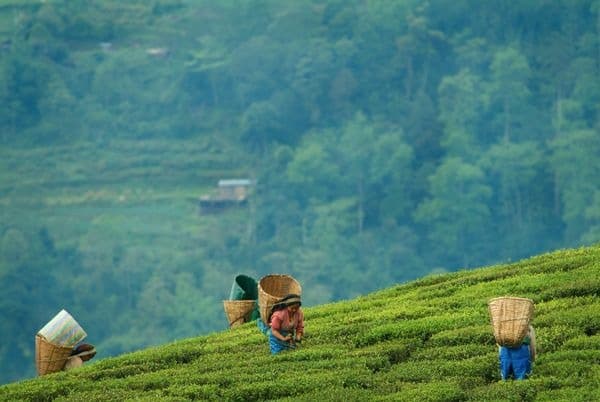
A Journey to the Heart of India's Tea Plantations
India is the world's leading tea producer. By producing 900,000 tons annually, the country alone ensures one-third of the world's tea production, some of which is considered among the finest in the world!
India is the world's leading tea producer. By producing 900,000 tons annually, the country alone ensures one-third of the world's tea production, some of which is considered among the finest in the world! From Darjeeling to the Assam region, passing through Munnar and Nilgiri, we invite you to embark on a journey to the heart of India's most beautiful tea plantations.
1. Darjeeling, the "Champagne of Black Teas"

One cannot speak of India's tea plantations without mentioning the famous Darjeeling plantations. Situated in the foothills of the Himalayan mountains at altitudes ranging from 400 to over 2,000 meters, the Darjeeling region cultivates teas that rank among the finest in the world. It's no wonder it's nicknamed "the champagne of black teas." Spread across 20,000 hectares, the gardens dedicated to tea cultivation form striking landscapes between vertiginous slopes and clouds clinging to the mountains.
Traverse the magnificent tea plantations of Darjeeling with our Trek in Darjeeling Singalila circuit
As for the flavors of the teas, they are renowned for their delicate floral aromas, spicy notes, and subtle bitterness. Beyond black tea, the region also produces green teas called Oolongs. It's worth noting that Darjeeling plantations have three distinct harvests, each called a "flush," and each offering unique flavors.
2. The Assam Region, the Country's Largest Tea-Producing Region

Head to northeastern India to discover the Assam region, equally renowned for black tea production. Recognized as the country's largest tea-producing region—often called "the tea granary"—this region produces no less than 500,000 tons of tea annually, sourced from nearly 2,500 different gardens. Among the types of tea to discover, one can cite "orthodox" productions, with spicy and robust flavors, cultivated in the gardens of Mokalbari, Doomni, Hattiali, Sockieting, Maud Sankar, and others.
Assam State is also known for housing the Tocklai Tea Research Center, the country's largest tea research facility. Here you can learn the secrets of tea cultivation and harvesting and discover more about the importance of tea in Indian culture.
3. Munnar and the World's Highest Tea Plantation

We now take you to southern India, to Kerala State. It's precisely on the Western Ghats in the hill station of Munnar that we invite you to stop and discover tea plantations stretching as far as the eye can see. A true haven of peace, this region, located at approximately 1,700 meters altitude, is also renowned for its production of pepper, rubber, and cardamom.
Not far from Munnar, you'll also discover a tea plantation with a picturesque setting: Kolukkumalai mountain. Perched at nearly 2,500 meters altitude, it is the world's highest tea plantation! Built over 70 years ago at the summit of a steep ridge overlooking the plains of Tamil Nadu, this tea plantation still uses traditional technology! It's well worth a visit if you're seeking an authentic tea plantation off the beaten path.
Hike through the small villages and charming tea plantations of Munnar thanks to our Adventure in South India circuit
4. Nilgiri, the Teas of the Blue Mountains

We conclude our tour of India's tea plantations in the southwestern part of the country, in Tamil Nadu State at Nilgiri. Nicknamed the "Blue Mountains" due to the blue color of the eucalyptus leaves that dominate the region, Nilgiri experienced its first tea plantations in the 1830s. Since then, these tea plantations, situated at altitudes between 1,000 and 2,500 meters, form the second tea-producing region after Assam.
The teas from the Nilgiri region are generally described as full-bodied, intensely aromatic, and fragrant. They are commonly compared to Ceylon teas. Given their intense flavor and consistency, Nilgiri tea is often used as a base for making iced tea or for preparing the famous chai masala, a traditional Indian tea recipe that consists of blending black tea with milk and spices.
Florine Dergelet