Howrah
Howrah
Howrah, linked to Kolkata by the famous cantilever bridge spanning the Hooghly, blends a monumental railway terminus, a legendary flower market, and a botanical garden home to one of the world's largest banyan trees.
Howrah is a twin city of Kolkata, separated from it by the Hooghly, the western branch of the Ganges. Connected to the metropolis by the celebrated Howrah Bridge, it houses one of Asia's largest railway hubs, a mythical flower market, and industrial quarters inherited from the colonial era. Less touristy than Kolkata, it offers a raw and vivid window into urban Bengal.
Practical information at a glance
- Access from Kolkata: on foot or by rickshaw across the Howrah Bridge; ferry from Kolkata's ghats (Babu Ghat, Chandpal Ghat); metro line 2 (partially in service).
- Howrah railway station: main terminus for long-distance trains from across India — allow extra time to navigate this vast complex.
- Recommended duration: half a day to a full day depending on your interests.
- Best season: October to March (manageable heat and humidity).
- Dress code: modest clothing recommended for temples.
What to see
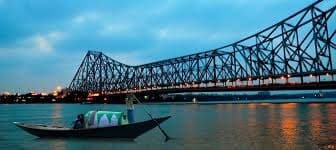
Howrah is worth visiting as much for its iconic infrastructure as for its markets. The Howrah Bridge (Rabindra Setu), a cantilever bridge without bolts, remains the region's most recognizable image. The Mullick Ghat flower market, on the Kolkata side but accessible from Howrah, overflows with marigold garlands at dawn. The Botanical Garden (Acharya Jagadish Chandra Bose Indian Botanic Garden) houses a giant banyan tree over two centuries old, one of the largest in the world.
History and context
Howrah developed as an industrial center under the East India Company in the nineteenth century. Foundries, jute mills, railway workshops: the city became the industrial heart of Calcutta. Howrah railway station, inaugurated in 1854, is among India's oldest. The current bridge, completed in 1943, replaced a colonial floating bridge and today carries some of the world's heaviest traffic.
Highlights of your visit
The Howrah Bridge at dawn
Crossing the bridge on foot at sunrise, when porters, cyclists, and tea vendors flood the roadway, gives a vivid sense of the intensity of Bengali life. The view of the Hooghly and its ghats is unobstructed in the morning light.
Howrah railway station
With its twenty-three platforms, the station is a spectacle in itself: streams of passengers, street vendors, entire families camped on the platforms. Arriving or departing at night amplifies the atmosphere.
The Botanical Garden and the Grand Banyan
The Grand Banyan (Ficus benghalensis) spreads across more than 14,000 m² with its aerial roots. The main trunk was struck by lightning and removed, but the canopy survives, forming a forest unto itself. The garden is open to the public every day.
The ghats and ferries
Howrah's ghats, less crowded than those in Kolkata, offer views of river life: fishing boats, packed ferries, washermen. The ferry crossing remains one of the region's cheapest and most authentic journeys.
Photography tips
The Howrah Bridge photographs beautifully from Kolkata's ghats (Strand Road) or from a moving ferry. Golden morning light is far preferable to afternoon light, often veiled by pollution haze. Inside the station, natural light filters through the glass roof — avoid using flash out of respect for travelers.
Location and access
Howrah is connected to Kolkata by the Howrah Bridge and Vidyasagar Setu (the second Hooghly bridge). Ferries depart regularly from ghats on both shores. Howrah railway station is the arrival point for most trains from Delhi, Mumbai, Chennai, and Varanasi. Within the city, local rickshaws and buses serve the inner neighborhoods.
Nearby attractions
- Kolkata — the neighboring metropolis, reachable in minutes, home to Victoria Park, the Kumartuli neighborhood, and Park Street.
- Howrah Botanical Garden — the Grand Banyan and colonial greenhouses to explore on foot.
- Belur Math — headquarters of the Ramakrishna Mission on the Hooghly's shore, remarkable syncretic architecture.
- Dakshineswar Temple — nineteenth-century Kali temple, a major pilgrimage site upstream on the Hooghly.
Frequently asked questions
The two cities naturally visit together. Howrah fits easily into a Kolkata day: cross the bridge on foot in the morning, explore the botanical garden in the afternoon, return by ferry at sunset.
Yes, the bridge has pedestrian walkways on both sides. Motor traffic is dense; stay to the sides and avoid rush hours if you wish to stop and take in the views.
The garden is open daily except on Holi. It is best to visit early in the morning to avoid the heat and enjoy the peace before crowds arrive.
Photography from the bridge is tolerated for tourists, but is officially subject to restrictions for security reasons. Avoid photographing military or police installations at the bridge's ends.
October to March offers manageable heat and no rainfall. Avoid June through September (intense monsoon) and May (extreme heat often exceeding 40 °C).
Belur Math sits upstream on the Howrah shore. A ferry from Howrah's ghats or a taxi or rickshaw from the station will get you there. The distance is short but traffic can lengthen the journey.
Photos
Want to discover this destination?
Our local advisors design your tailor-made trip.