Indian etiquette and customs
India is a country very open to other cultures and while Indians show great tolerance towards travellers, you must also know how to adapt and respect certain local rules and customs. When in doubt, you can always ask those around you or your guide.
India is a country very open to other cultures and while Indians show great tolerance towards travellers, you must also know how to adapt and respect certain local rules and customs. When in doubt, you can always ask those around you or your guide.
To help you navigate this wealth of cultural differences, we've outlined here a few rules of etiquette and Indian customs to keep in mind during your stay in India.
What should you not do in India?
1. Using your left hand
You will see very few left-handed people in India. Indeed, the use of the left hand being traditionally reserved for "impure" gestures (reserved for personal hygiene), it is quite frowned upon to use it for everyday actions.
This should not worry left-handers. If you do everything with your left hand, there is little problem. However, if you are right-handed and occasionally use your left hand to eat for example, you risk attracting remarks or making your table neighbours uncomfortable.
Be also mindful in temples. Use exclusively your right hand to receive or give an offering. The same applies in the street if you give alms to a beggar.
2. Wearing shoes in temples
Removing your shoes before entering a temple or religious site is a universal rule in India.
In some places, you may be allowed to keep your socks, but not everywhere. Signs and your guide can indicate the proper practice to follow.
Then remember to bring shoes that are easy and quick to remove if you plan a circuit in India with visits to many Hindu temples.
Beyond temples, it is customary to remove your shoes before entering an Indian home. Keeping shoes on indoors is perceived as a serious lack of hygiene and respect. Check at the threshold or wait to be invited, but if in doubt, take them off.
3. Touching in public
Undemonstrative (with the exception of young people in major cities), you will rarely see couples touching in public in India. Kissing on the cheek is already considered a sexual act. If you are travelling as a couple or with family, try to be discreet with affectionate gestures and avoid kissing in public.
If you meet someone for the first time, unless they offer you their hand, avoid launching into a vigorous handshake. Simply join your two hands under your chin and pronounce "Namastè (hello)" while bowing slightly. This recommendation applies even more when meeting someone older than you, or of the opposite sex.
Also avoid touching a child's head; you could bring them bad luck. And in general, never point a finger at someone.
Do not be surprised to see men in the street holding hands or linking little fingers. This is not romantic or sexual in nature but a simple sign of friendship.
Gentlemen, in case you are inclined to be "chivalrous", be careful. Helping a woman carry her luggage, get off the bus, or giving up your seat quickly becomes an insult. In general, avoid addressing women.
Finally, avoid getting carried away and try to keep your cool in all circumstances.
4. Showing your body
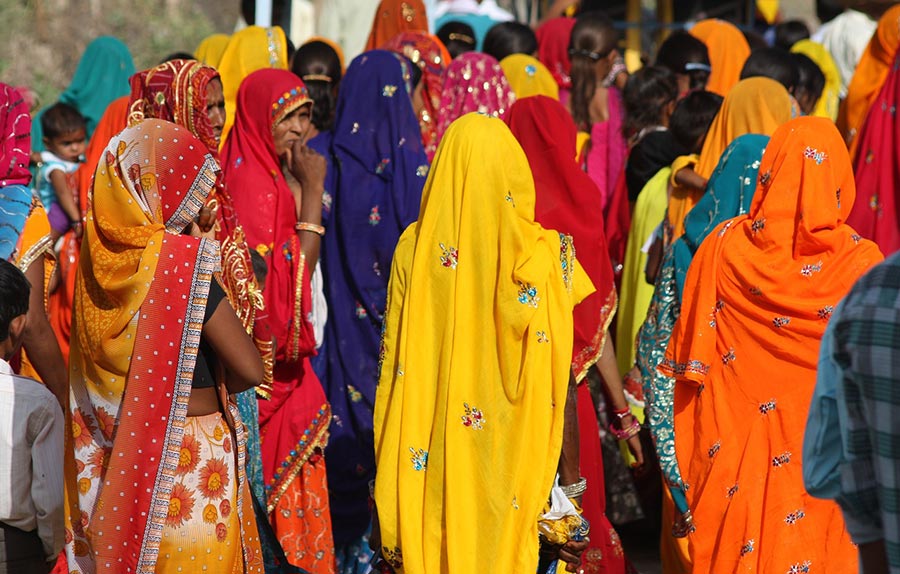
Although Western fashion increasingly attracts Indian youth, traditional dress codes (sari for women) remain vibrant.
In large hotels with a pool, you occasionally meet Indian women bathing: they wear clothing covering their bodies, never swimsuits. For Western women, opt for a standard one-piece swimmer.
Men or women, wear clothing that conceals the shoulders and thighs. Ladies, avoid plunging necklines and tight-fitting clothes. If you need to go to an official office, do not display vacation attire; wear at minimum long trousers and a shirt.
5. Taking photographs without permission
Although many Indians are welcoming, it is impolite to photograph someone without their permission, especially in rural areas or religious sites. Women, elderly people or sadhus (ascetics) may feel offended or uncomfortable. In temples, museums or palaces, certain areas are also forbidden from photography, even without flash. Observe the signs or ask before taking out your camera.
6. Ignoring rules of hierarchy
Indian society places great importance on age, social status and position. Interrupting an older person, raising your voice or expressing direct disagreement can be seen as disrespectful. In interactions, be humble and polite. It is common to use titles such as Sir, Madam, or Ji after the first name to show respect.
7. Eating or passing objects over someone
Passing a dish over someone's head, or walking over a bag or personal item, is considered disrespectful. In Hindu culture, the head is the most sacred part of the body. Be careful never to step over it, even accidentally.
8. Openly criticising religion or politics
Religious beliefs are taken very seriously in India. Even if you are shocked by certain practices, avoid any negative comment on a religion, deity or ritual. Similarly, do not engage in controversial political discussions, particularly on sensitive issues such as Kashmir, castes or minorities. This can create tensions or even conflicts.
What are the other Indian customs?
Saying "no" and nodding your head to say yes
This is undoubtedly the most disconcerting custom for a Westerner. In India, in response to a closed question, you will often be answered with a slight lateral head movement, accompanied by an enigmatic smile. This is a "yes". Conversely, Indians avoid saying "no" directly. They prefer to explain at length, with courtesy (and often an accent difficult to understand), why they cannot meet your request.
Being invited for a meal in an Indian family
If you are invited to dinner at an Indian family's home, know that it is frowned upon to offer your help with preparation or tidying up. In India, the host takes full responsibility for the reception. Wanting to help can be perceived as a lack of respect towards the lady of the house. Simply thank them warmly and appreciate the welcome. Show restraint in your compliments about the food, as this can be interpreted as a source of bad luck. The same restraint applies to compliments about children.
Traditions at weddings
An Indian wedding is a grand affair, often spanning several days. It blends religious rituals, songs, dances and festive meals. Guests wear colourful and refined clothing. Bring a small gift or an envelope with money if you are invited. The ceremony is sometimes long, but you are free to arrive or leave at any time discreetly.
White clothing in case of mourning
Unlike the West, white is the colour of mourning in India. At funeral ceremonies, the deceased's relatives wear white clothing, as a sign of purity and detachment. Black, on the other hand, is rarely worn, as it is considered unlucky. If you attend a funeral ritual, remain sober and respectful: discretion is essential.
Nose piercing, a popular tradition among women
Among Indian women, nose piercing is both an aesthetic ornament and a cultural marker. Often done from adolescence, it symbolises femininity and, in certain regions, entry into adulthood or marriage. The jewel is worn on the left or right, depending on local traditions. It can also have religious or Ayurvedic significance.
Traditions around babies in India
The birth of a child gives rise to several rituals. One of the most common is the naming ceremony (Namkaran), celebrated after a few days or weeks. It is also common to shave the baby's head (Mundan) around one year of age to symbolise purification and ward off bad influences. Offering new clothes or jewellery is a frequent practice to mark the event.
Touching feet
Touching someone's feet, particularly elders or spiritual figures, is a great sign of respect in India. By touching someone's feet, you acknowledge their wisdom or authority. In return, they touch your head or bless you as a sign of goodwill.