When Kerala enters a trance: witnessing a Theyyam on the Malabar coast
Kerala is rich in festivities, but the surroundings of Kannur, in the north of the state, stand out for an extraordinary celebration: Theyyam, a vivid trance ritual that blends Hinduism and
Kerala is rich in festivities, but the surroundings of Kannur, in the north of the state, stand out for an extraordinary celebration: Theyyam, a vivid trance ritual that blends Hinduism and mysticism. Journey into the heart of Kerala and one of its most captivating traditions.
Midnight, on a night of waning moon. Kerala appears lost in the arms of sleep. Yet there is a village in the north of the "land of coconuts" where festivities are about to unfold. Welcome to Kuttave, in the Kannur district on the North Malabar coast. All the inhabitants have gathered in the middle of the forest. A great bonfire has been lit and a small sanctuary erected at the center of the clearing. Tonight, it is a day of celebration for the Hindu community, as the village organizes its annual Theyyam.
Theyyam in Malayalam means "dance of the god." The word designates both the divinity represented by the dancer and the ritual itself. Along with Kalaripayyat and Kathakali, it is one of the three major art forms of Kerala. For Theyyam, which according to legend was born from an encounter between folk dances organized to celebrate the end of harvests and Hinduism, is both a religious ceremony and an art form. Indeed, watching the commotion around the costumes in the nearest house leaves no doubt that an extraordinary spectacle is about to unfold before us.
The festivities are launched with fireworks that resound for kilometers around. But for the evening's climax, we will have to wait a few more hours. The dancers prepare to enter a trance: they don their exuberant costumes, cover their skin with makeup, pray, meditate, and drink as well. Around 4:30 in the morning, drums echo in the distance and the villagers, scattered about, gather near the sanctuary. The dancers then arrive to the rhythm of wild percussion, surrounded by a throng of devotees.
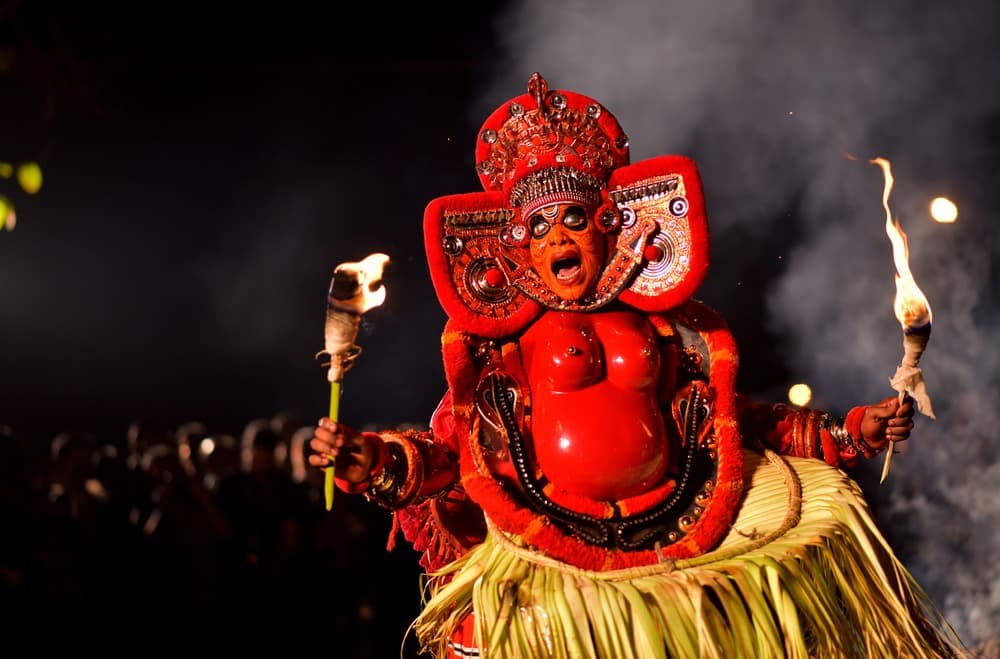
The agitation centers on the man in the most spectacular costume: he wears a crown several meters tall, mingling palm fronds and flaming torches. The same materials form the skirt around his waist. His bare chest is painted and adorned with jewels. His face is entirely covered with pigments and his arms are daubed with a reddish paste. He is the principal divinity of the ceremony: Puthiya Bhagavathi, or "the new goddess."
To celebrate his arrival, the devotees (all young men) begin a frenzied race around the sanctuary, leaping as they pass with both feet into the embers of the nearly smoldering fire. The Theyyam then begins a chaotic dance. His face reveals no expression and his gestures are frenzied. During the performance, the dancer's identity dissolves and it is the divinity who blesses in turn the devotees and the villagers.
The dance will last until dawn, when the sun's rays strip the forest of its mystical charm. The devotees will then return home and the dancers will reclaim their bodies, rejoining the ranks of mortals…until the next time.
Despite the official abolition of the caste system in India in 1950, traditions remain deeply rooted, and only descendants of a certain lower caste enter into trance during these ritualistic dances. Just 50 years ago, they were not welcome in temples, which gave birth to religious ceremonies held in the heart of the forest.
The Kannur district is home to more than 800 Kavus (or "sacred groves"), and each one hosts a Theyyam, so the dancers travel from village to village.