Dzongri
Dzongri
A high-altitude plateau at 4,020 m in Khangchendzonga National Park, Dzongri is the highlight of the Goecha La trek in Sikkim, with direct views of Kangchenjunga.
Dzongri is a high-altitude plateau located at approximately 4,020 metres in West Sikkim district, in the state of Sikkim, India. A key stage on the Goecha La trek, it offers direct views of Kangchenjunga (8,586 m), the world's third-highest peak. The plateau is surrounded by rhododendrons, alpine meadows, and small glacial lakes. It serves as a passage point for hikers seeking to approach the high Himalayan valleys without requiring a technical expedition.
Practical Information at a Glance
- Access: usual departure from Yuksom, approximately 35 km on foot (3-4 days of trekking depending on pace).
- Mandatory permit: Inner Line Permit (ILP) required for non-Sikkimese Indian nationals; Protected Area Permit (PAP) required for foreign visitors — to be obtained before departure.
- Recommended season: April–May (rhododendrons in bloom) and October–November (clear skies, views of Kangchenjunga).
- Suggested duration: 2 nights on-site for acclimatisation and excursions to Dzongri Top.
- Accommodation: tents or basic shelters (trekkers' huts) managed by the Sikkim Tourism Development Corporation.
- Accessibility for people with reduced mobility: not accessible — high-mountain terrain, unimproved trail.
What You'll See
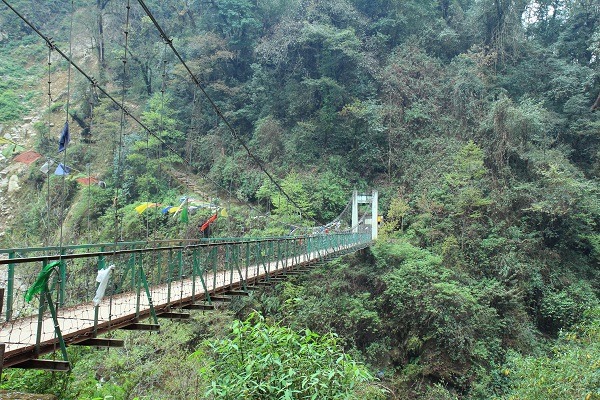
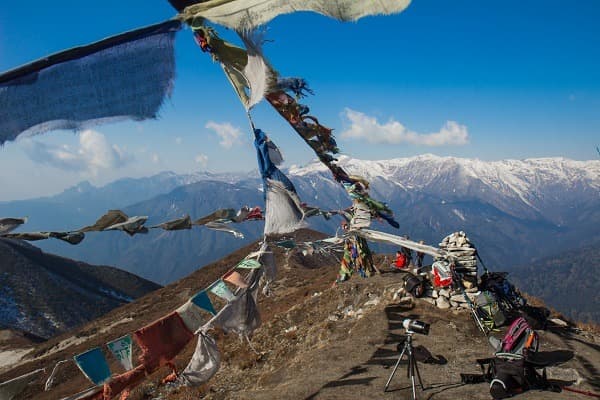
The plateau itself is a vast grassy expanse scattered with boulders, framed by snow-capped ridges. On clear days, the panorama from Dzongri Top (approximately 4,500 m, about 1 hour's climb) reveals Kangchenjunga, Kabru, Rathong, and Kokthang. Below, the Prek Chu valley winds through forests of rhododendrons and magnolias.
History and Context
Dzongri lies within Khangchendzonga National Park, inscribed as a UNESCO World Heritage Site in 2016. The region is sacred to the Lepcha and Bhutia Buddhist communities, who regard Kangchenjunga as a protective deity. The Goecha La trek, of which Dzongri is the central stage, was gradually opened to tourism from the 1980s onwards following the partial lifting of access restrictions to Sikkim.
Highlights of Your Visit
Dzongri Top at Sunrise
Departing before dawn from base camp allows you to reach Dzongri Top as low-angle light bathes the glaciated faces of Kangchenjunga in orange and rose tones. This is the main reason for spending two nights on the plateau.
Rhododendron Flowering
In April–May, the slopes between Yuksom and Dzongri are blanketed with red, pink, and white rhododendrons. Some trees reach several metres in height in forested zones between 2,500 and 3,500 m.
Samiti Lake (en route to Goecha La)
A day's march beyond Dzongri, the Samiti glacial lake (approximately 4,200 m) mirrors the surrounding peaks. It forms a natural stopping point for those continuing towards Goecha La Pass.
Photography Tips
Light is optimal early morning from Dzongri Top — clouds typically invade the valley by mid-morning. A telephoto lens allows you to capture detail in the Kangchenjunga séracs. In April–May, frame rhododendrons in the foreground with snow-capped summits in the background for high-contrast images. Photographic restrictions in the national park mainly concern wildlife; verify current rules with the park office in Yuksom.
Location and Access
Dzongri is located within the Khangchendzonga National Park, West Sikkim district. The logistical starting point is Yuksom, accessible by vehicle from Gangtok (approximately 5–6 hours' drive) or from Bagdogra (the nearest airport, in West Bengal). No road leads to Dzongri; access is entirely on foot. Local agencies in Yuksom arrange permits, licensed guides (mandatory for foreign visitors), and porters.
Nearby Attractions
- Yuksom — Sikkim's first capital, trek departure point, home to Norbugang Monastery and Kathok Lake.
- Goecha La Pass — the trek's final objective at 4,940 m, facing the Kangchenjunga glacier.
- Pelling — West Sikkim town with views of Kangchenjunga and access to Pemayangtse Monastery.
- Pemayangtse Monastery — one of Sikkim's oldest and most important Buddhist monasteries.
Frequently asked questions
April–May for rhododendrons, and October–November for clear views of Kangchenjunga. Summer (June–September) coincides with the monsoon: slippery trails and reduced visibility.
Yes. Foreign visitors must obtain a Protected Area Permit (PAP) in addition to your Sikkim entry permit. These documents are obtained from the relevant authorities before departure; a local agency in Yuksom can facilitate the process.
The Yuksom–Dzongri trek is rated moderate to difficult due to altitude (risk of altitude sickness) and duration. Good physical fitness and gradual acclimatisation are essential. A licensed guide is mandatory for foreign visitors.
Basic shelters (trekkers' huts) managed by the Sikkim Tourism Development Corporation are available on the plateau. Most organised groups also bring their own tents.
Yes. Yuksom, Pelling, and Pemayangtse Monastery are easily visited before or after the trek. Gangtok, Sikkim's capital, makes a convenient base for organising your entire stay.
Photos
Want to discover this destination?
Our local advisors design your tailor-made trip.