Bangalore (Bengaluru)
Bangalore (Bengaluru)
Bengaluru blends Hoysala palaces, Victorian gardens and high-tech dynamism at 900m altitude. An ideal starting point for exploring Karnataka and southern India.
Bengaluru — officially renamed in 2006 — is the capital of Karnataka and the technological engine of India. At 900 metres altitude on the Deccan, the city enjoys temperate weather year-round. Hoysala royal palaces, Victorian botanical gardens, vibrant street quarters and high-tech campuses coexist in a metropolis of over twelve million inhabitants. It is both a gateway to southern India and a destination in its own right.
Practical Information at a Glance
Access: Kempegowda International Airport (BLR), connected to the city centre by Vayu Vajra shuttle and metro (Airport Express line now operational).
Urban Transport: Namma Metro (Purple and Green lines), BMTC buses, auto-rickshaws and ride-sharing apps (Ola, Uber).
Dress Code: Covered clothing recommended for temples and mosques; shoes removed at the entrance of places of worship.
Recommended Duration: 2 to 3 days for major sites; 4-5 days to explore neighbourhoods and nearby excursions.
Best Time to Visit: October to February — mild temperatures, rare rainfall.
What to See
The Bangalore Palace, built in 1887 in Tudor-Gothic style, houses ornate interiors with woodwork and paintings. Lalbagh Botanical Garden, founded in the 18th century by Hyder Ali, sprawls across 240 acres of rare plants and a glass greenhouse inspired by London's Crystal Palace. Cubbon Park offers a green lung in the heart of the administrative district.
The Bangalore Fort, a vestige of Kempe Gowda's citadel, and Tipu Sultan's Summer Palace — an 18th-century teak pavilion — bear witness to the Mysore era. The Commercial Street quarter and KR Market (Krishna Rajendra Market) concentrate silks, spices and jasmine flowers.
History and Context
Kempe Gowda I founded the city in 1537 and built an earthen fort. It fell under Mughal control, then the Mysore sultanate — notably under Hyder Ali and Tipu Sultan — before being ceded to the British in 1799. British colonisation brought cantonments, gardens and institutions that still shape the city's character today. Since the 1990s, Bengaluru has emerged as the "Silicon Valley of India", home to Infosys, Wipro and hundreds of startups.
Highlights of Your Visit
Lalbagh Botanical Garden
The garden harbours century-old trees, a lake and a heritage glass greenhouse. Floral displays in January (Republic Day) and August (Independence Day) draw thousands of visitors. Best visited early morning to avoid crowds.
Tipu Sultan's Summer Palace
This two-storey teak palace, built around 1791, is remarkable for its painted columns and ogival arches. Murals depict battle and hunting scenes. Entrance is paid; the site is managed by the Archaeological Survey of India.
ISKCON Temple
One of the world's largest Krishna temples, inaugurated in 1997. The architecture blends Dravidian style with contemporary elements. Heavily visited on weekends and during Janmashtami festivals.
Indiranagar and Koramangala Quarter
These neighbourhoods concentrate specialty cafés, Kannada restaurants and craft beer bars — reflecting the city's cosmopolitan culture. Ideal for an evening or lunch away from classic tourist circuits.
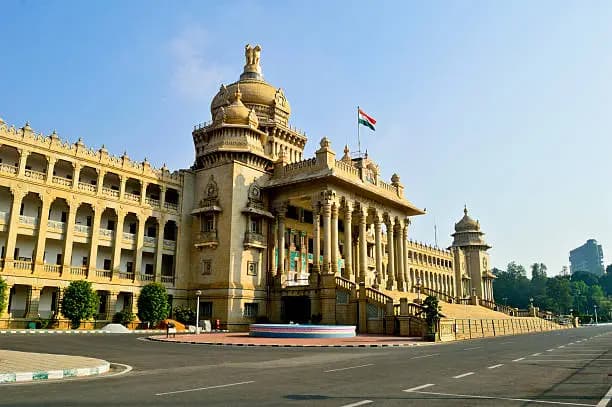
Vidhana Soudha
The seat of Karnataka's Parliament, completed in 1956, is an imposing example of neo-Dravidian style. The building is illuminated on Sunday evenings and public holidays — a spectacle visible from Cubbon Park.
Photography Tips
Lalbagh: Golden light in late afternoon on the Victorian greenhouse; arrive early for empty pathways.
Tipu Sultan's Summer Palace: Dark interiors — tripod useful; natural light enters through the arches in the morning.
Vidhana Soudha: Best view from Ambedkar Veedhi on Sunday evening during illumination.
KR Market: Maximum colours at dawn when flowers arrive. Ask permission before photographing vendors.
In temples, check photo restrictions at the entrance — some inner sanctuaries prohibit them.
Location and Access
Bengaluru lies on the southern Deccan, approximately 350 km from Chennai and 140 km from Mysuru. Namma Metro serves the main sites (MG Road, Cubbon Park, Majestic stations). Auto-rickshaws remain the most practical means for short distances within the city. The airport is about 40 km from the city centre.
For excursions, KSRTC buses regularly connect Bengaluru to Mysuru, Hassan (departure point for Belur and Halebidu) and Coorg.
Nearby Attractions
Mysuru — About 3 hours away by road, the Mysore Palace and Devaraja Market make it a major Karnataka stop.
Belur — The 12th-century Chennakeshava Temple, a masterpiece of Hoysala architecture, some 220 km away.
Halebidu — Former Hoysala capital, its twin temples rival Belur in sculptural refinement.
Coorg (Kodagu) — Region of coffee plantations and forests, about 250 km away, ideal for nature and trekking.
Shravanabelagola — Monolithic statue of Gomateshwara, a major Jain site, about 160 km away.
Frequently asked questions
October to February offers the most pleasant climate: mild temperatures (15-28°C), little rain. Avoid June-September if you dislike monsoons, though the city remains functional.
Two days suffice for major sites (Lalbagh, Tipu Sultan's Palace, Cubbon Park, ISKCON). Plan 4-5 days if you wish to explore neighbourhoods and take excursions to Mysuru or Coorg.
Yes: shoulders and knees should be covered in most temples and mosques. Shoes are removed at the entrance. Some temples (like ISKCON) provide sarongs at the entrance.
Yes. Mysuru (palace, market) can be visited as a day trip or weekend outing. Belur, Halebidu and Shravanabelagola can be combined in one or two days. Coorg requires at least one night on site.
At sites managed by the Archaeological Survey of India (Tipu Sultan's Palace, Fort), photography is generally permitted outdoors. Inner temple sanctuaries may prohibit it — check signage at the entrance.
Namma Metro covers the main routes (MG Road, Majestic, Cubbon Park stations). For sites off the network, Ola and Uber are reliable. Auto-rickshaws are convenient but negotiate the fare or insist on the meter.
Want to discover this destination?
Our local advisors design your tailor-made trip.