Aihole
Aihole
On the banks of the Malaprabha River, Aihole concentrates 125 Chalukya temples where South India invented its architectural language. Complete site guide.
Aihole is renowned for its profusion of ancient temples creating one of the most picturesque landscapes imaginable. This small village, situated approximately fifty kilometers north of Badami, makes for a delightful stop to escape the ordinary and discover medieval architecture in India.
History
Once called Ayyavoḷe and Aryapura in ancient inscriptions, Aihole was established as the first capital of the Chalukya dynasty in 450. The village contains approximately 125 stone temples, including experimental structures created by artisans during the Chalukyan period. The city is considered a cradle of Hindu rock-cut architecture. Near Aihole, close to the Meguti hills, lies the Morera Angadigalu site, which houses numerous caves dating from prehistoric times. This location is believed to have been an agraharam. Several brick structures from the pre-Chalukyan era have also been identified within the village itself.
Today
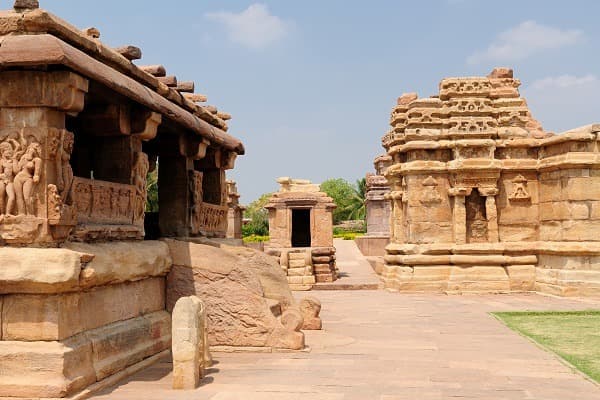
On the banks of the Malaprabha River in northern Karnataka, Aihole contains a vast archaeological site comprising around one hundred temples. These structures perfectly reflect the achievements of Hindu medieval architecture. Among the notable monuments, discover the Durga Gudi temple, which stands among the ancient temples that played a major role in the evolution of rock-cut architecture in South India.
Scattered throughout the village of Aihole in various forms and sizes, the stone temples erected from the 6th century onward proudly display their picturesque facades. Thanks to their authenticity, these monuments attract architecture enthusiasts and historians alike. In fact, it is these distinctive structures that give Aihole its tourism appeal. While the Lad Khan and Durga Gudi temples draw the majority of visitors, smaller sanctuaries are scattered throughout the village, waiting quietly to be discovered.
West of the Ravana Phadi site, you will find the Huchimalli temple, built in the Nagara architectural style. The structure stands boldly apart from other monuments. The site is served by a small mandapa accessible by a flight of steps. Past the entrance, you will notice that the temple walls embody simplicity. It is the intricate motifs of the slender sanctuary that make all the difference. A finial crowns the sculptures, reminiscent of the amalaka that forms the shikhara, a typical feature of temples in the Nagara style. Visible from every corner of Aihole, the Meguti temple stands majestically atop a hill. This monument houses a celebrated inscription: "the Aihole inscription." This engraving has made it possible to trace numerous historical events of the Chalukyan era. Written in Sanskrit using Kannada script, the text mentions the complete lineage of Chalukya rulers. It describes the defeat of Harshavardhana by Pulikeshi II, as well as the victory of the Chalukyas over the Pallava kings. The inscription also contains a reference to Kalidasa, which helped historians establish an approximate chronology for the illustrious poet. Descending the hill, you will spot a series of small temples nestled among the houses of villagers. Their architecture blends Nagara and Dravidian styles, though some appear to belong to no specific category.
On the other side of the village, the Galaganatha temple complex dominates the banks of the Malaprabha River. The complex may initially appear as a random arrangement of facades restored by the Archaeological Survey of India. Nevertheless, several finely carved doorways prove that this site indeed holds authentic architectural stones, found nowhere else in Aihole. From time-patinated sandstone walls to the remains of ancient sanctuaries, passing through worn mandapas, the Galaganatha temple complex bears witness to the city's rich past.
Climate
Aihole is situated in a region that experiences a steppe climate, classified as BSh according to the Köppen-Geiger classification. As a result, rainfall is low throughout the year. The area receives average annual precipitation of 661 mm. Regarding temperature, the average is 26.1°C.
Aihole is located approximately one hour's drive from Badami, the nearest city. Badami itself lies 500 km from Bangalore. Regular buses shuttle between the two cities. Badami is also connected to Hubli, 130 km away, by road.
To travel from Badami to Aihole, you can either take a local bus or hire a rental car.
The best way to explore the village of Aihole remains, without question, on foot. Indeed, this city and its temples are best discovered during a walking tour. The region is also well-suited for hiking. Therefore, remember to bring walking shoes, light clothing, and a cap if you plan to visit Aihole.
Want to discover this destination?
Our local advisors design your tailor-made trip.